
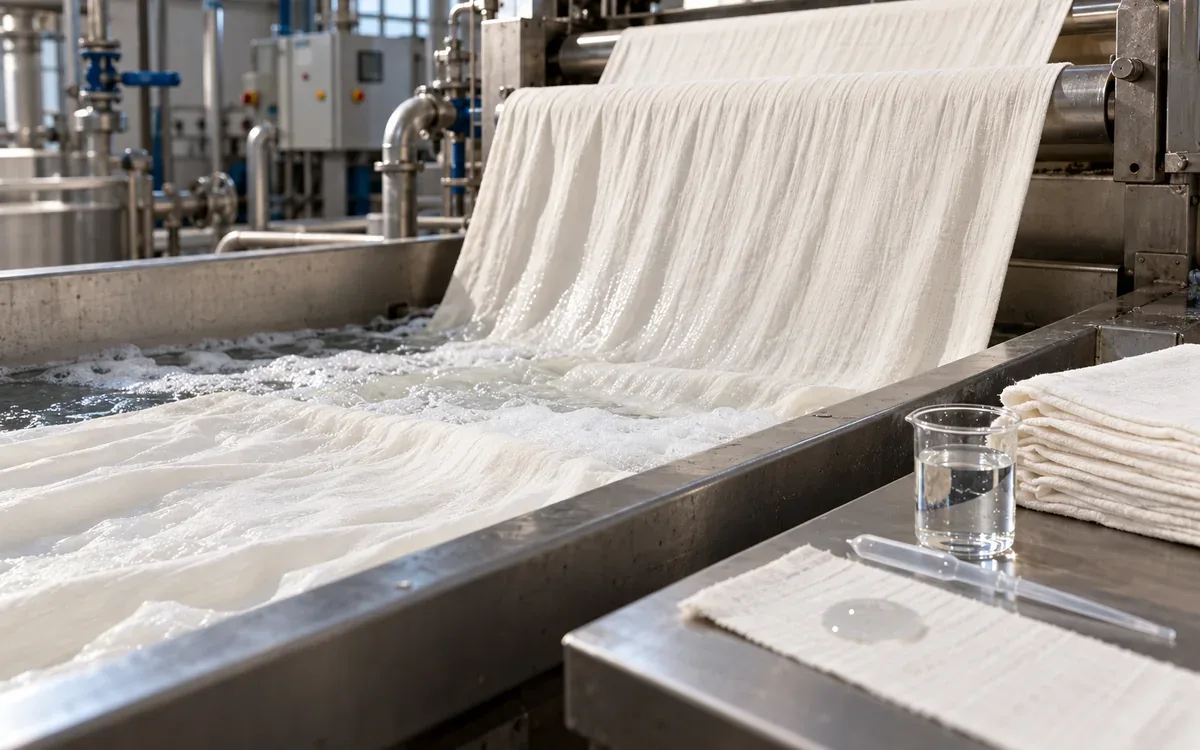
Scouring should leave cotton evenly ready for the next bath
Cotton scouring removes material that keeps process water from reaching the fibre evenly. The goal is a clean, even fabric surface. The cloth must be ready for the next approved stage. A bath that reaches its set temperature has completed a machine step. It has not, by itself, proved that the cloth is ready.
A useful release decision brings together several checks. The fabric should wet evenly at the required locations. It should retain enough strength for its intended use. It should meet the next process's limits for residues and appearance. The wash stage must also remove what the treatment has loosened.
This guide explains how to compare cotton scouring routes and set useful absorbency checks. The trial figures are made up to explain the checks. They are not production recipes. Use the chosen product instructions to set doses and safe limits. Prove the hold conditions through a valid process trial.
Understand what needs to leave the fabric
Raw cotton carries waxes, pectins, and other natural matter. Yarn and fabric production can add more material to the cloth. Cotton Incorporated explains how scouring removes unwanted matter and helps cotton absorb water. See its dyeing preparation guidance.
Begin with the actual fabric history. A woven cotton fabric may still carry warp size. A knit may carry knitting oil. A blend adds another set of fibre and processing constraints. “Cotton fabric” is not a complete input specification.
Ask the supplier which size, lubricant, and finishing products were used. Record previous treatments and any known contamination. An oil mark calls for a check of that local area. Poor wetting across the full width calls for a wider check.
Keep three preparation questions separate
Desizing asks whether the relevant size has been removed. Scouring asks whether the fabric has been cleaned and wets well enough for the next stage. Bleaching asks whether the remaining colour has been reduced to the required level.
These operations may share equipment or form parts of one route. Their endpoints still differ. A white fabric can have poor local wetting. A fabric that wets quickly can retain enough colour to affect a pale shade.
Before approving a combined route, decide which result proves each job. One absorbency value cannot prove that size and colour have gone. It cannot prove retained strength either.
Choose a route from the fabric and its intended use
A mill can scour cotton with alkali or use an enzyme route. Neither name defines a complete process. The liquor must wet and reach the fabric. The route also needs a suitable wash and clear release checks.
Pectinase-based preparation targets pectin in the cotton surface structure. Novonesis describes this approach in its textile biopreparation guidance. Water and energy claims depend on the route used for comparison. Mill conditions matter too. Test those claims in a trial before treating them as mill results.
For a first trial, make a route comparison sheet like this:
Decision point | Question to settle before the trial |
|---|---|
Fibre composition | Are all fibres compatible with the proposed chemistry and heat? |
Contamination | What natural and added materials must be removed? |
Next process | Is the fabric going to a dark shade, pale shade, white finish, or another route? |
Equipment | Can the machine provide the required contact, control, and washing? |
Release limits | Which absorbency, appearance, residue, and strength checks apply? |
Resource boundary | Which baths and repeat treatments will the comparison include? |
First define the fabric quality needed at the bath exit. Then compare costs. A low initial treatment cost has little value if the next dyeing stage needs repair.
Treat the wash as part of the route
A useful research result is that removal of one component does not guarantee good wetting. Colombi and colleagues studied enzyme scouring of knitted cotton. They found that the steps after treatment had a strong effect on wetting. Their 2021 experimental paper examined both the enzyme stage and subsequent washing.
Agrawal and colleagues also studied the interaction between wax removal and pectinase performance. Their 2007 research supports examining these steps together.
This gives the mill a useful check. Keep one sample after treatment and another after the full wash. If only the second sample gives acceptable wetting, the wash has a defined role. Shortening it is a process change that needs evidence.
Build a useful scouring trial
Start with fabric from one known lot. Keep a retained untreated sample. Divide matched sections among the routes. This helps keep an input change from looking like a treatment effect.
For a three-route trial, do not give one route the cleanest roll. Do not give another route only the dirtiest roll. Where possible, take nearby sections from several input positions. Share them across all routes.
Label the samples before processing. Make a sample map that lasts through processing. State the roll, length and width positions, route, and test stage. Photographs can help the trial team, but they do not replace the labels.
Change one question at a time
A first comparison might examine the current alkaline route against a proposed enzyme route. Keep the final drying, conditioning, and test methods consistent. Record all route differences, including washing.
A later trial can isolate a single change, such as wash contact or auxiliary choice. Several inputs may change at once: enzyme dose, treatment time, wash heat, and machine load. The result may identify a useful combined route. It will not reveal which change caused the improvement.
Include at least one repeat of the current approved route. That provides a live reference for the day, fabric, water, and machine conditions. A historical result from another cotton lot is weaker evidence.
Record the conditions the cloth received
The recipe setpoint belongs in the record. So does the measured process history. Note when the process reached its target and how long it stayed there. Record any stop or loss of control.
Also record fabric mass, loading pattern, bath volume where relevant, and circulation settings. The right chemical doses do not prove even contact. Poor contact can still cause the trial to fail.
For detailed dose conversions, use ApparelDiary's liquor ratio and dosing checks. The scouring trial should use those controls while concentrating on the fabric result.
Separate absorbency tests by the question they answer
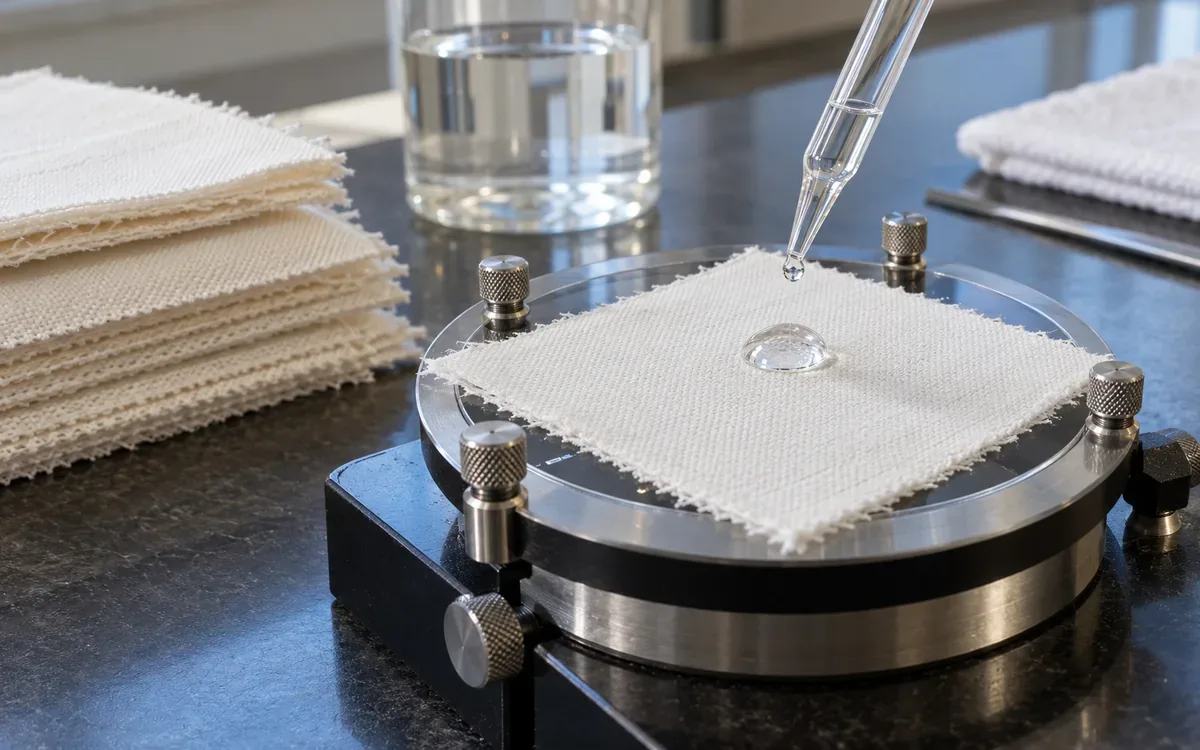
“Absorbency” can refer to several behaviours. One test times a drop as it enters the fabric. Another follows water as it travels along a strip. Neither result alone measures the total water a fabric can hold.
AATCC lists several separate methods. They cover absorbency, vertical and horizontal wicking, moisture management, and drying. See its moisture management testing programme. Choose the method that fits the decision.
Property | Useful question | Limit of the result |
|---|---|---|
Surface wetting time | Does water enter this tested location promptly? | Does not describe every point on the roll |
Vertical wicking | How does water rise along a prepared strip? | Depends on direction, structure, and test conditions |
Water uptake by mass | How much water remains after a defined procedure? | Requires a clear wetting and drainage basis |
Moisture management | How does liquid move through and across the tested fabric? | Does not by itself approve a scouring route |
For routine release, a plant may use an absorbency method it has validated. Add a map of the test sites. Product development may need more than one liquid transport test.
Do not give a house test the name of a standard method unless it follows that method. A plant may change the equipment, sample preparation, or endpoint. Describe each change clearly.
Use the current method
AATCC's 2026 manual change notice identifies an updated TM79 absorbency method. Laboratories should control the edition they use and review method changes.
The method owner provides the full procedure. A short web summary leaves out details. These may concern equipment, samples, conditioning, calculations, or reports. A buyer's specification may also name a particular method and edition.
Keep test preparation consistent
A sample straight from a bath is wet. Another may be dry and conditioned. Compare these states only when the test is designed to do so. Define the condition in which each sample is tested.
Use the same drying route for trial comparisons. Record whether the specimen was tested before or after any softener or other finish. A finish can change the measured surface. A test after finishing may therefore answer a different question from a test after scouring.
Keep test water, equipment, timing, and handling under control. Avoid touching the test area with oily or wet fingers. Keep specimens away from benches or packing materials that could contaminate them.
A repeat test should use a fresh test area. Do not retest the same wet spot. That can make the fabric seem to perform better than it does.
Check the rinse state
Decide whether release samples represent the full production wash or a defined laboratory rinse. Use that same basis in every comparison.
Compare two matched samples. Test one after the normal wash. Give the other a further controlled rinse before testing. If wetting changes greatly, check what remains on the cloth. Find out how the extra rinse affected it.
This comparison does not identify the residue by itself. It gives the team a more focused next question. Use appropriate chemical tests or supplier support when the cause is unclear.
Sample the cloth, not just the most convenient corner
A single fast-wetting sample can hide a slow-wetting strip at an edge. Across-width differences matter when the next process must produce a uniform shade.
For a trial, define positions before seeing the results. One practical plan is left, centre, and right at the beginning, middle, and end of each trial section. Keep the distance from the edge consistent and record it.
This gives nine positions per route. If the trial has three routes and two separately processed repeats, there are:
3 routes × 2 repeats × 9 positions = 54 mapped positions
A real process needs its own sample count. Base it on process variation, risk, the method, and the buyer’s needs. The example shows how to make the sample plan visible before testing begins.
Do not let the average hide a problem
Suppose nine hypothetical wetting times are:
2, 2, 3, 3, 3, 4, 4, 5, and 19 seconds
The mean is 5 seconds. The median is 3 seconds. Neither statistic explains the one slow location.
Suppose the trial rule sets an 8-second maximum at every mapped site. This trial fails that rule. The 19-second result needs investigation even though the mean looks acceptable.
Keep the position linked to the result. A slow reading may recur at the same edge. Or slow readings may be scattered through the cloth. These patterns call for different checks. The map gives the process team information that a single average removes.
Compare cleaning with retained fabric performance
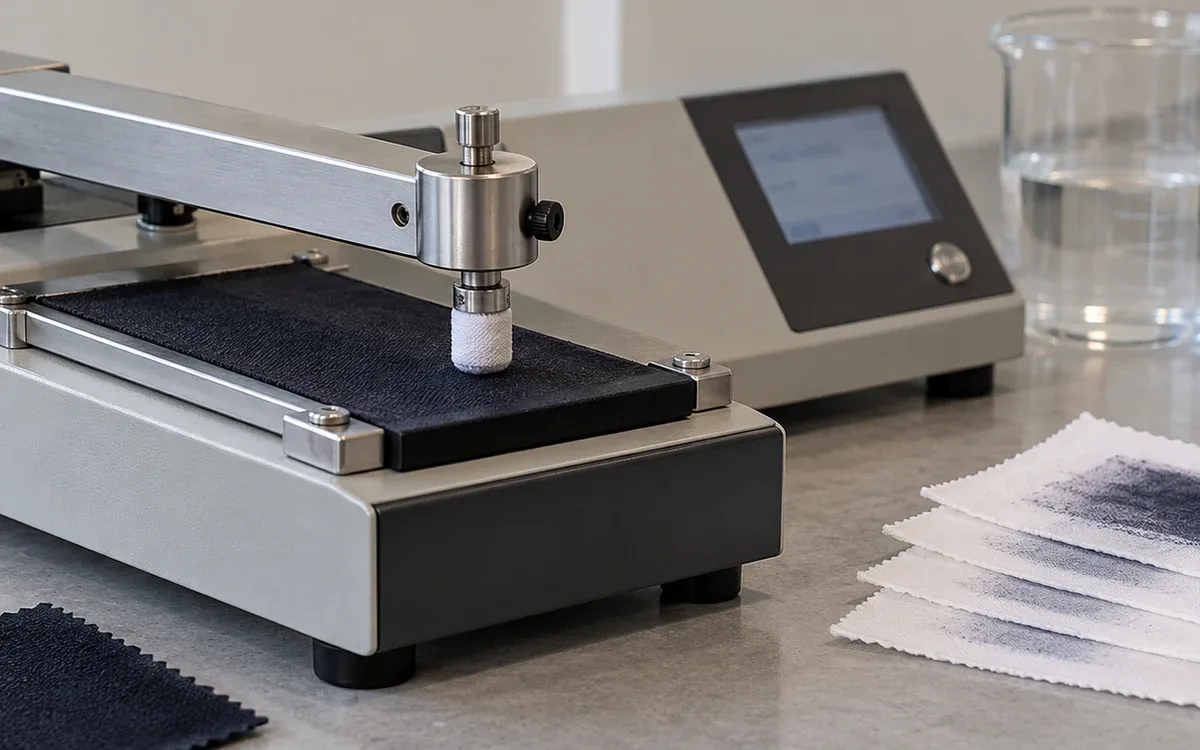
Wetting is a useful endpoint, but it is not the only one. A route should also preserve properties that matter to the product.
Choose a strength test that fits the fabric and buyer specification. Keep direction, conditioning, method, and specimen preparation consistent. A number from one strength method cannot simply replace a number from another.
Consider this hypothetical comparison of matched woven cotton specimens:
Route | Mean breaking force | Retained force versus input | Worst mapped wetting time |
|---|---|---|---|
Untreated reference | 540 N | 100% | Above the trial observation limit |
Trial A | 520 N | 96.3% | 6 s |
Trial B | 500 N | 92.6% | 3 s |
Retained force is calculated as:
Retained force (%) = treated mean force ÷ matched input mean force × 100
For Trial A, 520 ÷ 540 × 100 = 96.3%.
Suppose the project requires at least 95% retained force. Each mapped site must also wet within 8 seconds. Trial A meets those example limits. Trial B wets faster but misses the strength requirement.
These means do not describe test uncertainty or all variation. Review individual results and repeat trials before making a production decision. The example illustrates why the fastest wetting result should not automatically win.
Use appearance as another independent check
Record motes, visible marks, creases, and local differences under a defined inspection setup. Do not reduce appearance to “good” or “bad” without a reference.
If the fabric will receive a pale shade, carry a trial sample through that actual route. An absorbency pass cannot prove that the underlying colour is suitable.
ApparelDiary's right-first-time reactive dyeing guide explains how preparation results fit into the wider dyeing decision. Keep the scouring record linked to the later shade result.
Choose auxiliaries by function and compatibility
A scouring auxiliary may help with wetting or washing. It may emulsify oil, control foam, or serve several of these roles. Its product name alone does not define performance in the mill's liquor.
For example, CHT describes alkali stability, low foam, wetting, and oil emulsification for its FELOSAN BCR washing product. Those are product-specific claims. Another product needs its own data and trial.
Ask which conditions the supplier used to support its recommendations. Check compatibility with the other products, incoming water, machine, and fibre blend.
Do not respond to foam by adding an untested defoamer and then ignore that addition in the record. It becomes part of the process and may affect later results.
Use the product's current safety information and the plant's approved handling method. Enzymes and strong alkalis need different controls. A treatment may be gentler on fabric and still need careful handling.
Measure the whole resource cost
Cotton Incorporated discusses enzyme processing among options for more sustainable textile manufacturing. Savings depend on the route that the new process replaces. Check that route in the actual mill.
Compare from the same input state to the same accepted output state. Include washing, rejected fabric, repeat treatment, machine occupancy, and any added drying.
For water, a simple useful measure is:
Water intensity = total route water used ÷ accepted fabric mass
A route using 6,000 litres for 500 kg has a nominal intensity of 12 L/kg. If 50 kg remains unaccepted while the rest is released, the current accepted-output basis is 6,000 ÷ 450 = 13.3 L/kg. Record how reworked fabric is later accounted for so that the same mass is not counted twice.
Estimate heat carefully
A first heat comparison can use:
Heat added to water = water mass × specific heat capacity × temperature rise
For this simple estimate, use about 4.18 kJ per kilogram per degree Celsius for liquid water. It excludes vessel heating, fabric heating, losses, evaporation, heat recovery, and boiler efficiency.
Suppose two hypothetical routes each treat 500 kg of fabric with 4,000 kg of water. The initial water temperature is 25°C. Route A heats that bath to 95°C; Route B heats it to 60°C. Both then use a separate 2,500 kg wash heated from 25°C to 70°C.
Heat component | Route A | Route B |
|---|---|---|
Main bath | 325.1 kWh | 162.6 kWh |
Wash bath | 130.6 kWh | 130.6 kWh |
Estimated water heating total | 455.7 kWh | 293.2 kWh |
For Route A's main bath:
4,000 × 4.18 × (95 − 25) ÷ 3,600 = 325.1 kWh
Using unrounded values, the difference in this limited estimate is about 162.6 kWh per batch. It is not a measured fuel saving. It also does not establish that either temperature is suitable for a given product.
Use this calculation to identify where to measure. Then compare meter readings over repeated accepted batches.
Troubleshoot the pattern before changing the recipe
Start an investigation with the mapped result and process history. Increasing every chemical dose may hide the cause and create a new problem.
Observed result | First investigation | Useful comparison |
|---|---|---|
Whole section wets slowly. | Check dirt or oil in the input. Check treatment and washing. | Compare with a retained approved sample. |
One edge often wets slowly. | Check handling and contact across the width. | Compare left, centre, and right at several positions. |
Only the extra-rinsed sample wets well. | Check washing and matter left on the surface. | Compare matched samples with and without the extra rinse. |
Fast wetting with low strength. | Check treatment severity, input changes, and the test. | Use matched untreated samples and repeat force tests. |
Good wetting but a poor pale shade. | Check remaining colour, marks, and the full preparation route. | Carry samples through the intended dyeing process. |
Results vary after machine stops. | Check time and contact during the stop. | Mark and compare sections before, during, and after the stop. |
These are investigation routes, not diagnoses. Several causes can produce the same symptom. Keep the evidence that supports each change.
Set a release rule that operators can use
A practical release sheet names the fabric lot, approved route, sampling plan, test method, and limits. Name who may release the fabric if a result is close to or outside the limit.
Record actual values. “Absorbency passed” gives the next team little to work with. A map of test values, plus the method and sample condition, is much more useful.
If a result fails the rule, identify the affected cloth. Keep its history traceable. Define what additional testing or reprocessing would justify release. Do not let an average replace a maximum-location rule after the results are known.
For a new route, require successful repeated trials and a clear production control plan. The plan should list the input checks and the process records. State which fabric results call for action.
Keep the first production batches visible
A lab trial can compare treatments well. A full load has different fabric movement and contact patterns. The small trial may not reproduce them. Approve the transfer in stages. Identify the first production lots clearly. Test the same mapped sites used to judge evenness.
Check what happens when the machine load changes. A route proved on a light trial load needs evidence at its intended production load. Likewise, a change from one fabric construction to another deserves a review of the trial's scope.
Carry samples from the first lots through the next process. Link the results to their scouring records. If shade variation appears later, the team can compare the preparation map with the affected fabric. Without that link, the mill may repeat the whole investigation from the start.
When the route is stable, adjust routine sampling based on the evidence and the product's requirements. Keep extra checks for new inputs, unusual stops, and changes to auxiliaries or washing.
Frequently asked questions
Does scouring always need bleaching?
The answer depends on the required output. Scouring addresses cleaning and wetting; bleaching addresses colour. A dark-shade route and a white fabric route may need different preparation. Validate the full route against its intended use.
Can a pectin test replace an absorbency test?
It answers a different question. A pectin result can help assess the targeted treatment, while an absorbency test measures a fabric response. The wax-removal and washing studies show why both checks matter. One chemical endpoint should not replace the wetting test without evidence.
Is a larger weight loss proof of better scouring?
No. A mass change does not identify everything removed, and the comparison depends on a consistent moisture basis. Use it alongside specific cleaning checks, appearance, absorbency, and retained performance.
Should every fabric have the same wetting-time limit?
A limit should follow the intended use, method, and validated process. Do not turn an example value from a training article into a universal buyer requirement.
Why repeat a trial that already passed?
One trial gives evidence for one set of inputs and conditions. Repeats help show whether the route can deliver the result despite normal variation. They also reveal whether a promising average hides unstable locations.
Make uniform readiness the final decision
Good cotton scouring leaves an even, usable fabric. It also preserves the properties the product needs. Prove that result with a defined test method, a sample map, retained-performance checks, and the complete wash route.
When trials differ, ask what the cloth gained and lost. Measure the resources used to produce fabric that passed. Use those facts to choose the route. Bath temperature, chemical price, or one quick wetting result gives only part of the answer.
References
Cotton Incorporated: Dyeing preparation.
Novonesis: Textile biopreparation.
Colombi and colleagues: Advances in sustainable enzymatic scouring of cotton textiles.
Agrawal and colleagues: Wax removal for accelerated cotton scouring with alkaline pectinase.
AATCC: Moisture management proficiency testing and method list.
AATCC: Changes in the 2026 Manual.
Discussion0
Loading the discussion…