
What a well-controlled vat process must achieve
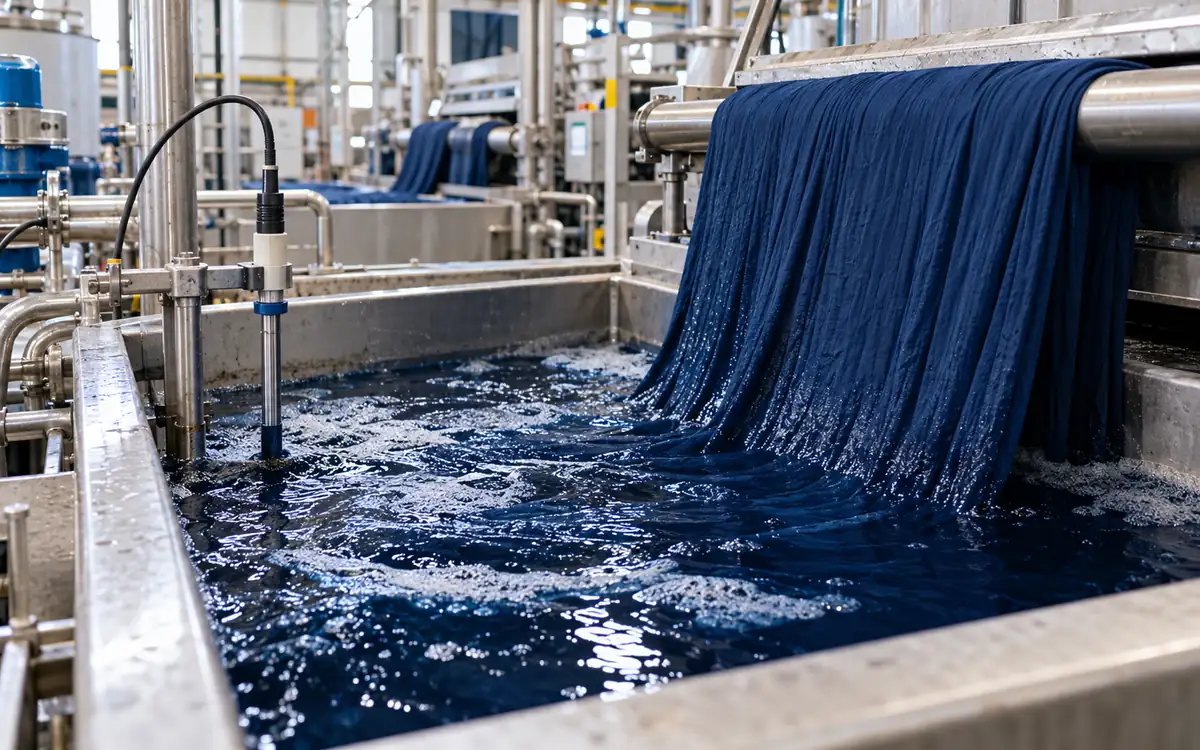
Vat dyeing of cotton depends on a planned change in the dye's chemical form. The dye must enter the fibre in a useful form. It must then become insoluble again and survive final washing. A dark bath proves only part of that work. So does a strong reducing reading or an attractive wet sample.
The control plan has four main stages. These are reduction, dye uptake, oxidation and soaping. Each stage needs a clear purpose and its own evidence. That makes a failed shade easier to investigate. It also helps prevent the wrong correction. Extra dye cannot fix every problem that starts later in the route.
This guide concerns vat dyeing of cotton fabric. Its examples illustrate process control and calculations. The figures are made up for teaching. They are not operating recipes. Set production conditions for the chosen dyes, equipment, chemical grades and fabric.
Follow the dye through its changes
Vat dyes are usually supplied in their oxidized state. In that state, they dissolve poorly in water. Reduction needs suitable alkaline conditions. It creates the soluble leuco form used to dye cotton. Oxidation then returns the dye to its insoluble form within the fibre. Cotton Incorporated explains this sequence in its technical dyeing booklet.
This route differs from reactive dyeing, which forms a bond with cellulose. Its process endpoints differ too. A reactive dyeing endpoint cannot simply prove that vat dyeing succeeded.
Use four distinct questions:
Stage | Main question | Evidence to retain |
|---|---|---|
Reduction | Has the selected dye reached the required useful reduced state? | Keep dye-specific checks, bath conditions and the redox record. |
Dye uptake | Has colour reached the required parts of the fabric evenly? | Keep samples that represent the fabric and its process history. |
Oxidation | Has the reduced dye been converted as required? | Record approved oxidation conditions. Keep the treated sample. |
Soaping and rinsing | Is the developed shade stable and adequately washed? | Check dry shade, wash results and relevant fastness tests. |
The leuco bath does not show final colour. Nor does cloth that has only partly oxidized. Keep the sample stage on its label. “After dyeing” is too vague. The fabric still has several chemical changes to pass through.
Select a dye range for the service conditions
Choose the required end-use performance before building the recipe. Ask which wash conditions and rubbing exposure the fabric must withstand. Check light exposure and finishing stages too. Workwear and decorative fabric may have similar colour standards. They can still need different performance evidence.
Current suppliers offer dedicated vat dye ranges for cellulosic fibres. For example, CHT identifies BEZATHREN for cellulose and blends. It lists resources for both exhaust and continuous application. It also offers selected liquid forms. Those details come from the manufacturer's vat dye portfolio.
A range description does not establish the fastness of every dye mixture. Obtain the technical information for the exact products. Check the recommended reduction conditions and application route. Confirm the oxidation method and washing process too. Check that the dyes in a combination can share those conditions.
Keep the commercial product names and strengths on the recipe. Two containers may have similar colour names. Their contents may still need different recipes. A change from powder to liquid also changes the weighing and delivery task. Review product concentration, dispersion preparation and metering. Equal kilograms may not give equal colour.
The colour approval should use fabric that has completed the intended process. ApparelDiary's lab dip and buyer sign-off guide explains that approval handoff. The vat production record must show how the cloth reached that approved state.
Confirm the cotton and chemical starting points
A vat process cannot make an unevenly prepared substrate disappear. Record the fabric identity and preparation lot. Check whether wetting and residual chemistry meet the approved specification. If preparation changes, investigate that change before adjusting the vat recipe.
ApparelDiary explains the broader preparation checks in its right-first-time cotton dyeing article. These remain useful at this handoff. For vat dyeing, ask one extra question. How will the prepared fabric affect reduction and oxidation?
Use accurate chemical names. One reducing agent is sodium dithionite. It is also called sodium hydrosulfite. Its formula is Na₂S₂O₄. A similarly spelled name for sulfate or sulfite does not identify the same chemical. Use supplier labels and product codes when receiving and issuing chemicals. Check the safety data sheets too.
The Fisher Scientific safety data sheet names the chemical and its synonym. Sodium hydrosulfite is another name for sodium dithionite. It warns that contact with acids releases toxic gas. Follow the plant's approved handling procedures. Use its approved procedure when changing stages too. Do not casually add acid to correct a reducing bath.
Keep three quantities separate in the record. These are dye amount, alkali amount and reducing-agent amount. An alkaline bath is not proof that reduction is adequate. A reducing reading alone does not prove readiness either. Check that the selected dye is ready for uptake.
Convert each recipe quantity on its stated basis
Vat recipes can express additions on fabric mass, dye mass or liquor volume. The unit belongs beside every number. An isolated instruction such as “add ten percent” is incomplete.
Consider a hypothetical teaching example. A lot contains 400 kg of dry cotton. The recipe calls for dye at 2% on fabric weight:
Dye mass = 400 kg × 2 ÷ 100 = 8 kg.
Now take a separate, made-up auxiliary instruction. It says to use 10% on dye weight. The mass is:
Auxiliary mass = 8 kg × 10 ÷ 100 = 0.8 kg.
If someone instead calculates 10% on fabric mass, the result is 40 kg. That is fifty times the intended amount. The example illustrates a basis error; it does not recommend either addition for a vat bath.
Write “owf” and “owd” out in full where operators could confuse them. Confirm whether the instruction uses the commercial product mass or its active content. Never apply a purity correction unless the supplier's recipe basis calls for it.
For additions expressed per litre, use the actual applicable bath volume. Include dosing water where the method requires it. The detailed volume calculations belong in ApparelDiary's liquor ratio and dosing checks. Keep these separate bases clear throughout the vat route. The lab, chemical kitchen and dye machine must all use the same meaning.
Use redox potential as a defined measurement
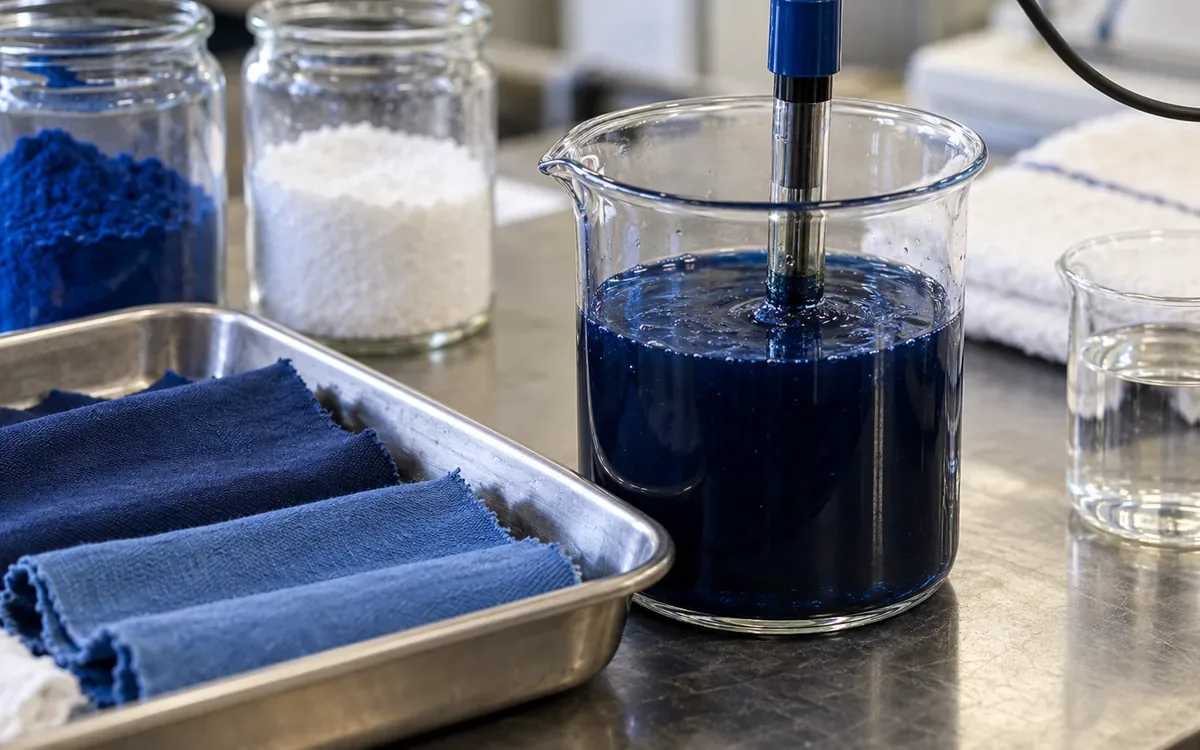
Oxidation-reduction potential, or ORP, is often reported in millivolts. It is useful only when the measurement system is defined.
HORIBA explains that a measured ORP depends on the reference electrode used. Its guidance also describes mixed solutions. These can contain several chemical equilibria. One simple reaction may not explain their measured potential. See the basis of ORP.
Before copying a target from a paper or supplier sheet, record:
The reference electrode and its filling solution.
Whether the displayed value is raw millivolts or a converted value.
The sample temperature and measurement location.
The electrode check and cleaning procedure.
The point in the process at which the target applies.
A missing reference can make two valid readings appear to disagree.
A reference conversion example
Use two fictional systems to see the problem. Assume both systems have known offsets to one reference scale. These are +200 mV and +250 mV.
System A reads −700 mV. Its converted value is −700 + 200 = −500 mV.
System B reads −750 mV. Its converted value is −750 + 250 = −500 mV.
The raw readings differ by 50 mV, yet the converted values agree. These offsets are invented for the calculation. Obtain real offsets from the instrument documentation at the applicable conditions.
A second trap is applying an offset twice. A meter may already display a value on the standard hydrogen electrode scale. Adding another correction would create an error. Thermo Fisher's ORP electrode guide explains this distinction. It separates raw readings from values on that scale. It also gives the calibration procedure.
Build a measurement record that can support a decision
A single redox reading is a weak record of a changing process. Define the events at which readings are needed. These might include completed preparation and the point before fabric entry. Other checks may fall during the hold or before the next stage. Use the same method across trials.
Write down when a sample left the machine and when the measurement began. An open beaker does not reproduce every condition inside a running vessel. Changes during transfer can become part of the reported result. Use the same sampling method for each check. This helps separate process changes from sampling changes.
Do not force an unstable instrument to provide a convenient endpoint. Check its condition and follow its manual. Thermo Fisher recommends fresh standard for calibration. It advises rinsing between measurements and stirring standards and samples evenly. Its guide also explains how electrode care differs. Refillable and gel-filled types have different needs.
Set a local rule for recording a stable result. Preserve unusual response times and repeated failures in the log. The same probe may also drift in a check solution. If so, investigate the measurement system first.
An ORP value may be credible. It still does not directly measure reducing-agent concentration. Nor does it measure dye uptake within cotton. Use the reading alongside the approved chemical checks. Include evidence from the fabric too. The display is useful evidence. Its meaning must stay within the limits of the method.
Keep reduction and dye uptake under separate review
The reduction method must make the dye usable. It must keep the required state through application. Follow the supplier's instructions for preparing and adding each part. These include the dye dispersion, alkali and reducing system.
There is no single temperature, pH or millivolt value for every vat dye. Ask for the limits that apply to the actual combination. If the operating ranges do not align, change the combination or route before a bulk trial.
Research illustrates why several outputs deserve attention. Veeresh and Chakraborty examined ten vat dyes. They recorded bath potential, pH and fabric colour strength. Their 2020 experimental study then compared two reducing systems. One was conventional. The other used alkaline pectinase and iron(II). The recipe and results belong to that experiment. They do not apply to every mill.
Check chemical delivery and fabric movement during production. Do they match the approved trial? One sampling point may give an acceptable reading. That does not prove equal treatment throughout the load.
Weak colour has several possible causes. Useful reduction may be incomplete, or application conditions may be unsuitable. Check for a wrong product, uneven substrate or later colour loss. Locate the failed stage before adding dye. An early addition can hide the cause and confuse the next batch.
Control the transfer into oxidation
Reduction and oxidation serve opposite purposes. Set out the transition between them in a clear procedure.
Record how the approved route drains, rinses or transfers the cloth. Track fabric hold-up. Note any pause before oxidation. A restart may differ from a steady run. This can happen even with an unchanged recipe.
Carryover matters because wet cloth moves liquor as well as dye. A change in retained liquor can alter the material entering the next bath. The next example shows how much carryover can change. It does not estimate an oxidant recipe.
Assume 500 kg of dry fabric retains 0.70 kg of liquor per kilogram of fabric:
Retained liquor = 500 × 0.70 = 350 kg.
A validated assay of that liquor reports 0.80 g of residual reducing chemical per kilogram of liquor. The carried amount is:
Carried chemical = 350 × 0.80 = 280 g.
Now let retained liquor rise to 0.90 kg/kg. The same calculation gives 450 kg of liquor. It carries 360 g of chemical. That is an increase of 80 g, or about 28.6%.
These are hypothetical data. State the assay basis clearly. A redox reading cannot supply that concentration. The result is also not a direct oxidant requirement. Other substances and reaction conditions affect the real demand. The chosen oxidation route matters too.
Check pickup or drainage first. Do not compensate with an unexplained chemical addition.
Validate oxidation on the treated fabric
Specify the approved oxidation agent or air-oxidation route for the chosen dyes. Record the treatment conditions. Include time, temperature and other required controls. Follow current product guidance. An old general recipe cannot replace it.
Judge the result after the complete agreed sequence. A change in bath potential adds useful evidence. Alone, it cannot prove complete oxidation across the fabric.
Take samples that represent the likely variation. For a continuous route, include startup, steady running and restart sections. For a batch, use the agreed locations or sampling method. Label each sample so its position can be traced.
If the cause remains unclear, compare matched pieces under controlled conditions. Keep the dyeing stage the same. Give one piece the normal oxidation route. Give another the approved investigation route. Wash and dry both in the same way.
If their final shades differ, the experiment points toward the later treatment. It does not prove that more oxidation is always better. Check fastness and strength before changing production. Test the other required fabric properties too.
A clear investigation asks one question at a time. Changing all three stages may produce an acceptable shade. Yet the cause may remain unknown. Keep reduction, oxidation and soaping changes traceable.
Investigate a stoppage as a separate event
Take an example continuous line. One treatment zone holds 60 metres of fabric. At a steady 30 metres per minute, the nominal residence time is:
Residence time = 60 m ÷ 30 m/min = 2 minutes.
This describes steady movement. It does not describe a stop. If the line pauses, some fabric stays inside that zone. Other sections wait elsewhere. Their chemical exposure histories can differ. The restart also passes through a transition before normal running returns.
Mark the stop time, fabric position and restart time. Record what happened during the pause. Check liquor circulation, chemical delivery and temperature. Identify the affected length from the machine path and actual sequence. Do not assume that a single two-minute figure describes every metre.
Take separate samples from before the stop, the held section and the restart. Complete the same oxidation and soaping route for each. Then compare dry colour. Include width positions if the visible fault varies across the cloth.
Suppose the steady section passes and only the held section fails. That pattern supports an investigation of the interruption. It gives little reason to change the dye amount for the entire next order. Check the transition record. Where feasible, reproduce the suspected condition in a controlled trial.
Keep the affected section traceable while the decision is pending. This protects acceptable fabric from needless treatment. It also preserves evidence of the original event. A blanket correction could erase the pattern that explains the failure.
Treat soaping as part of colour development and release
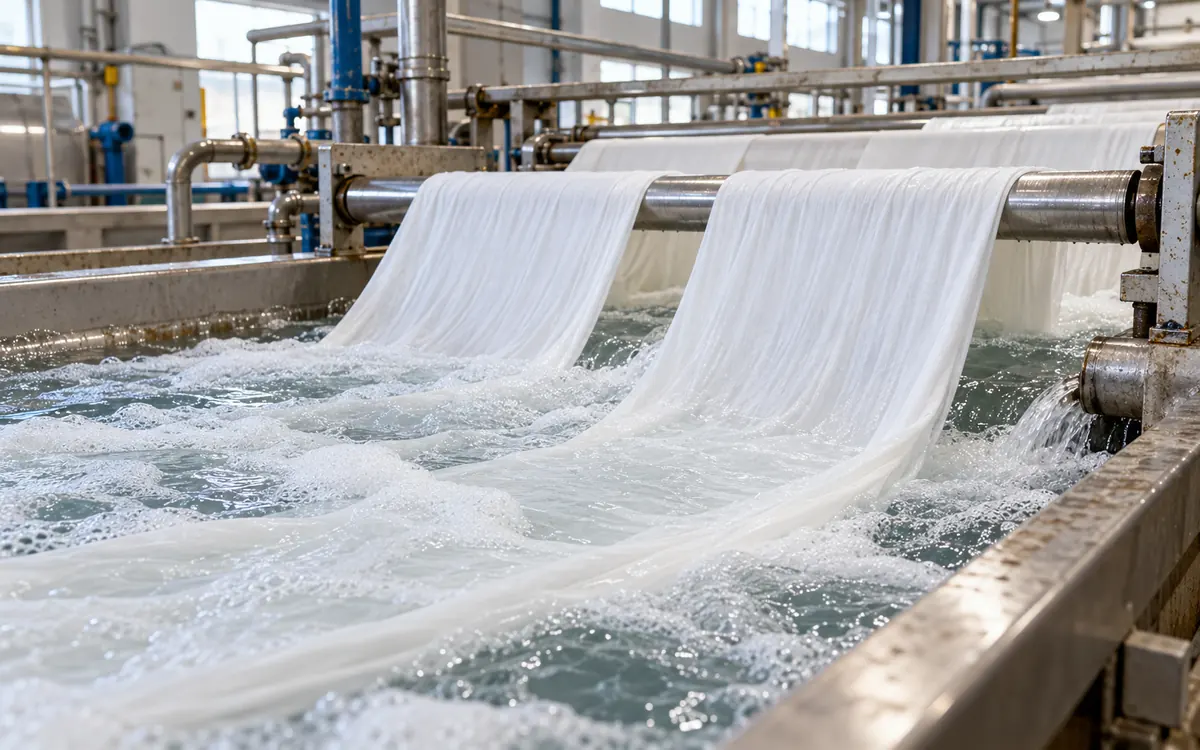
Do not shorten soaping just because the shade looks close. It is more than a quick cleanup. Make the final judgement after the specified washing sequence and drying.
BASF's vat application brochure warns that some deviations are hard to detect early. They may become clear only after steaming, oxidation and soaping are complete. Its HydroBlue and RotaSpray technical leaflet concerns a particular continuous application system. The useful general lesson is to retain evidence from the completed route.
Where the method permits, keep three labelled samples. Take them after oxidation, after soaping, and after final finishing. Compare them under the same viewing and measurement conditions. This reveals when a shade shift entered the route.
More washing may change the shade greatly. If so, check the washing endpoint and earlier stages. An underwashed sample may match the master. That does not make it ready for service.
A practical split-sample trial can distinguish competing explanations:
Trial piece | Treatment held constant | Controlled change | Question |
|---|---|---|---|
A | Use common dyed fabric. | Apply the normal full route. | What does the current process deliver? |
B | Use the same dyed fabric and soaping. | Run the approved oxidation trial. | Does oxidation explain the difference? |
C | Use the same dyed fabric and oxidation. | Run the approved soaping trial. | Does washing explain the difference? |
D | Repeat A. | Make no planned change. | How repeatable is the comparison? |
Use pieces large enough for the agreed tests. Repeat the trial if variation could change the decision. Keep each trial within validated fabric and chemical limits.
Diagnose faults by where they first appear
A useful fault report names the first stage that differs from a successful reference. “Vat shade failed” gives the next shift very little to investigate.
Observation | First checks | Avoid assuming |
|---|---|---|
ORP differs but final fabric agrees | Check the reference scale and temperature. Review sampling and probe condition. | Do not assume the recipe needs a change. |
Weak colour after the full route | Check product issue and reduction evidence. Review application and later shade loss. | Do not assume more dye is the first remedy. |
Spots appear before oxidation is complete | Check dispersion and contamination. Review local treatment and transfer history. | Do not assume all spots share one chemical cause. |
Shade changes mainly during soaping | Review earlier oxidation and washing conditions. Check whether results repeat. | Do not treat the pre-soaping shade as final. |
Startup differs from steady running | Check application balance and residence time. Review transition records. | Do not reject the whole dye mixture without evidence. |
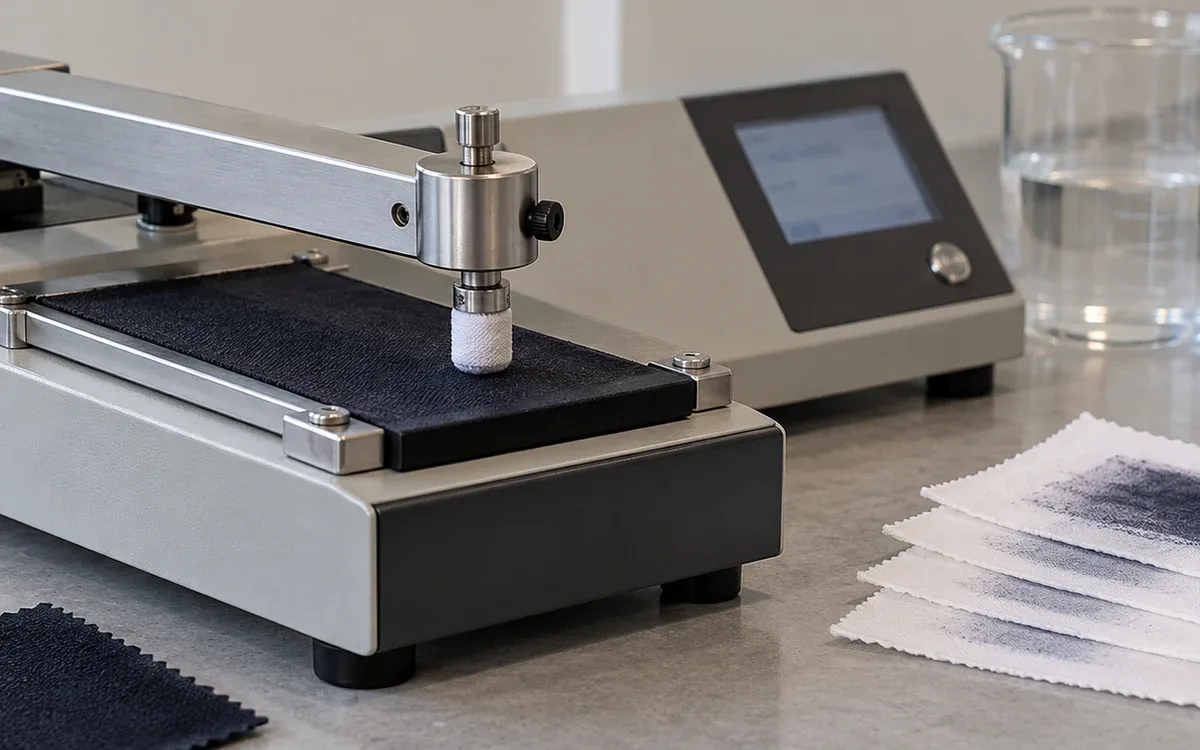
Fastness fails despite a colour match | Check washing and the exact dye choice. Review required test conditions. | A shade match does not prove durability. |
Where possible, keep a known acceptable reference from the same process. Compare the new fabric with it. Memory of a previous season is less reliable.
Record corrections as changes, including their time and reason. A recipe with unrecorded additions is hard to repeat reliably. Before making it the new standard, run it again from the beginning. Check whether it repeats the corrected result.
Judge process changes against the whole route
Lower chemical or water use is useful. The finished fabric must still meet its requirements. Use a common starting point for both routes. Measure them through to the same released condition.
Commercial options may combine stages. DyStar describes Cadira VAT as an exhaust route. It combines scour-dyeing with post-bleaching during soaping. Its Indanthren brochure presents that system with specified dyes and auxiliaries. The savings claims apply to that system. Test them under local mill conditions.
Experimental alternatives deserve the same discipline. The pectinase and iron(II) study reported useful results under its tested conditions. It does not prove that every recipe can change its reducing agent alone. Other parts of the route may need to change to preserve performance.
For a comparison, keep the fabric specification and release tests common. Record chemicals, water and energy used. Count process time across all affected stages. Include additional washing or corrections. Check the resulting effluent through the mill's actual treatment requirements.
Also state what was not measured. A trial may record water volume but lack energy data. It can then support a water comparison. It cannot show that every environmental impact fell.
Frequently asked questions
Does a more negative redox reading always mean better dyeing?
No. A reading must have a defined reference and method. It also represents only one part of the process evidence. Use the approved dye-specific limits and confirm the fabric result.
Can pH replace a redox measurement?
No. They describe different properties. Record each value where required. Use the correct instruments and methods. One value may pass its limit while the other does not.
Why can two samples match before washing and differ later?
They may have reached different states during oxidation or washing. Compare samples after the same complete treatment. A partly processed colour match is a poor release standard.
Can a laboratory vat recipe move directly to production?
Its chemistry gives a starting point. Production must also reproduce delivery, fabric movement, sampling and stage transitions. Record these in the production trial. Compare the final fabric.
What should the final batch record contain?
Keep product identities, recipe bases and actual additions. Record methods, stage times and transition details. Save samples that represent the fabric. Add dry shade and required performance results. Explain every correction.
Make each stage prove its own result
A controlled vat process connects bath evidence to finished fabric. Reduction must support application. Oxidation must produce the required dye state. Soaping must lead to a stable shade with the required performance.
Keep those decisions separate in the record. Review them together at release. This makes a successful batch easier to repeat. It makes a failed batch easier to explain. The team then has a sound basis for process improvement. It can judge what a favourable reading means for finished fabric quality.
References
Cotton Incorporated: Dyeing Booklet.
CHT: Vat dyes and BEZATHREN application resources.
Fisher Scientific: Sodium hydrosulfite safety data sheet, product S310-100.
Thermo Fisher Scientific: ORP Electrode User Guide.
BASF and RotaSpray: Pad-spray-steam dyeing of vat dyes with HydroBlue 90.

Discussion0
Loading the discussion…