
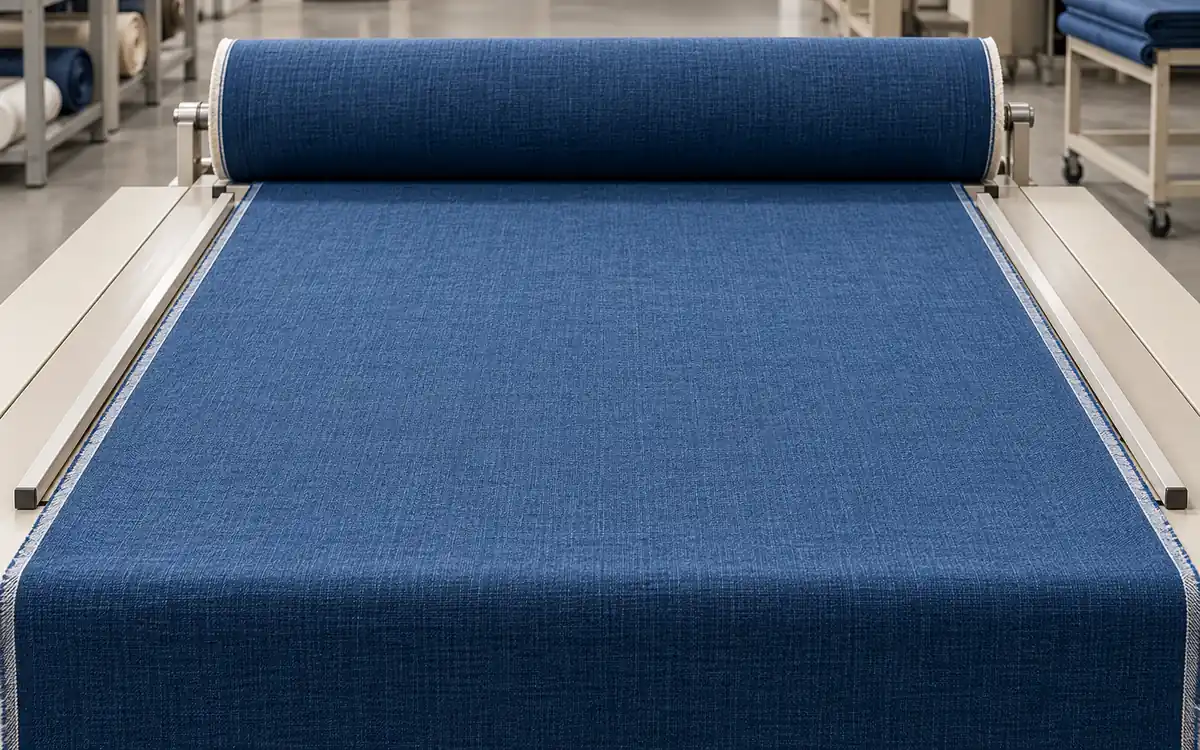
Fabric GSM testing and roll weight reconciliation answer related questions at different scales. GSM describes mass per unit area for the fabric tested. A roll check asks whether measured net mass agrees with the recorded fabric area on the same basis. A disagreement should trigger an investigation of identity, units, packaging, sampling and material condition before a supplier shortage is claimed.
This guide gives laboratory and receiving teams a calculation path, a segment-based example and a diagnostic record. The arithmetic can expose inconsistent records; it cannot establish shipment conformity without the agreed sampling, test method and purchase criteria.
Establish what each measurement includes
Record the roll identifier, material, construction, finish state and measurement condition. A receiving weight measured immediately after transport and a specimen tested after conditioning describe different states unless the agreed method makes them comparable. Keep the original observations and identify any later measurements separately.
ASTM D3776/D3776M-20(2025) describes several approaches to fabric mass per area. Its public scope distinguishes full pieces, full-width samples, small swatches and narrow fabrics. A swatch result should not be represented as proof of the entire roll. The licensed method and buyer requirements govern specimen preparation and reporting.
ISO 139:2005 addresses textile conditioning and testing atmospheres, with Amendment 1:2011 also listed by ISO. Record the actual applicable procedure. A standard name typed onto a receiving form is not evidence that the prescribed conditions were achieved.
Keep gross fabric width distinct from usable cutting width. The edge material may remain part of the weighed roll even when it cannot enter a marker. Likewise, a tube or wrapping contributes to scale mass but not to the fabric area. Each comparison must include the same physical material.
Calculate GSM from the actual specimen area
GSM equals specimen mass in grams divided by specimen area in square metres. When area is recorded in square centimetres, GSM equals mass × 10,000 ÷ area. A convenient multiplier follows from area; it is not a property of every circular cutter.
For an illustrative 100-square-centimetre specimen weighing 1.86 grams, GSM is 1.86 × 10,000 ÷ 100 = 186. A 50-square-centimetre specimen weighing 0.93 gram gives the same result. Multiplying the second mass by 100 would incorrectly report 93 GSM.
Retain individual specimen results and locations. If three equal-area investigation samples give 182, 186 and 190 GSM, their arithmetic mean is 186 GSM. That mean is meaningful for the sampled locations; using it for a whole-roll mass estimate adds an assumption about representativeness that must be stated.
Check the balance and cutter under the laboratory's approved procedure. Repeatability on one specimen tests a different issue from variation between fabric locations. A consistent balance cannot compensate for an incorrect specimen area or a sample cut from an unrepresentative strip.
Use the fabric calculators as a second arithmetic check after confirming their inputs. Preserve the original measured values so a correction can be reconstructed rather than replacing an unexplained output with a more plausible number.
Reconcile a uniform roll on a matching area basis
Expected fabric mass in kilograms equals length in metres × width in metres × GSM ÷ 1,000. For a uniform illustrative roll of 120 metres, 1.60 metres gross width and 186 GSM, the result is 35.712 kilograms.
Suppose the scale reads 37.20 kilograms and the actual tube and wrapping tare is 1.30 kilograms. Net mass is 35.90 kilograms. The difference from the estimate is 0.188 kilogram, or 0.188 ÷ 35.712 × 100 = approximately 0.526 percent of expected mass.
That percentage is a discrepancy description, not a pass limit. Its meaning depends on the uncertainty and representativeness of the length, width, mass and GSM inputs. Do not invent an acceptance tolerance from the number of decimal places displayed by the scale.
If usable width were 1.55 metres, its area-equivalent mass would be 34.596 kilograms. Comparing that value with the whole net roll would create an apparent 1.304-kilogram excess. The comparison would be inconsistent because the excluded edge fabric is still on the scale.
Use a segment calculation when variation matters
A single average can be misleading when material changes along a roll. The following is a constructed arithmetic example with two separately characterised segments. It demonstrates summing compatible area-mass estimates; it is not a prescribed sampling scheme.
Segment | Length m | Gross width m | Representative GSM | Estimated mass kg |
|---|---|---|---|---|
A | 60 | 1.60 | 180 | 17.280 |
B | 40 | 1.58 | 190 | 12.008 |
Total | 100 | Not one common width | Area-weighted result | 29.288 |
Total area is 60 × 1.60 + 40 × 1.58 = 159.2 square metres. The corresponding area-weighted GSM is 29.288 × 1,000 ÷ 159.2 = approximately 183.970. Averaging 180 and 190 without weights would give 185 GSM, despite the segments representing different areas.
If someone instead uses 100 metres, 1.60 metres and 185 GSM, estimated mass becomes 29.600 kilograms. The 0.312-kilogram difference arises from the chosen aggregation, before considering any scale error. Keep the segmentation evidence and calculation with the reconciliation.
Investigate in an order that preserves evidence
First verify roll identity and units. Match the scale record to the actual roll, distinguish yards from metres and convert centimetres to metres before multiplication. Check whether an ERP export already applied a conversion; applying it twice can produce a systematic error across the shipment.
Next verify packaging tare. Use evidence for the packaging actually present rather than a default that may describe a different tube. Preserve a gross measurement if the packaging cannot yet be separated, and label any estimated net mass accordingly.
Then examine width, length and specimen coverage. ASTM D3774-18(2024) provides a width-method reference. If measurements repeat at one location but change across locations, investigate that distribution. If repeated readings at the same location disagree, address the measurement process before widening the sample.
Finally compare material condition and test state. Moisture changes and finish differences can affect mass. A reconciliation cannot distinguish those causes by itself. Refer any proposed moisture correction to a competent laboratory using the agreed method rather than adjusting the weight until it matches the invoice.
Record the sensitivity of the estimate
Before requesting a retest, identify which input could explain the observed gap. In the uniform example, changing GSM by one unit changes estimated mass by 120 × 1.60 ÷ 1,000 = 0.192 kilogram. Changing recorded length by one metre changes it by 1.60 × 186 ÷ 1,000 = 0.2976 kilogram. These are calculation sensitivities with other inputs held fixed, not uncertainty estimates. They help the investigator choose a useful next check without assuming that either input is wrong.
Keep calculation and acceptance decisions separate
The investigation record should contain the original entries, corrected entries, reason, evidence and approving person. A reported difference may be real while remaining within the commercial agreement, or may disappear after a unit error is corrected. Neither conclusion justifies deleting the original observation.
Link the findings to the cutting process control record. Correcting gross area does not automatically change usable fabric allocation, and a technically reconciled roll may still have an unresolved quality hold.
Choose one disputed roll and complete the identity, area basis, tare, specimen coverage and condition checks before contacting the supplier. Send the underlying measurements and calculation, together with the contractual question that remains. That evidence gives the next measurement a defined purpose.
References
ASTM D3776/D3776M-20(2025) Standard Test Methods for Mass Per Unit Area of Fabric
ASTM D3774-18(2024) Standard Test Method for Width of Textile Fabric
ISO 139:2005 Textiles Standard atmospheres for conditioning and testing
ARTICLE BODY END
Editorial appendix
Original calendar seed: roll weight reconciliation for incoming fabric
Adopted intent: fabric GSM testing and roll weight reconciliation
Intended action: REFRESH; UPDATE_EXISTING. Refresh the verified canonical GSM page; do not publish a second roll-weight URL.
Content gap: The existing live article and prior GSM drafts cover the base calculation. Additional depth should remain on that canonical URL.
Distinct added value: Original unequal-area segment calculation; numerical sensitivity check to prioritise follow-up measurements.
Nearest existing canonical: https://appareldiary.com/article/fabric-gsm-testing-and-roll-weight-calculation-guide
Overlap checks: Checked live homepage, topics, tools, search, both archive pages for the three nonsafety verticals, Safety navigation and known earlier draft topics. Public-page and title screening is incomplete for unpublished work because no complete CMS or prior-state export was supplied.
Keyword evidence: Source: supplied Day 1 calendar and current public search retrieval. Geography: international English queries; location not controlled. Date: 2026-10-18 Asia/Dhaka. Current volume, KD, ranking and property performance: Not independently verified. Historical SEMrush screenshot rows in the calendar were not promoted to current evidence.
SERP observations: Results included ASTM mass-per-area scopes and roll inspection material. The live Apparel Diary guide already fulfils the base intent; a new synonym URL would collide. Observed 2026-10-18; returned search results are not a complete or location-controlled Google ranking capture.
Continuity: The available state is blank, so the prompt default selects Day 1. Today adds ten DRAFT rows; no publication is claimed.
Technical QA: 186 GSM from either specimen area; uniform mass 35.712 kg; discrepancy 0.188 kg or 0.526434 percent. Segments total 29.288 kg on 159.2 m2, yielding 183.969849 GSM. Sensitivities 0.192 kg per GSM and 0.2976 kg per metre.
Reviewer questions and caveats: Compare with the current published version and merge the new examples while retaining validated existing assets and links. Use site measurement uncertainty and contractual criteria.
Implementation: Review and approve before CMS use. For REFRESH, compare and merge into the stated live canonical; retain verified assets and author attribution. For NEW, recheck overlap and canonical settings immediately before publication.
Source verification
ASTM D3776/D3776M-20(2025) Standard Test Methods for Mass Per Unit Area of Fabric — Public scope distinguishes full-piece, full-width, small-swatch and narrow-fabric options; no licensed procedural clauses reproduced. Accessed 2026-10-18 Asia/Dhaka.
ASTM D3774-18(2024) Standard Test Method for Width of Textile Fabric — Public scope covers fabric width and usable width, with full-roll and specimen options; full licensed method not accessed. Accessed 2026-10-18 Asia/Dhaka.
ISO 139:2005 Textiles Standard atmospheres for conditioning and testing — Public abstract supports the conditioning-atmosphere reference only; exact laboratory conditions are not prescribed here. Accessed 2026-10-18 Asia/Dhaka.
ISO 139:2005 Amendment 1:2011 — Public catalogue confirms the listed amendment; full text not accessed. Accessed 2026-10-18 Asia/Dhaka.
Internal link map
fabric calculators | body section: Calculate GSM from the actual specimen area. Live destination opened during research.
cutting process control record | body section: Keep calculation and acceptance decisions separate. Live destination opened during research.
Suggested reverse link: https://appareldiary.com/article/fabric-gsm-testing-and-roll-weight-calculation-guide → this approved article or refreshed section using its operational task as anchor. Add only after editorial approval.
Pending batch links: Articles 02 and 04 after approval. These are editorial suggestions only; no proposed destination is linked as live in the body.
Featured image brief
Suggested filename: fabric-gsm-testing-and-roll-weight-calculation-guide-featured.webp
Size and crop: 1200 x 750 pixels; 1.6:1 landscape. WebP for the eventual asset; aim near 50 KB when feasible and below 100 KB without severe degradation. Status: brief only.
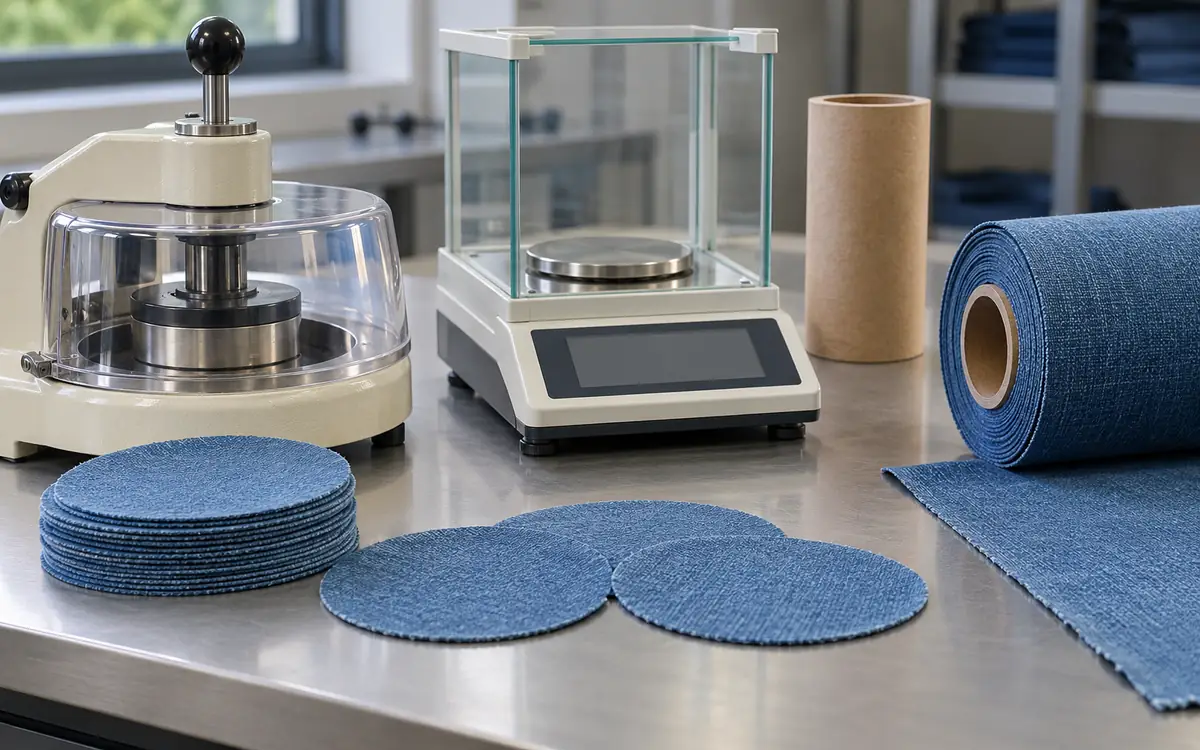
Generation prompt: Create a photorealistic professional industrial editorial photograph. A photorealistic textile laboratory bench with blue circular fabric specimens, a covered circular cutter, a precision balance with blank display, and a short fabric roll. Include a separate cardboard core behind the scale to suggest tare without a fabricated numeric result. Use believable textile materials and construction, natural proportions, restrained cream steel and blue tones, and soft balanced lighting. Keep the main subject in a central crop-safe area with crisp fabric texture. Compose at 1200 x 750 pixels for eventual WebP export. The scene is explanatory and is not attributed to any real factory.
Draft alt text: Fabric specimens and a covered cutter beside a balance and separate roll core
Optional caption: Review the material and records together before approving the next action.
Negative constraints: No female figures; no people needed. No readable numbers, text, fake labels, logos, watermark, unsafe practice, exposed blades, obstructed exits, fictional measurements or claimed real-factory attribution.
QA precautions: Inspect the eventual asset for plausible equipment and cloth, crop, stray text, compression damage and correspondence to this article. Any precise labels or data visual must be typeset and checked separately.
In-body image brief
Suggested filename: fabric-gsm-testing-and-roll-weight-calculation-guide-body.webp
Size and crop: 1200 x 750 pixels; 1.6:1 landscape. WebP for the eventual asset; aim near 50 KB when feasible and below 100 KB without severe degradation. Status: brief only.
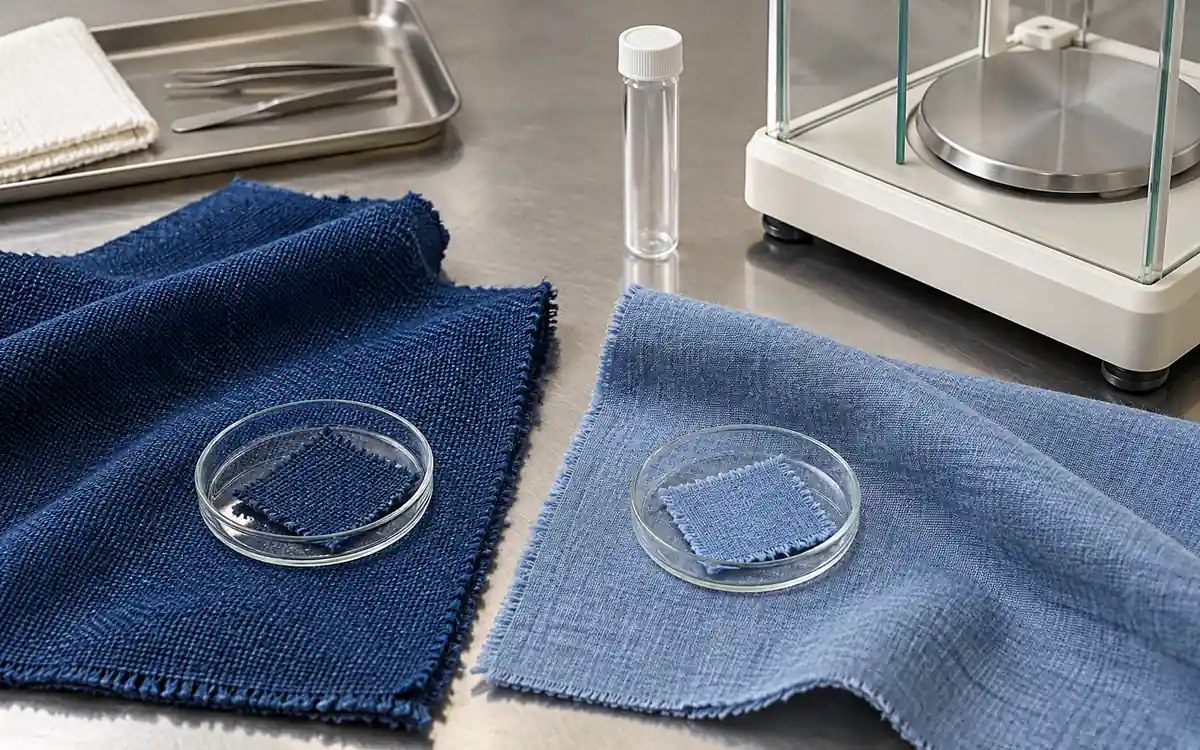
Generation prompt: Create a photorealistic professional industrial editorial photograph. A realistic overhead bench photograph of two separate fabric lengths with slightly different blue textures, each with its own specimen dish, beside an empty tube and a stable laboratory balance. The different section areas should be visually clear, with no charts or generated text. Use believable textile materials and construction, natural proportions, restrained cream steel and blue tones, and soft balanced lighting. Keep the main subject in a central crop-safe area with crisp fabric texture. Compose at 1200 x 750 pixels for eventual WebP export. The scene is explanatory and is not attributed to any real factory.
Draft alt text: Two fabric sections with separate specimen dishes for a segmented mass check
Optional caption: Original unequal-area segment calculation.
Negative constraints: No female figures; no people needed. No readable numbers, text, fake labels, logos, watermark, unsafe practice, exposed blades, obstructed exits, fictional measurements or claimed real-factory attribution.
QA precautions: Inspect the eventual asset for plausible equipment and cloth, crop, stray text, compression damage and correspondence to this article. Any precise labels or data visual must be typeset and checked separately.
Discussion0
Loading the discussion…