
What a water repellency test tells you
A jacket shell may shed drops well yet let water through under a sustained shower. Another fabric may show a dark wet patch on its face while the layer below stays dry. These outcomes describe different parts of water performance. A useful test plan keeps them separate.
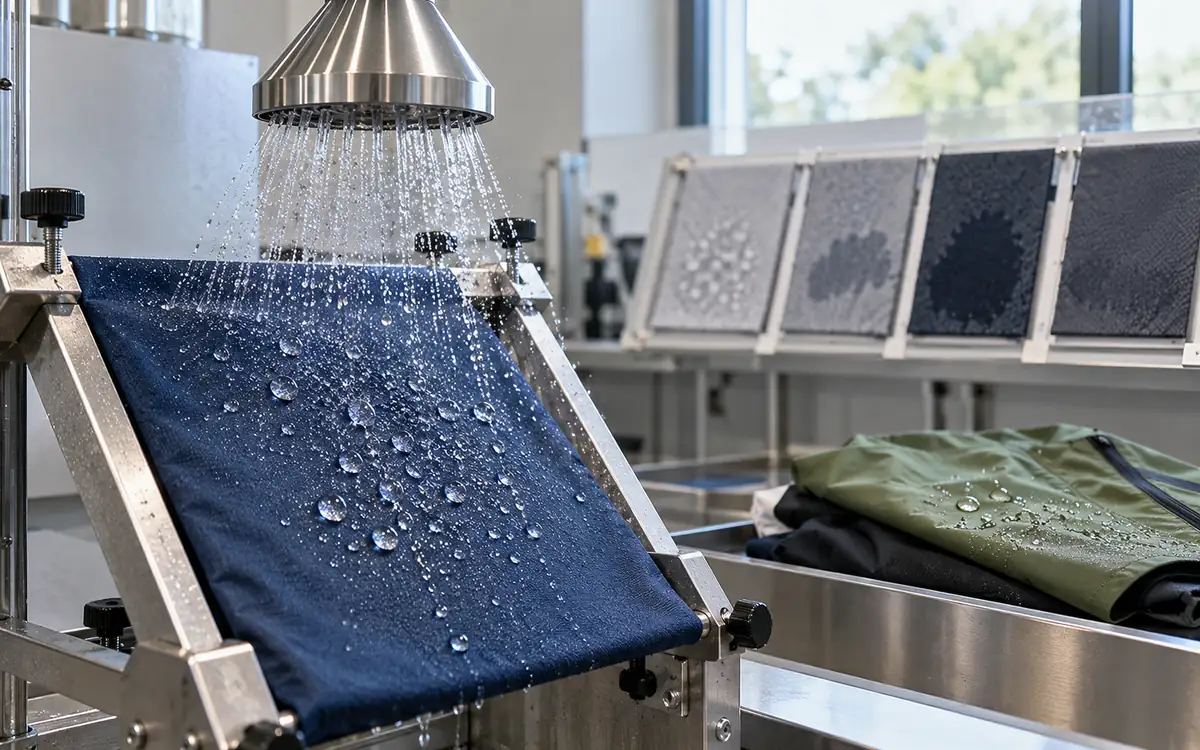
A water repellency test asks how the fabric surface responds to water. The spray rating is a common way to assess that response. It does not, by itself, establish a waterproof claim. ISO 4920 makes this limit clear: its spray method assesses surface wetting, not water passing through the fabric. Do not use this method to predict rain penetration resistance.
First turn the broad claim into a testable requirement. “Sheds light rain after ten washes” needs a defined care process and a surface rating. It may also need a separate rain penetration limit. “Keeps water out” needs evidence about passage through the material. Neither phrase is complete when the method and condition are missing.
This guide explains how to select these tests, read their results, and use them in fabric approval. All numerical examples are hypothetical. They show how to interpret data, not acceptance limits for every type of clothing.
Separate three questions before choosing a method
Water on a fabric can remain as beads, spread over the face, enter the material, or pass right through it. A test may observe only one of these events. Ask three questions when reviewing a proposed report.
First, how much of the exposed face becomes wet? This is the question behind a visual spray rating. Second, how much water remains within the specimen after the specified treatment? This is an absorption or water uptake question. Third, how much water reaches the back or a collection system? This concerns penetration.
Units help show what was measured. A visual rating is a grade. Water uptake may be a percentage of starting sample mass. Penetration may be the mass gained by a backing paper. It may also be the volume collected below the cloth. Merging these into one number loses their meaning.
Reader question | Suitable test route | Main result to examine |
|---|---|---|
Does the face resist wetting during a controlled spray? | AATCC TM22 or ISO 4920 | Visual surface rating |
Does water pass through under a defined rain exposure? | AATCC TM35 | Water collected by the backing blotter |
How does a fabric resist impact penetration? | AATCC TM42 | Penetration under that method's conditions |
How does a fabric respond to a Bundesmann rain shower? | ISO 9865 | The specified surface, uptake, and penetration results |
How much static water pressure can the material resist? | A separate hydrostatic pressure method | Pressure at the defined endpoint |
The last row belongs in a wider waterproof fabric specification. A strong result there does not replace a surface wetting result, and a high spray rating cannot supply the missing pressure result.
Select the exact spray method and edition
AATCC TM22-2024 covers the resistance of fabric surfaces to wetting by water. It applies to fabrics with or without a water repellent finish. A controlled spray produces a wetting pattern, which is compared with the method's photographic scale.
ISO 4920:2012 addresses the same broad property. That shared purpose does not make every detail equal. Record the method code, edition, sample preparation, and scale. “Spray test, pass” alone does not let a buyer check what happened.
Before testing, resolve any difference between the buyer's manual and the laboratory's current method. A buyer may have fixed an earlier edition in a contract. Changing an edition without agreement may break the link between test and limit. Even a minor change can matter. Name the adopted method on the work instruction.
Use the current controlled method for apparatus sizes and water requirements. Follow its conditioning, test steps, and grading rules too. A short internet procedure is useful for understanding the principle. It is not a substitute for those instructions. Do not mix preparation from one method with the scale from another. That does not prove full compliance with either.
Write a request the laboratory can act on
Start with the actual material code and its intended face. Add the roll or lot, color, finish code, and sample location. Include the required care state and the result format. These details keep a small laboratory specimen connected to the fabric that will be cut.
State whether the sample is an unfinished development fabric, a finished bulk roll, or a piece removed from a garment. A finish trial before the final process may help development. It may not release bulk cloth after later washing, handling, or treatment.
For a material with two different faces, mark the face before cutting the specimen. Do not rely on color or gloss alone. Some fabrics look similar from either side, particularly after finishing. Marking should not contaminate the test area.
Agree on the sampling plan as well. One piece from the roll edge gives information about that piece. It provides little evidence about the center or another roll. Place test locations across the region that will enter the garment. ApparelDiary's guide to usable and nominal fabric width can help teams define that region consistently.
Read spray ratings as grades, not percentages
A spray rating ranks a visible condition. The numbers are not measured percentages of water blocked. Grade 80 does not mean that 80% of water stayed outside the cloth.
This matters when comparing finishes. If a trial moves from 80 to 90, report the grade change. Do not call it a 12.5% increase in water repellency. That sum treats grades as a continuous physical quantity. The visual scale does not define them that way.
Suppose three specimens from Finish A receive grades of 90, 90, and 80. Finish B receives 80, 80, and 80. The individual results reveal that A reached the higher grade twice but also had a lower result. If the hypothetical requirement is at least 90 for every specimen, neither finish passes. If the agreed rule is at least 80 for every specimen, both pass.
A mean of 86.7 looks precise. It hides the visible categories and the failed piece. Follow the selected method and the buyer's rules for summarizing grades. Retain the individual results even when a summary is required. Do not invent an intermediate category that the grading system does not permit.
Make visual assessment consistent
The test and visual judgment have separate sources of variation. A lab may control the spray well but still get weak data. Grading conditions may change, or the reference may be poor.
Use the required reference scale in suitable condition. Use the light, viewing position, and grading time set by the method. Keep comparison images large enough to inspect. A photograph on a dim phone screen is a poor replacement for a controlled grading reference.
Train staff with samples that include difficult patterns. Large drops on a dark ground may be easier to see than small wet patches in a busy print. A wet surface may also change gloss. Record any feature that makes the rating uncertain.
When two assessors disagree, preserve their first assessments and review the reason. Did they judge the same part of the specimen? Was one looking at loose water while the other judged wetting? Did either wait longer? Agreement after discussion helps training. It must not erase the fact that the first rating was difficult.
Use photographs as supporting records, with the sample identity and the time clearly linked. They help explain unusual patterns. They do not by themselves validate a rating obtained with the wrong test conditions.
Control the water delivery before blaming the finish
A distorted spray pattern can make one part of the specimen receive more water than another. Inspect the apparatus and use the checks required by its method and maintenance plan. A partly blocked nozzle, leak, or changed sample position may create a misleading failure pattern.
For a made-up diagnostic example, a machine check delivers 250 mL in 25 seconds. Its average flow is 10 mL/s. If a later check delivers the same volume in 40 seconds, average flow has fallen to 6.25 mL/s. That is a 37.5% reduction.
These figures are hypothetical, not a permitted spray test setting. They show why recording only total volume can miss a delivery change. The relevant tolerances and actions must come from the chosen method and equipment instructions.
Keep the water source and its condition under control too. Do not add an agent to make the spray pattern look smoother. Do not reuse water just because it looks clear. The procedure and system must allow reuse. Dirty water may change contact with the cloth.
When a control result changes at the same time as several unrelated fabrics, check the test system first. When only one lot changes, inspect its history and location. This order of investigation often prevents a needless finish adjustment.
Know when a rain test adds useful evidence
A spray test gives a limited exposure and a surface assessment. A rain test adds evidence about water passing through under its particular conditions.
AATCC TM35-2018e2 is a rain test that can use different impact intensities. Its method summary describes a weighed blotter behind the cloth. A controlled spray runs for five minutes. The blotter is weighed again to find how much water reached it. The method can test a single fabric or a fabric assembly.
AATCC TM42-2017e also addresses water penetration caused by impact. Its scope includes garment fabrics. It notes that structure and the water response of fibers and yarns matter. It is still a separate procedure. Do not put a TM42 result in a TM35 table just because both concern impact and leakage.
Select the test that matches the product requirement and retain its conditions. For rain testing, “less water passed through” is meaningful only when the exposure is the same. Milder impact, a shorter test, or another assembly may reduce the number. That does not prove a better material.
Calculate blotter gain without changing the claim
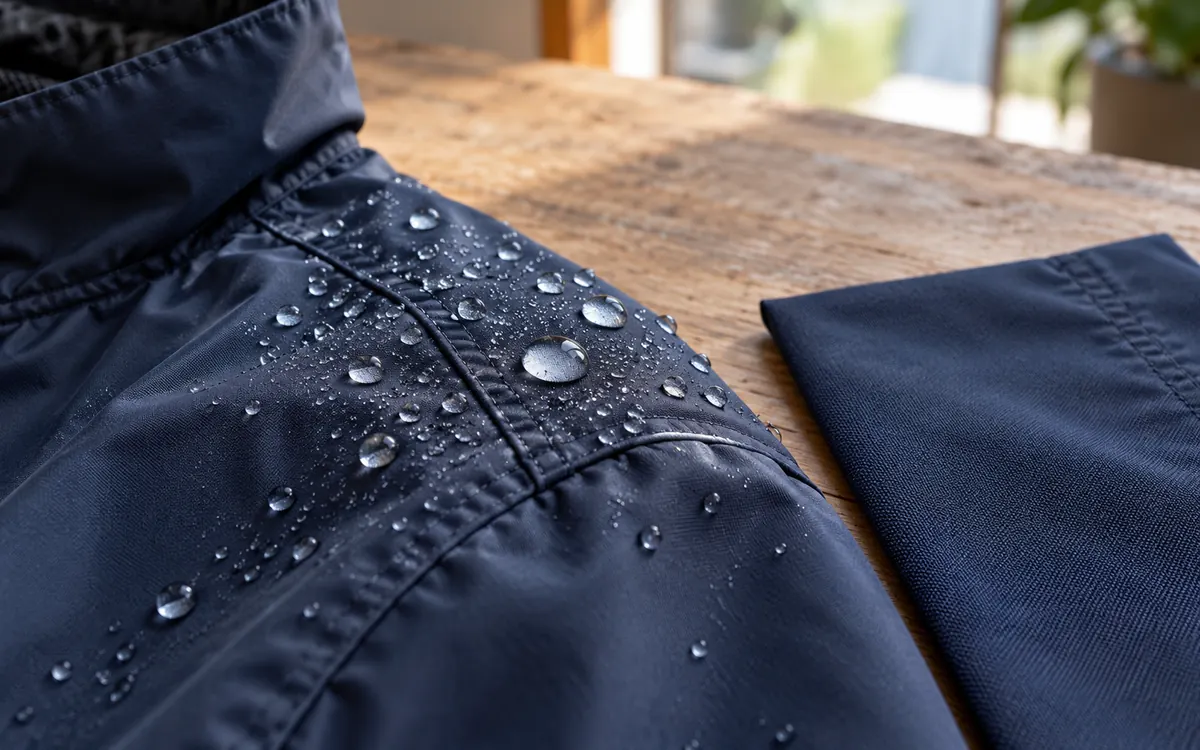
In a hypothetical rain test, the conditioned backing blotter has a starting mass of 5.214 g. After exposure, its mass is 5.486 g.
Water gained by the blotter = final mass − starting mass
Water gain = 5.486 − 5.214 = 0.272 g = 272 mg
A second fabric tested under the same conditions has a blotter gain of 0.081 g, or 81 mg. Its measured gain is 191 mg lower. Relative to the first result, that reduction is about 70.2%:
Reduction = (0.272 − 0.081) ÷ 0.272 × 100
This supports a narrow statement about measured water gain in this test. It does not show that the second fabric is “70% more waterproof.” Nor does it predict how many hours a wearer can remain dry.
If the made-up limit is no more than 0.100 g, the first piece fails. The second passes. Keep the original masses, the balance resolution, and the calculated difference in the record. A sheet that stores only “pass” cannot reveal a subtraction or unit error later.
Treat small mass gains with care
Small gains can be important, but they are also easy to disturb. Delay between exposure and weighing can allow water to evaporate. Handling can add moisture. A damp surface near the balance can wet the backing paper before the measurement.
Use a handling sequence that follows the method and makes timing consistent. Prepare a clear route from the test position to the balance. Keep each blotter linked to its sample code. Do not stack wet papers where water can move between them.
A blank or handling check can help investigate a suspect result. Suppose an unused blotter handled alongside the test gains 0.030 g while the specimen blotter gains 0.020 g. The check calls the measurement into question. It does not authorize subtracting 0.030 g and reporting a negative leak result.
Find the source of the change, correct it, and repeat as the procedure allows. Apply a blank correction only if the method or an agreed validated procedure allows it. An improvised correction may hide the fault the check revealed.
Use the Bundesmann method for a broader rain response
ISO 9865:1991 specifies the Bundesmann rain shower test. ISO confirmed this edition in 2022. Its age alone is therefore not a reason to replace it with an unrelated method.
A Bundesmann system can provide several distinct observations. The James Heal performance testing guide describes three results. These are a surface grade, water uptake from sample mass, and water collected in cups below. Its process uses a centrifuge to remove excess surface water before final weighing.
The value of this approach is the separate record for each response. A fabric may resist visible wetting yet leak through a local weak spot. Another may hold much water but let little through. One unlabeled score would hide that difference.
Follow the full method for the rain exposure, handling, timing, and calculation. A general description of the instrument does not supply every test setting. When comparing laboratories, check that the same outputs were measured on the same basis.
Calculate uptake using the stated starting mass
Assume a specimen's conditioned starting mass is 4.80 g. After the specified rain exposure and removal of excess surface water, its mass is 5.52 g.
Water retained = 5.52 − 4.80 = 0.72 g
Water uptake = 0.72 ÷ 4.80 × 100 = 15%
Now consider a heavier specimen with a starting mass of 6.00 g and the same gain of 0.72 g. Its calculated uptake is 12%. Both retained the same absolute mass, but the percentage differs because the starting masses differ.
Report the required percentage together with enough raw data to understand it. If the method uses conditioned mass, do not replace it with oven dry mass. The denominator helps define the result.
Also distinguish retained water from penetrated water. Retained water stays with the cloth after the required handling. Penetrated water reaches the collection system. Do not add both and call the total water absorption. That needs a test definition that accounts for every part of the water balance.
Test durability in a defined care state
An initial spray grade describes a new specimen. A claim that extends through care needs tests after the stated care sequence. Record the wash method, detergent, cycles, and drying. Include any allowed treatment after care.
ISO 6330:2021 provides domestic washing and drying procedures for textile testing. A complete care sequence includes the selected drying procedure, not washing alone. This matters if a brief says “ten washes” but leaves out what follows each wash.
Do not heat a sample before retesting merely to restore a favorable grade. If the product care instructions and approved test plan include a heat treatment, identify it. If they do not, an extra treatment creates a different test state.
In trials, keep the as-cared result separate from the result after allowed maintenance. Both may help, but they answer different questions. A consumer claim should name the state supported by the evidence.
ApparelDiary's fabric shrinkage testing guide explains why care procedures must also be fixed when assessing dimensional change. Keep a traceable care history here too, even though this test measures a different property.
Combine results in a fabric approval decision
Consider two hypothetical shell fabrics. Both meet the agreed new-fabric spray requirement. After the stated care, A keeps the required surface grade. B falls below it. In a separate rain test, A exceeds the allowed blotter gain. B stays below it.
There is no single winner under a specification that requires both properties. A has a penetration problem under the rain test. B has a surface wetting problem after care. Choosing either needs a material change or a justified change to the product requirement.
Finding | First useful question | Evidence to obtain |
|---|---|---|
Low surface grade, low penetration | Is surface wetting the only failed requirement? | Confirmed grades after the defined care state |
High surface grade, high penetration | Where does water pass through? | Repeat rain data and inspection of local defects |
Good initial grade, poor result after care | Which care step changes the response? | Controlled results before and after that step |
Wide variation within a roll | Is the variation linked to location? | Mapped samples across and along the usable width |
Surface treatment can affect the first result without solving every other issue. For the distinct question of surface treatment stability, see ApparelDiary's guide to plasma treatment, surface ageing, and durability. Use test results to guide the next checks. They do not identify the cause alone.
Questions that often delay approval
Can fiber content predict the spray grade?
Fiber content alone is not a test result. Construction, finish, condition, and the selected procedure also matter. Do not assign a grade to every cotton or polyester fabric based on a single example.
Can a water repellent finish prove a garment is waterproof?
A finish description states what was applied or intended. It does not supply measured performance. A material test also leaves garment openings, joins, and design outside its scope.
Should the two fabric faces receive the same rating?
That depends on the material and requirement. Test the intended exposed face for the stated application. If both faces matter, name and test each one. Do not average their results.
Can a spray rating be converted into a rain result?
There is no general conversion. The methods expose and assess the material differently. A link seen in one controlled trial is not a universal equation.
What should happen when two laboratories disagree?
First compare the method edition, care state, exposed face, sample origin, and raw results. Then review apparatus checks and grading conditions. New samples may repeat the dispute if those differences remain.
Turn the report into a clear material decision
A useful water repellency report names the property, the test method, and the specimen state. It preserves visual grades as grades and mass measurements as mass measurements. Show each failure clearly. Do not bury it in a broad performance score.
Use spray testing to judge surface wetting. Add a suitable rain or impact test when passage through the material matters. Use the Bundesmann outputs separately when the specification calls for that method. Then connect each result to the care state and the exact requirement it must meet.
Keep the final approval attached to a dated material specification. If the finish supplier, cloth structure, or care label changes, decide which tests need repeating. An old report still describes its original sample and conditions. It may not cover the revised product.
This gives finishers and buyers a clear next step. They can improve the surface, study leaks, control variation, or revise a claim. A water repellent label is useful when evidence says exactly what the cloth can do.
References
AATCC TM22-2024: Water Repellency, Spray Test.
ISO 4920:2012: Resistance to surface wetting, spray test.
AATCC TM35-2018e2: Water Resistance, Rain Test.
AATCC TM42-2017e: Water Resistance, Impact Penetration.
ISO 9865:1991: Bundesmann rain shower test.
James Heal: Performance Testing Product Guide, 2023.
ISO 6330:2021: Domestic washing and drying procedures for textile testing.

Discussion0
Loading the discussion…