

Cost of Capital for a Private Apparel Factory: Build a Defensible Range
Estimate an apparel factory's cost of capital with transparent equity, debt and tax assumptions. Test market-value weights, peer betas and decision ranges.
Garment Factory Calculators and Guides
Industrial Engineer & Business Process Optimization Executive
Salauddin Ahamed Sagar is an industrial and production engineer in Dhaka, Bangladesh, specializing in ready-made garment manufacturing, ERP systems, and industrial engineering. He leads ERP and process optimization projects at Apex Holdings Ltd. and previously worked in line balancing and industrial engineering at Epyllion Group and Young Group. He holds a BSc in Industrial and Production Engineering from NITER (University of Dhaka) and founded Apparel Diary to share practical engineering methods, calculators, and factory operations guides.
Estimate an apparel factory's cost of capital with transparent equity, debt and tax assumptions. Test market-value weights, peer betas and decision ranges.

A planner will be able to pick the right smoothing model for a given SKU, tune alpha, beta and gamma against a holdout period instead of by feel, and know which forecast error metric to track so bias gets caught before it fills a warehouse.

Compare invoice finance for apparel exporters with worked advances, fees, reserves, part payments and recourse cases. Trace cash now and at final settlement.

Control warp sizing with checked add-on, solids and moisture calculations. Compare coating, yarn stretch, loom stops and removal before approving a recipe.

Write woven patch specifications for clear artwork, accurate dimensions, suitable edges, secure attachment, garment comfort, and proven care performance.

A practitioner guide to standard minute value: rating, allowances, a fully worked time study, and what an SMV error actually costs a costing sheet.

Prepare a factory loan application with a reconciled funding request, sales and bank receipts, a full debt schedule, and clear repayment and downside checks.
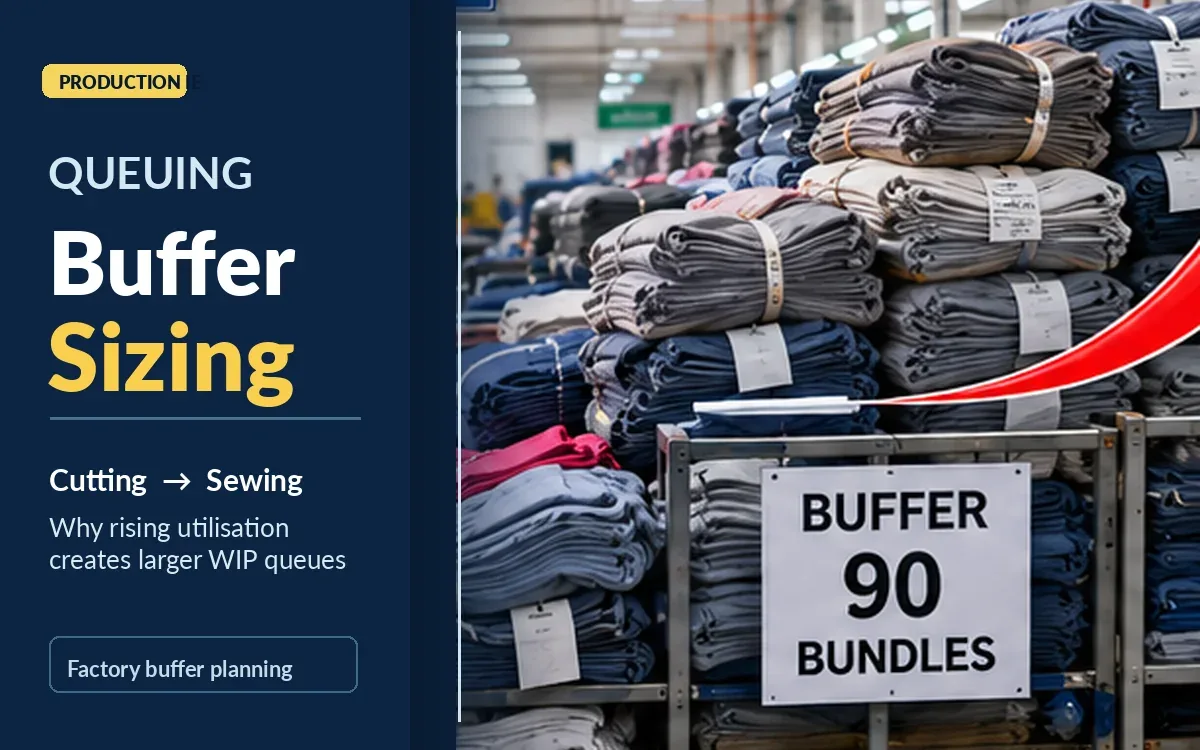
Sizing WIP buffers between production stages from measured arrival and wait-time data using Little's Law, and defend a lower utilisation target instead of guessing rack sizes.

Compare apparel factories using checked financial ratios. Work through margins, capital returns, debt and interest cover, with leases and timing kept clear.