

A jacket may still have years of use left when its owner changes size, moves to a warmer place or stops using it. Patagonia Worn Wear gives that garment a possible next owner. The work starts well before a second sale: someone has to check the jacket, clean it and decide whether it belongs in the used range.
A broken zip raises a different question. If the owner still wants the jacket, a repair may be more useful than a trade-in. This is where the programme becomes interesting as a business model. It offers several routes for an existing product, and each route needs its own rules, skills and costs.
This guide explains how those parts work together. The customer-process information refers mainly to Patagonia's US programme as reviewed in October 2026. Rules, prices and service times can change, and other markets may differ. All operating calculations are hypothetical examples.
What changed in October 2026
On October 14, 2026, Patagonia announced that customers could buy new and Worn Wear products through one cart on patagonia.com. The company described this as the final step in bringing Worn Wear in-house, after warehousing, shipping and customer service had already moved from an outside provider. Patagonia's resale announcement
For a shopper, the change removes a small but real task: leaving the new-product shop to look elsewhere for used gear. The two options can now be considered in one visit. That makes the choice easier to find, though the shopper still needs to compare the actual garments.
It does not make the two inventories identical. New stock may contain many units of the same style and size. Used stock is limited by what comes back and passes the programme's checks. The exact item available today may be gone tomorrow.
For a brand analyst, the important development is the connection between service and retail. Used gear becomes part of the main offer, while the business must still handle the differences behind the scenes.
Repair, trade-in and resale serve different needs
A customer should begin with the purpose, not with the service name.
Owner's situation | Route to consider | Main question |
The item is useful but has a repairable problem | Repair | Can it be restored for continued use? |
The item is functional but no longer wanted | Trade-in | Does it meet the current programme rules? |
The customer needs an item and is open to used gear | Resale | Does this specific item suit the intended use? |
The item has reached the end of its usable life | Available end-of-use route | What treatment is actually offered? |
This table is a decision aid. It does not guarantee that a particular item will be accepted.
Patagonia's Worn Wear page describes professional laundering, inspection, authentication, condition grading and repair where needed. It also states that used products receive the same Ironclad Guarantee as new ones. These are the company's descriptions of its service. Patagonia Worn Wear
The distinction between the routes is important. A coat that still fits and serves its owner may be best kept in use. A trade-in is useful when ownership should change. A repair can preserve use without creating a sale.
How a US trade-in works
Patagonia's trade-in page asks for clean, functional gear in good condition. Customers can use its eligibility process before sending items or taking them to an eligible store. The page explains that the final credit depends on inspection and that some product types and conditions are excluded. Patagonia trade-in terms
Read the current rules before packing. A brand label alone does not establish eligibility.
Check the exact item
Identify the garment, its size and its condition. Look at the labels and essential parts. A missing hood or damaged closure may change the assessment.
Avoid relying on an old social post or another customer's experience. Acceptance rules can change, and two garments that look similar may be in different condition.
Clean and inspect it
Follow the garment's own care instructions. Empty pockets and check the inside as well as the outside. Describe any visible problem honestly.
A short home inspection can prevent an avoidable rejection. It is not a substitute for the programme's assessment.
Review the credit and any fee
An estimate is useful for deciding whether to proceed. It is not a final valuation. The US page reviewed for this guide lists a $7 deduction for mailed trade-ins and says exact credit is set after inspection. Confirm the current amount before submitting. Current US trade-in information
A merchandise credit is also different from cash. Its practical value depends on whether the owner wants to use it under the programme's terms.
Choose what should happen if the item is rejected
Read the options at submission. Keep a copy of the choices made and any tracking details.
The useful question is not only “How much credit might I get?” It is also “What happens if this item is not accepted?” A clear answer reduces uncertainty for both the customer and the service team.
The repair route has its own assessment
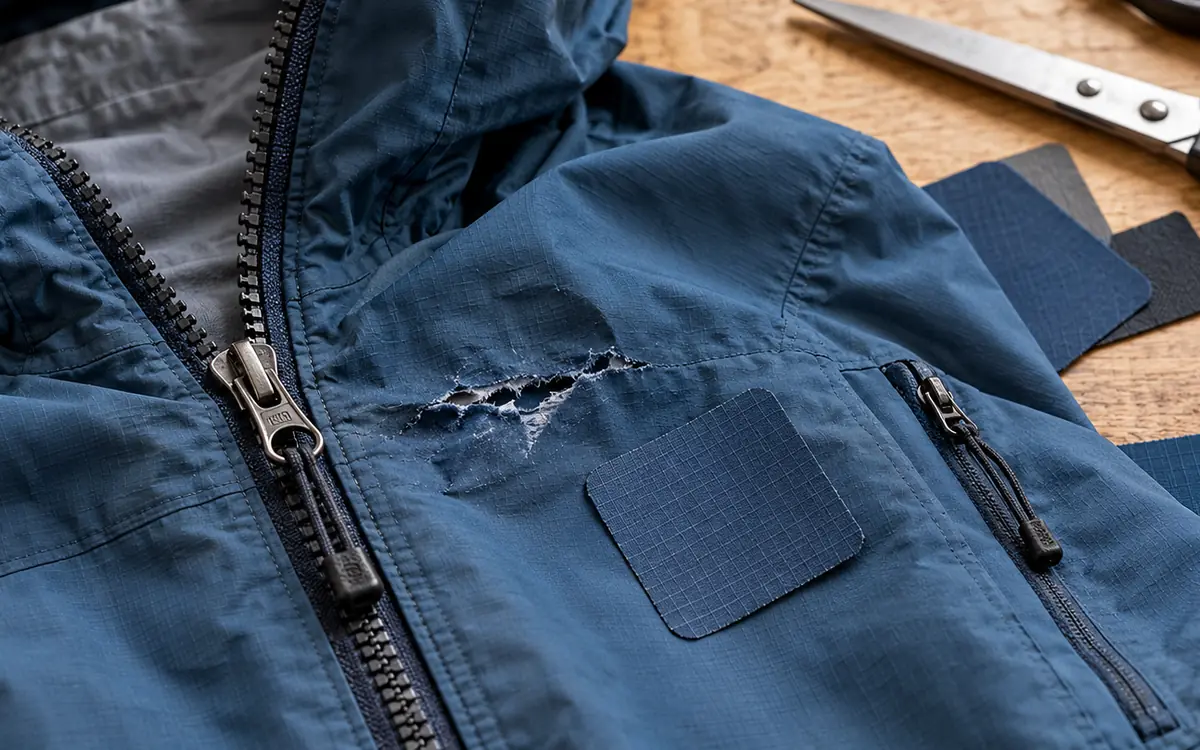
Patagonia's US repair page says that many issues can be repaired, but some cannot. It also explains that a repair may use a similar material or colour when an exact match is unavailable. The aim is to restore the item's integrity, which may leave a visible repair. Patagonia product repair information
This sets a sensible expectation. Restoring function does not always mean making the garment look new.
Before requesting repair, identify the problem as clearly as possible. A photo and a precise location can be more useful than “the jacket is broken.” Explain whether the issue concerns a zip, seam, tear, missing part or another feature.
Do not begin a repair that needs skills or materials you do not have. For simple work, Patagonia provides care and repair guides, including guidance on buttons, buckles and zipper sliders. Choose a guide that matches the actual item and task. Patagonia care and repair guides
For the product-development perspective on care information, see ApparelDiary's garment care label validation guide. The label helps the owner maintain the item; a repair assessment addresses a particular problem.
What the Ironclad Guarantee does and does not say
Patagonia's published guarantee describes repair, replacement or refund routes when a product does not meet the customer's satisfaction or perform as expected. It also says damage from wear and tear may be repaired at a reasonable charge. Read the terms and the current service page together for the actual case. Patagonia's Ironclad Guarantee explanation
A guarantee supports confidence, but it should not be turned into a promise that every old item can be restored forever. Material condition, damage and available parts still matter.
For a used buyer, the useful questions are practical. What does the listing say about condition? What happens if the item does not meet expectations? Which service route applies after purchase?
Keep the answers with the purchase record. A clear description and a clear after-sale route are part of the value of branded resale.
Why the business model is different from ordinary stock buying
A conventional clothing order can specify a quantity of one style, colour and size. A resale operation begins with a much less predictable stream.
It may receive ten jackets with different levels of wear, two bags missing parts and a nearly unused fleece. The items need individual decisions before they can become saleable stock.
The following process map is an analytical model for branded resale. It is not a claim about every internal Patagonia step.
Receive and identify the item.
Decide whether it falls within scope.
Assess condition and function.
Choose preparation or repair work.
Create an accurate sale listing.
Store and pick the correct individual item.
Deliver it and support the buyer.
Record returns, problems and the next route.
Each step adds cost and creates a chance for error. A strong resale model needs enough value in the item to support this work.
Intake is a decision point
An item can be physically present but not yet ready to sell. Treating all arrivals as inventory available for sale overstates what the business can offer.
Separate received, accepted, in preparation and listed quantities. This makes delays visible and prevents the team from promising stock that still needs work.
Condition is part of the product information
For used goods, condition is not a small footnote. It is part of what the buyer is choosing.
A useful description names the issue and its location. “Some wear” is less helpful than a clear account of surface wear on a specific area. The description should also distinguish appearance from function.
Item identity must survive the process
The coat photographed for a listing must be the coat picked for the order. A shared style number alone may be insufficient when several used units have different condition.
A resale business therefore needs an item-level identity that stays attached through preparation, storage and sale. This is a practical inference from the nature of individual used goods, not a statement about Patagonia's database design.
A worked example of resale economics
Resale can create value, but a selling price alone says little about the result. The business must account for items that arrive, fail checks, need preparation or remain unsold.
Consider a fictional resale operator processing one defined intake cohort. The numbers are not Patagonia data.
Assume:
1,000 items arrive.
700 pass acceptance.
560 of those accepted items sell within the review period.
The average sale price is $75.
The model assigns a $16 acquisition charge to each accepted item.
Intake costs $3 per item received.
Cleaning, preparation and average repair cost $8 per accepted item.
Sale-related handling costs $7 per item sold.
A planning allowance for returns and service is $4 per item sold.
The acquisition charge is a simplified economic assumption. It is not a statement about how Patagonia accounts for gift-card credits.
Step 1: Calculate acceptance and sell-through
Acceptance rate = (Accepted items ÷ Received items) × 100
Acceptance rate = (700 ÷ 1,000) × 100 = 70%
The sell-through rate uses accepted items as its denominator:
Cohort sell-through = (Sold items ÷ Accepted items) × 100
Cohort sell-through = (560 ÷ 700) × 100 = 80%
The business sold 56% of all received items during the period. That figure answers a different question from the 80% sell-through rate.
Step 2: Calculate revenue
Revenue = Sold items × Average sale price
Revenue = 560 × $75 = $42,000
This is the model's gross sales revenue before the stated planning charges.
Step 3: Calculate the stated variable charges
Cost assumption | Calculation | Amount |
Acquisition | 700 accepted items × $16 | $11,200 |
Intake | 1,000 received items × $3 | $3,000 |
Preparation | 700 accepted items × $8 | $5,600 |
Sale handling | 560 sold items × $7 | $3,920 |
Returns and service allowance | 560 sold items × $4 | $2,240 |
Total | Sum of the five charges | $25,960 |
The model charges intake to every arrival. Rejected items still required work. It also charges preparation to all accepted items, including those not yet sold.
Step 4: Calculate the planning contribution
Planning contribution = Revenue − Stated variable charges
Planning contribution = $42,000 − $25,960 = $16,040
This is not net profit. It excludes fixed facilities, technology, management, taxes and other costs. It also gives no value to the 140 accepted items still unsold.
The calculation is a conservative cohort planning view, not a financial-accounting treatment of closing inventory.
Step 5: Test a weaker selling outcome
Keep the intake and preparation quantities unchanged, but assume only 420 accepted items sell. That is 60% of the accepted cohort.
Revenue becomes 420 × $75, or $31,500. Acquisition, intake and preparation still total $19,800. Sale handling and the allowance total 420 × $11, or $4,620.
Revised planning contribution = $31,500 − $19,800 − $4,620 = $7,080
The difference from the first case is $8,960. This shows why acceptance quality, saleability and time to sale matter together.
A team should not improve an acceptance rate by admitting items that are unlikely to sell. It should also avoid rejecting useful stock merely to simplify work. The goal is a sound decision for each item.
What the example leaves out
A model can make a tradeoff visible without capturing the whole business.
The example uses one average selling price. Real items may have a wide price range. It also uses one average preparation cost, although some items need little work and others need much more.
It assumes the listed items have a clear selling period. Seasonal demand could change the result. Storage time can matter, especially when an item occupies space while waiting for the right buyer.
Returns also need a defined treatment. A returned item may be saleable again, need more work or leave the resale route. Counting each transaction as a new recovered item would inflate the apparent scale.
These limits should be documented before anyone compares the result with another operator. A simple model with visible assumptions is more useful than a precise-looking figure built from mixed periods.
Repair and resale can support brand trust
Worn Wear gives Patagonia a way to remain involved after the first sale. That can make product longevity part of the customer's experience rather than only a claim at purchase.
This is an interpretation of the service model. It is not a measured claim that every customer becomes more loyal or that resale always increases new-product sales.
The trust mechanism is easy to understand. A buyer wants the used item to match its description. An owner wants a fair, understandable assessment. Both want a clear route when something goes wrong.
Consider a buyer who accepts a visible patch but receives an item with an undisclosed broken fastening. The problem is not simply that the garment is used. The delivered item differs from the promise. A clear condition record should help the service team resolve that specific gap.
A practical service review can ask:
Did the customer understand the next step?
Was the assessment consistent with the stated rules?
Did the listed condition match the delivered item?
Could the customer resolve a problem without repeating the whole story?
Did the service restore use or merely move the item to another queue?
The answers should lead to a concrete fix. A vague rejection message calls for a clearer reason. A wrong item calls for a review of the pick and identification process. Repeating the brand’s purpose does little to help the customer at either point.
What environmental claims require
Keeping a garment in use and selling a used garment are observable activities. Estimating avoided environmental impact requires more assumptions.
A resale sale does not by itself prove that a new garment was not bought. The buyer might have purchased used anyway, bought both items or bought something else. Cleaning, transport, repair and later use also need a defined boundary in any impact model.
For that reason, do not attach a universal carbon-saving percentage to every Worn Wear purchase without the relevant method and product scope.
Patagonia's 2025 progress report presents repair activity while also acknowledging unresolved product end-of-life problems. The report's own framing supports a careful account: useful action and unfinished work can exist at the same time. Patagonia's 2025 progress report
The practical question is what changed because of the service. Did the owner keep using the item? Did the buyer substitute it for a new purchase? How long did the next use last? These questions require evidence beyond a transaction count.
Reuse is different from recycling
Resale keeps the product in use as a product. Repair restores or extends that use. Recycling changes the treatment of the material after the product's use route ends.
The terms should remain clear in brand analysis. An item accepted for resale is not a recycled item merely because it has a second owner.
A collection route also does not establish the final material outcome. If a programme says an item will be recycled or repurposed, examine what that statement covers before claiming fibre-to-fibre recovery.
For the factory side of material records, ApparelDiary's guide to textile cutting-waste segregation and material balance shows why a recorded destination matters. Post-consumer garments present different challenges, but the need for a clear material account remains.
How a customer can make a sound choice
Start with what you already own. If the garment still meets the need, continued use may be the most practical route. If a problem is repairable, investigate repair before assuming replacement is required.
When buying used, read the exact listing. Check size, condition, material and intended use. A familiar model name does not remove the need to examine the individual item.
When trading in, compare the available credit with the effort and your own plans. Credit is useful when it supports a purchase you need. It should not become a reason to buy an unnecessary replacement.
Keep service and purchase records. They can help with later care, repair or a question about the transaction.
Most importantly, allow enough time. A service route that works well over several weeks may not solve an urgent need for tomorrow's trip.
Three ownership decisions that lead to different routes
Consider three hypothetical owners with similar jackets. Their best next steps differ because their needs differ.
The first owner wears the jacket every week. A small area is damaged, but the fit and main function still suit the owner. The useful question is whether a suitable repair can restore continued use. A trade-in offer is secondary because the owner still needs the garment. The repair team must assess the actual damage before any result can be promised.
The second owner has a functional jacket that no longer fits. Keeping it in a cupboard does not solve that mismatch. The owner can check trade-in eligibility, compare other legitimate reuse options and decide which route is practical. A credit has value only within its terms. It should be compared with the owner's real plans, not treated as cash in hand.
The third owner needs a jacket for an imminent trip. A used item may be suitable, but size, condition and delivery timing all matter. A lower price will not help if the garment arrives too late or does not meet the trip's needs. The owner should read the exact listing and current delivery information before choosing.
These cases show why the programme needs several routes. The same product type can call for repair, transfer of ownership or careful purchase. A useful service helps the customer identify the route that fits the situation, then explains its limits clearly.
What other fashion brands can learn
A brand considering buyback should follow an ordinary used item through the whole proposed service. Choose one that needs attention, such as a bag with a worn strap. Who will decide whether the strap is still sound? Who can replace it? What will the listing say afterward?
Before launching, define the products the business can handle well. A narrow, clear scope may be easier to operate than a broad promise with many hidden exceptions.
Put those questions to the people who will do the work. The repair team may need a spare part that the product team no longer stocks. The warehouse may need a way to separate two similar bags with different faults. These are useful findings before launch.
Then record both successes and exits. Count items restored to use, items sold, items returned and items moved elsewhere. Explain the time period and avoid counting the same item as several separate products.
The service should earn its scope one product group at a time. A brand with readily available parts and a clear condition standard may be ready for one category while still lacking a workable route for another. Patagonia's published programme is a case to study, not a ready-made cost model for every business.
Frequently asked questions
Is Worn Wear only a resale shop?
The broader customer proposition includes buying used, trade-in, care and repair. Each route has its own purpose and conditions.
Can any Patagonia item be traded in?
No. The current programme has product and condition limits. Check the live eligibility process before sending an item.
Is the estimated trade-in credit guaranteed?
The reviewed US page says final credit depends on inspection. Treat an estimate as an estimate.
Does repair make an item look new?
It may restore function while leaving a visible material or colour difference. Read the repair expectations for the specific service.
Are used products supported after sale?
Patagonia states that Worn Wear products receive its Ironclad Guarantee. Read the applicable terms and service information for the actual issue.
Does every resale purchase avoid a new purchase?
That cannot be assumed from the transaction alone. An avoided-impact claim needs evidence and a clear method.
Conclusion
Patagonia Worn Wear connects ownership, care, repair and resale through one brand. Its October 2026 move to a shared new-and-used checkout makes that connection more visible to shoppers.
The operating lesson is less simple than the storefront. Individual condition, acceptance decisions, preparation costs and after-sale support determine whether the service works. Read the rules for the specific route, keep impact claims within their evidence and judge the programme by useful outcomes for garments and customers.
Repair and resale connect to construction, so see garment seam types, the Zara business model and UNIQLO LifeWear.
References
Patagonia Works. A new milestone for Patagonia's resale business. October 14, 2026.
Patagonia. Worn Wear. Current US resale and service description; reviewed October 28, 2026.
Patagonia. Trade in your used gear. Current US eligibility and credit information.
Patagonia. Product Repair. Current US process and repair expectations.
Patagonia. Product Care & Repair. Care and repair resources.
Patagonia. What is the Ironclad Guarantee?. Published guarantee explanation.
Patagonia. 2025 Work in Progress Report. Company reporting on activity and unresolved impacts.



Discussion0
Loading the discussion…