
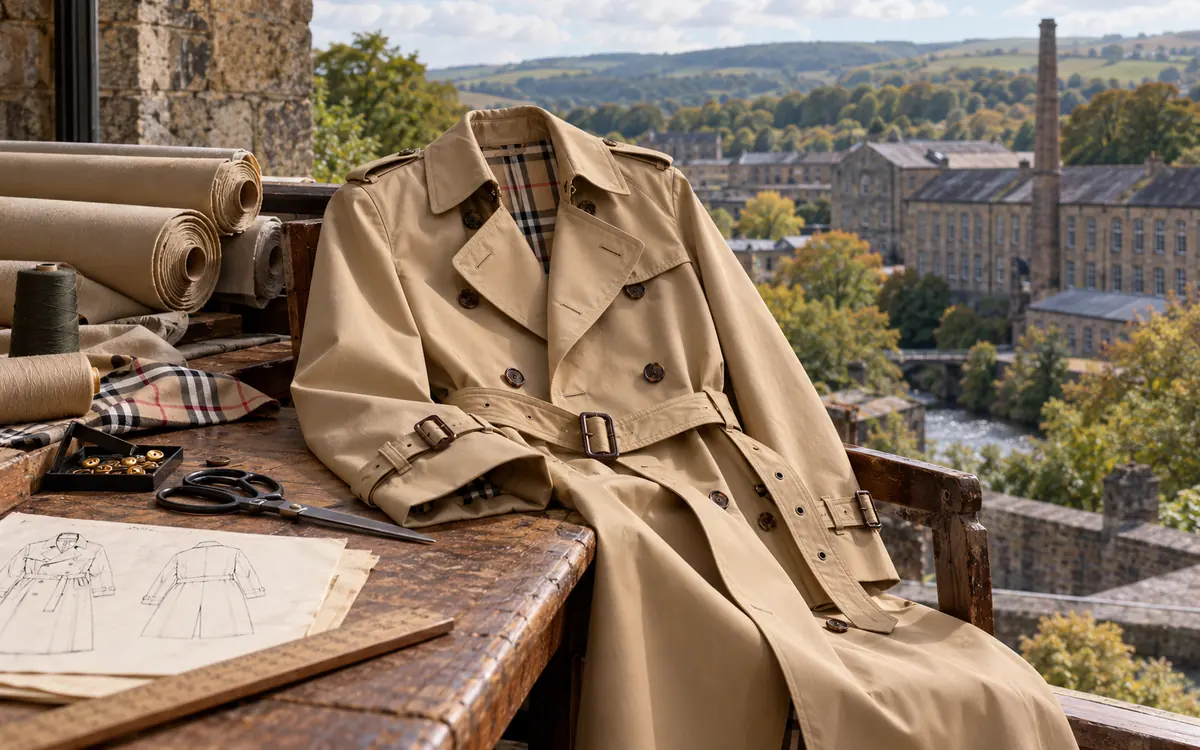
The Burberry trench coat is easy to recognise and surprisingly easy to oversimplify. A belt, a double-breasted front and a checked lining tell only part of the story. The fabric, cut and collar each play a part. Care and repair matter too. Together, they help explain the coat's place at the heart of the brand.
There is also more than one Burberry trench. A Heritage coat may share details with a light seasonal coat or a runway design. Yet their fabric, shape and purpose can differ. A useful guide should help you read the particular coat in front of you.
This article connects the history with those product decisions. The sources include Burberry's current product guides. A Victoria and Albert Museum exhibition guide adds historical context. They were reviewed in October 2026. It does not test whether a coat is genuine. The way a coat is made can also vary within the brand.
The story begins with a material problem
Thomas Burberry founded his business in Basingstoke in 1856. Burberry dates gabardine to 1879. Its timeline also names the Tielocken as an early coat that led to the trench. Early designs served people who spent time outdoors. They aimed to protect them from the weather. Burberry's historical timeline
The V&A's account adds useful material detail. It describes gabardine as a tight twill made from prepared yarn. Burberry used different fibres over time. It also traces the coat through military use and later fashion. Modern gabardines can differ from this early cloth. V&A: The Burberry Trench, Crafting an Icon
The important connection is between a practical problem and a lasting product identity. A fabric developed for weather protection became part of the way the brand is recognised.
An apparel student can begin with that purpose. The visible details make more sense when linked to use. The coat's look grew from use. It changed as the garment moved into civilian wardrobes and fashion.
Gabardine is central, but the word is not a full specification
A fabric name does not tell you everything about a finished coat. Fibre content, fabric weight, finish, lining and construction still matter.
Burberry's current craft page describes its trench gabardine as shower-resistant. It presents tropical gabardine as a lighter form. The stated uses include warmer seasons and layering. These are product descriptions with a defined scope. They should not be expanded into a promise that every coat will resist every type of rain. Burberry's trench craft guide
When comparing two coats, check the exact product information:
What is the shell made from?
Is the fabric described as standard or tropical gabardine?
What lining is used?
Which fit and length are named?
What care instructions apply?
What weather claim is actually stated?
The answer may differ between versions of the same named style.
Water resistance needs careful wording
A shower-resistant description does not provide a numerical waterproof rating. It also does not describe every possible route by which rain might enter a garment.
The practical reader should preserve the brand's wording. If a product page gives a specific test result, check the method and the garment or fabric it covers. If it does not, avoid inventing a rating.
ApparelDiary's guide to hydrostatic pressure testing of apparel fabrics explains one form of water-resistance evidence. A classic trench's heritage is not a substitute for a defined test result.
This does not make the heritage unimportant. It means history and present product performance answer different questions.
Where the Heritage coats are made
Burberry weaves gabardine at its mill in Keighley, Yorkshire. Its business-model page names Castleford as the site that makes Heritage Trench Coats. The wider business uses other production sites and outside suppliers too. The Yorkshire account applies to these Heritage products. It does not cover every Burberry category. Burberry's business model
The distinction between weaving and garment making is useful. One stage creates the cloth. The next turns it into a shaped, lined and finished coat.
A finished trench depends on both. A well-made fabric can be undermined by poor cutting or sewing. Careful sewing cannot correct every problem in an unsuitable fabric.
The two sites link the product to a place. Naming the sites and their work gives “British heritage” a clear meaning.
Read the coat from collar to hem
You do not need to dismantle a coat to understand its construction. A careful inspection can reveal how the parts work together.
The following sequence is an educational observation method. It is not a Burberry quality-control protocol and cannot establish authenticity.
Collar and neckline
Start with the coat on a hanger, then try it on. Look at how the collar sits when open and when fastened. Notice whether it follows the neck smoothly or pulls in one place.
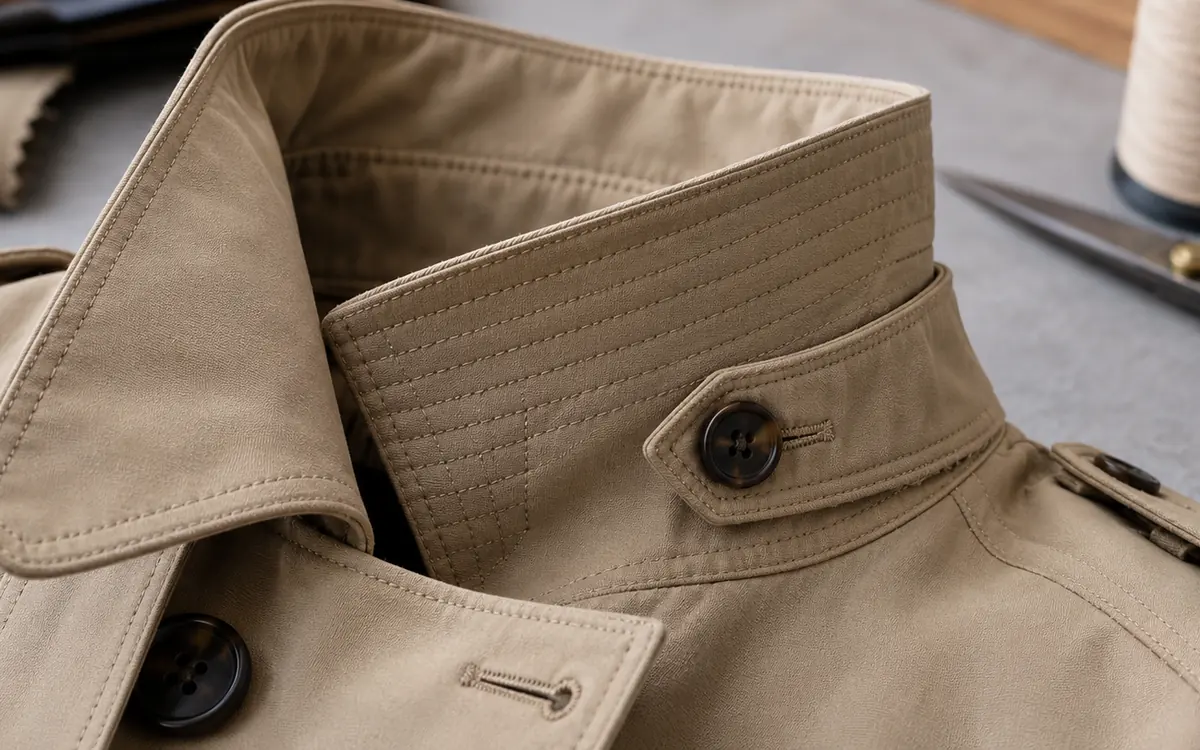
Burberry describes the collar as a skilled part of making a Heritage trench. Its craftspeople train for this stitching work. Its published accounts give different stitch figures in different contexts. Those figures should not be turned into a universal count that a customer must find on every coat. Burberry's Heritage trench account Burberry's 2024 Made in the UK series
The useful observation is how the collar behaves as a shaped component. Counting visible stitches without knowing the version or operation can create false confidence.
Front closure and overlap
Close the coat as intended. Check whether the front lies comfortably over the layers you plan to wear. A double-breasted overlap is part of the design, so it should be assessed in its closed position.
Look at the balance of the front and the way the belt changes it. A coat can appear neat when open yet feel restrictive when fastened. The fitting should include both states.
Shoulder and sleeve
Raise the arms, reach forward and sit down. Notice where movement is restricted, if anywhere.
Different sleeve and shoulder shapes create different appearances and movement. Do not assume that the same size label will feel identical across named styles.
A strong preference for a close silhouette may conflict with a plan to wear a bulky jacket beneath the coat. Resolve that use before choosing the size.
Belt, cuffs and small parts
Use the belt and cuff adjustments rather than judging them only by appearance. Check the range of each strap. Do the parts sit comfortably on the wearer?
Small parts help define the coat. The wearer also handles them in daily use. Missing or altered parts deserve attention when assessing a used coat.
Lining and hem
Look inside for the lining's condition and how it sits within the shell. Then check the hem while standing and walking.
The lining is part of comfort and movement, not only a place for a signature pattern. ApparelDiary's article on choosing garment linings explains these functions in greater detail.
A lining can catch on the clothes beneath it. That can affect comfort even when the shell looks good.
What the familiar details mean
Burberry links several features to military use. They include epaulettes, D-rings, the front flap and the storm shield. It also places the introduction of the Check lining in the 1920s. These features later became part of the brand's visual language. Burberry's history and design details
Today, a detail can carry both a practical role and a historical association. Its meaning is not fixed by its original use.
Detail to observe | Present-day reading question |
Epaulettes | How do they affect the shoulder line and the coat's character? |
Front flap | How does it sit when the coat is open and closed? |
Back storm shield | How does it move and layer over the back? |
Belt and D-rings | Does the belt placement suit the wearer and intended styling? |
Checked lining | Which lining is specified for this exact product? |
Cuff straps | Is the adjustment useful with the planned layers? |
The table deliberately asks questions rather than giving an authentication score. A collection of familiar details does not prove origin, age or condition.
A designer can ask which details may change. What still makes the coat easy to recognise? That is one way a house can renew a signature product without losing its identity.
Comparing the named silhouettes
Burberry's current craft guide describes several shapes. The Kensington has classic proportions and structured shoulders. The Chelsea sits closer to the body. The Waterloo is long with softer shoulder shaping. The Camden is a pared-back car coat. The Fitzrovia adds an A-line shape and volume, while the Mayfair uses a cropped, relaxed form. Burberry's current silhouette descriptions
Use those descriptions as a starting point. Check the exact product page because lengths, materials and available versions can change.
Shape | Main feature in the current description | Useful fitting question |
Kensington | Classic proportions and a structured shoulder | Does the shoulder and body suit the intended layers? |
Chelsea | A closer silhouette | Is there enough movement when fastened? |
Waterloo | Long length and softer shoulder shaping | Does the length work while walking and sitting? |
Camden | A streamlined car-coat form | Does the simpler front fit the intended wardrobe? |
Fitzrovia | More volume and an A-line cut | Is the added volume the desired shape? |
Mayfair | A cropped, relaxed jacket form | Does the shorter length work with the planned outfits? |
This is not a ranking from best to worst. Each shape makes a different design choice.
A close-fitting coat may be right for one use and inconvenient for another. A longer coat may provide the desired line but feel awkward for a person who spends much of the day seated. The decision should follow the wearer.
Heritage and seasonal products need separate reading
Heritage is a useful product label, but it should not make the reader stop checking. Seasonal designs may use different blends, proportions or details.
Burberry's January 2026 Gabardine Capsule gives a clear example of variation. The release describes cotton-nylon gabardine in several types of outerwear. It also includes knitwear and jersey pieces, some with gabardine details. The collection name therefore does not mean every piece is a classic cotton Heritage trench. Burberry's 2026 Gabardine Capsule
When studying a collection, separate three things:
The house code, such as a fabric story or familiar detail.
The actual product type, such as trench, bomber or jersey top.
The specification of the individual item.
Keep each claim tied to the product it covers. A fabric statement may not apply to every garment in a campaign.
It also makes the creative work easier to understand. A designer can place a trench detail on another garment. The new garment does not become a trench coat.
A practical fitting session
A useful fitting session begins before the coat is put on. Decide what you need it to do.
Will it be worn over a suit, a light shirt or thick knitwear? Is the main use walking, commuting, occasional events or travel? Which lengths do you already find comfortable?
Bring or wear a representative layer. Trying on a coat over a thin top and later expecting it to fit over a jacket can lead to a poor decision.
Check the closed fit first
Fasten the coat and use the belt. Stand naturally. Avoid holding a pose that makes the garment look better but does not reflect normal use.
Notice pressure at the chest, upper arm and back. Check whether the front overlap stays comfortable while sitting. A shop mirror gives only one view; movement supplies different information.
Compare adjacent options deliberately
If two sizes seem plausible, compare them with the same layer and the same actions. Otherwise, a change in the fitting conditions may be mistaken for a size difference.
Take notes on the actual issue. “The larger size feels better” is less useful than “the smaller size restricts forward reach over the blazer.”
Do not rely on a universal instruction to size up or down. The style, wearer, layer and preferred shape all affect the choice.
Judge length in motion
Walk, turn and sit. Consider footwear and how the coat will be carried or stored during the day.
A longer line can be part of the desired look. It can also affect how the hem behaves on stairs or while seated. The fitting should include those ordinary tasks.
This is not a test of whether the wearer has the “right” body for a coat. It is a test of whether the chosen product suits the wearer.
Worked example: why a flat measurement needs context
A small calculation can help explain fit terminology. It cannot select a Burberry size.
Consider a hypothetical coat measured closed and laid flat under a defined method. Its chest width is 62 cm. Assume the measured width represents half of the relevant garment circumference without distortion.
Approximate garment chest circumference = 2 × Flat chest width
Approximate garment chest circumference = 2 × 62 cm = 124 cm
Suppose the wearer's chest measure is 108 cm.
Nominal chest ease = Garment circumference − Body circumference
Nominal chest ease = 124 cm − 108 cm = 16 cm
That 16 cm is a difference between two measurements. It is not a recommendation for every coat or wearer.
Why the number does not finish the decision
The measurement method matters. A poorly positioned double-breasted front can change a flat reading. Stretch, shaping and the point of measurement can also affect interpretation.
The body measurement alone does not describe the clothing underneath. One chest measure also says little about the shoulder, sleeve movement or how the coat hangs.
If a comparable measure over the intended layer is 112 cm, the nominal difference becomes:
Difference over the stated layer = 124 cm − 112 cm = 12 cm
The arithmetic is simple, but the fitting remains essential. Treat the numbers as notes that help explain what you observe.
Keep the method with the measurement
Record how the coat was closed, where the width was taken and whether the fabric was relaxed. Use the same method when comparing another item.
These sample figures are not Burberry measurements. Use the actual product data for a named style. A size conversion cannot promise the same fit in an older and a newer coat.
Care is part of ownership
Burberry describes ReBurberry aftercare for its trench coats, including cleaning, repair and reproofing. Availability and the suitable service depend on the item and location. Confirm the current route with the brand before arranging work. Burberry's trench and aftercare description
The first source for routine care is the exact garment's label. A general online guide may refer to a different material or version.
Keep a few practical habits:
Check the label before cleaning.
Describe stains or damage accurately when seeking service.
Ask what a proposed treatment is intended to change.
Keep records of repairs, alterations and other work.
Let the service provider assess whether a requested change is suitable.
Do not assume that reproofing repairs structural damage. Do not assume that a repair will recreate the original appearance exactly. Ask what result is realistic for the actual coat.
Alterations deserve a separate decision
An alteration can affect more than one dimension. Shortening a hem changes its relationship to pockets, belt placement and other details. Changing a sleeve can affect where a cuff feature sits.
Before authorising work, explain the intended result and ask about the consequences. A small adjustment may be sensible; a major reshaping may change what attracted you to the coat.
For a used purchase, check whether alterations have already been made. The size label may no longer describe the garment's present dimensions.
Reading a used coat without pretending to authenticate it
A used trench offers another way to own the coat. Check its condition and origin in their own right.
Begin with the seller's description and photographs. Ask for measurements and clear views of the material and care labels. Check for visible wear, missing parts and any known alterations.
Examine areas that are handled or rubbed during use. These may include cuffs, the collar edge, pockets, belt holes and the hem. This is a general inspection approach, not a claim that all Burberry coats fail in those places.
Separate three judgments:
Does the item appear suitable for the intended use?
Is its condition described clearly enough?
Is there adequate evidence of its identity and origin?
A favourable answer to the first two does not establish the third. A familiar check, button or label does not prove that the coat is genuine.
If you need to confirm that it is genuine, seek a qualified service. Choose a reliable seller and read the terms. This article does not provide a guaranteed label-by-label test.
What the coat teaches about brand identity
The trench connects several parts of Burberry's identity. Its material history, craft sites and familiar details give the brand a base for new designs.
This is an interpretation of the product and company sources cited here. It does not measure the financial value of the trench or claim that every customer buys for the same reason.
For a brand student, examine how the product works across three time frames.
The past supplies a documented material and design history. The present supplies actual products, manufacturing claims and services. New collections show how the house chooses to change the idea.
A strong analysis should move between those time frames without blending them. A historical military detail may explain a design feature. It does not establish the current coat's performance in demanding conditions.
A new seasonal launch may change the design. It does not change the details of an older Heritage coat that someone already owns.
A product-reading worksheet for students and buyers
Choose one exact coat and record its name, product reference and date of review. Then complete the following table from available evidence.
Field | What to record |
Product identity | Exact style and version |
Shell | Stated fibre content and fabric description |
Shape | Fit, shoulder or sleeve description, and length |
Lining | Stated material and visible condition if used |
Details | Closures, belt, cuffs and other relevant parts |
Origin claim | Wording for this product, with its source |
Care | Actual label or official product instruction |
Intended use | Layers, setting and movement needed |
Open questions | Anything the available evidence does not establish |
Keep observation and inference separate. “The page describes a classic fit” is a source-based statement. “This fit may suit my blazer” is a judgment to test during fitting.
The worksheet is also useful when two pages appear to disagree. Check whether they refer to different years, markets or versions before deciding that one is wrong.
Two coats, one decision: apply the evidence
Imagine a buyer comparing two used coats with the same familiar check. This is a hypothetical exercise, not a report about named listings.
Coat A has clear photographs and a product reference. Its seller gives a chest width but does not explain how the front was closed. Coat B has more wear at the cuffs. Its seller supplies the care label, the measuring method and a record of a sleeve alteration.
At first, A may seem easier to assess because it looks cleaner. Yet its width cannot be compared fairly with B until the method is known. The buyer asks for the same closed, relaxed measurement on both coats. This resolves a specific information gap without pretending to authenticate either item.
The alteration on B creates a different question. The buyer needs the present sleeve length and the position of the cuff strap. The original size label cannot answer that.
Next, the buyer checks the intended use: wearing the coat over a blazer while travelling. A short fitting over a thin shirt would leave that question open. The buyer therefore compares the same layer, front closure and reaching movement in each available coat.
Suppose B allows that movement but its cuffs need work. The useful follow-up is a repair assessment and quote, not a promise that all wear can be removed. Suppose A looks sharp but restricts reach when fastened. Its clean appearance does not resolve that fit issue.
The decision now has separate parts: fit, condition, evidence of identity and the likely work required. Keeping them separate makes the trade-off visible. A buyer may reasonably decline both coats when the unresolved questions matter more than the apparent bargain.
Frequently asked questions
What is the link between Burberry and gabardine?
Burberry's documented history centres on Thomas Burberry's development of gabardine in 1879. The material remains central to the trench story. Each current product still has its own fabric details.
Where are Heritage Trench Coats made?
Burberry identifies Castleford for Heritage coat making and Keighley for gabardine weaving. Apply that information to the stated products and check the exact item.
How do Chelsea and Kensington differ?
The current guide describes Chelsea as closer to the body. Kensington has classic proportions and structured shoulders. Try the exact versions with the layers you intend to wear.
Is tropical gabardine the same as standard gabardine?
Burberry presents it as a lighter seasonal expression. Check the actual product's material and care information rather than assuming identical performance.
Can a flat chest measurement choose the right size?
It can support comparison when the method is consistent. It cannot replace checks of movement, shoulder shape, sleeve fit and layering.
Can this guide authenticate a used coat?
No. It explains product reading and condition questions. Authentication requires evidence and expertise beyond a list of familiar design features.
Conclusion
Burberry's trench coat connects a material invention with craft, shape and a lasting brand identity. Understanding it means moving beyond the visible check and belt to the actual fabric, construction and fit.
Read the exact product, preserve the scope of its claims and test it against the intended use. This keeps the history in view. It also helps a buyer or apparel student judge the actual coat.
Brand craft can be compared with other models, so see the Zara business model, UNIQLO LifeWear and tailoring versus industrial production.
References
Burberry. History. Official timeline; reviewed October 28, 2026.
Victoria and Albert Museum. The Burberry Trench: Crafting an Icon, large-print guide. Exhibition history and material context.
Burberry. Trench Craft. Current silhouette and fabric descriptions.
Burberry. Business Model. Manufacturing locations and wider production network.
Burberry. The Burberry trench coat. Heritage construction and aftercare.
Burberry. Made in the UK series. 2024 craft account.
Burberry. Gabardine Capsule. January 2026 material and collection information.



Discussion0
Loading the discussion…