
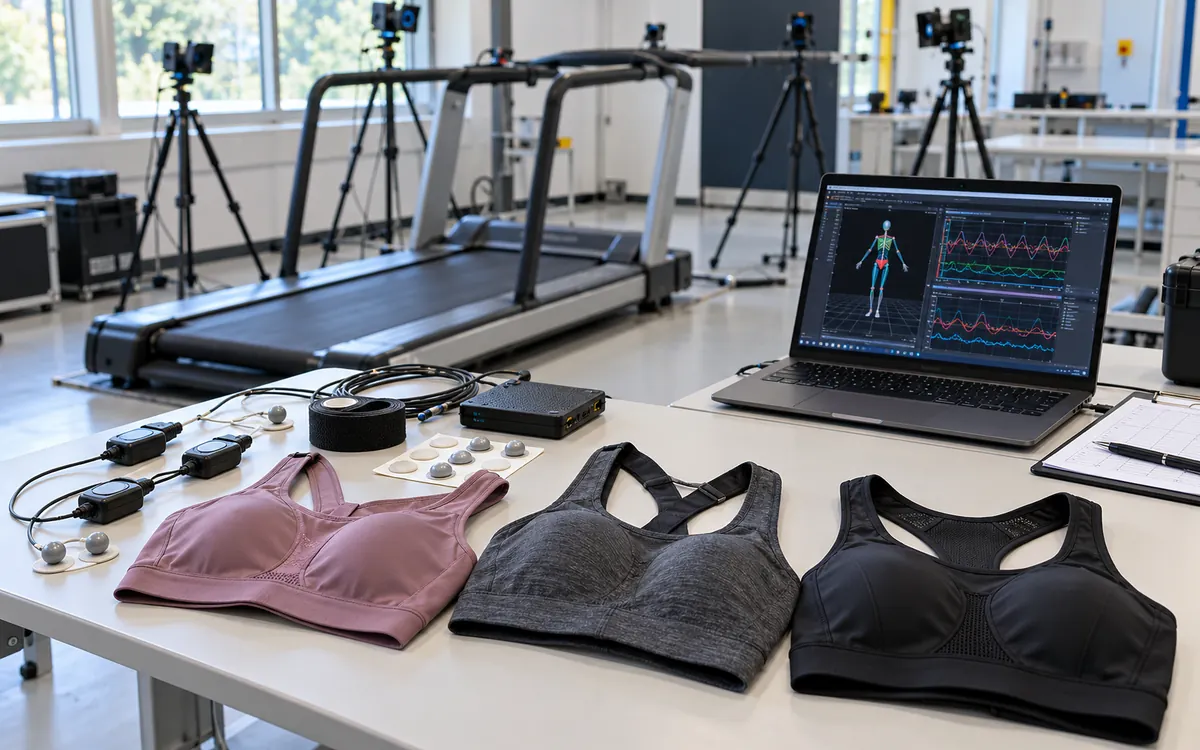
A sports bra may reduce visible movement and still rub at the strap. It may shift when the wearer changes direction. A video with little visible motion answers only part of the product question.
Sports bra support testing needs a clear brief. What activity is the bra intended for? Which wearers and sizes does the claim cover? What will the test measure, and what would count as a useful improvement?
This guide sets out a test plan for a product team. Discuss it with a qualified test lab. It separates research findings from an original example test plan. The worked data are hypothetical; they are not results for any commercial bra.
Define the claim before choosing the test
Start with one sentence that describes the intended outcome. For example: “Compare the new bra with the current model during steady treadmill running in the tested size group.”
That brief is more useful than “prove high support.” It identifies a comparison and an activity, while leaving the exact method to be agreed.
Test how easy the bra is to put on and adjust. Check breathing comfort, skin contact and repeated care as well. Do not assume a movement score covers those needs.
Sports Medicine Australia describes support in terms of limiting breast movement during activity. Its guidance also distinguishes encapsulation, crop-top and hybrid designs. Those design names help describe a product, but they do not replace a test of the actual bra. Source: Sports Medicine Australia.
Write down the intended use and the excluded uses. A running comparison should not quietly become a claim for every sport. A test on new bras should not become a durability claim.
Keep the main outcomes separate
Choose outcomes that answer different questions. If you merge them into one score too soon, you may hide why a sample performs well or poorly.
Outcome | Example measure | Question it answers |
Breast movement | Range of motion relative to the torso | How far does the measured point move? |
Speed of movement | Peak or average velocity | How quickly does its position change? |
Change in movement speed | Acceleration | How rapidly does velocity change? |
Local contact | Pressure at defined sites | Where and how much contact pressure occurs? |
Garment stability | Band shift, strap slip, cup movement | Does the bra remain in place? |
Wearer response | Defined comfort or support rating | How does the participant experience it? |
Usability | Fastening and adjustment observations | Can the wearer use it as intended? |
State the unit and calculation for every measured outcome. Millimetres, metres per second and metres per second squared are not interchangeable.
Coltman's research team compared six strap conditions. The group included 23 active women with larger breasts. Strap comfort and pressure changed across conditions. The study found no significant difference in vertical breast movement. This supports keeping those results separate. It does not prove that one strap design is best for every wearer. Source: Coltman and colleagues.
Distinguish a fitting screen from a laboratory claim
A fitting screen helps identify obvious problems before a formal trial. A participant can report rubbing, slippage or poor coverage during suitable movements. Those observations are valuable even without a motion-capture system.
A lab test adds defined measurements and controlled conditions. It still needs good fitting and clear participant feedback.
Portsmouth has described its sports bra testing work in a public notice. It combines motion sensors with ratings of comfort, felt support and appearance. The notice describes earlier research work. It is not a current booking offer. Source: Portsmouth testing notice.
Do not label a shop-floor jump check as a laboratory support test. Take the wearer's discomfort seriously. A good lab motion score does not make it less real.
The two forms of evidence serve different decisions. A fitting screen may stop an unsuitable sample from reaching the formal comparison. The formal test may then measure performance in a stated group and activity.
Choose a panel that matches the claim
Define the wearer group before inviting people to take part. Include the size range, fit needs and sports experience. Add any rules set by the test team about who can take part.
A single fit model can help develop a prototype. That person cannot represent every body shape covered by the same size label.
If the range spans several bands and cup groups, plan how the panel will cover them. Do not assume the middle size represents both ends of the range. Choose the sample size to suit the study question and the expected spread in results. Seek statistical advice where needed.
Keep names and personal details separate from product data used in routine review. Agree on consent and privacy rules. Include how to handle photos and body measurements.
The trial should allow participants to stop without pressure to continue. Qualified staff should choose suitable tasks. They should also plan how to respond to discomfort. A product trial should not turn into an endurance challenge without proper oversight.
Control fit before recording motion
Record the exact model, size label and fitting method. Note strap settings, fastening position and whether removable pads are installed. Keep these settings the same within the planned comparison.
“Size medium” is not enough if the prototype and reference use different size charts. Check that each garment fits the wearer under the agreed method.
Decide in advance how to handle a bra that cannot be fitted correctly. It may belong in a separate fit-failure result rather than the movement analysis. Do not silently remove it and then claim that the bra suits everyone.
Also record sample history. A stretched reference bra may be an unfair match for a new prototype. Use that contrast only if it is the test question.
For factory teams, connect these details to the approved garment specification sheet. Keep a record of the sample's materials and revision. Its marketing name alone is not enough.
Match the movement task to the use
Choose activities that reflect the claim and can be repeated safely. Running, jumping and direction changes are different tasks. Visible movement alone does not make them equivalent.
Gibson and colleagues compared five bras across five exercises. Their reported performance varied by activity and direction of motion. The public abstract also describes weak links between comfort and motion reduction. Those links were not consistent. Those findings support an activity-specific report. Source: International Journal of Exercise Science.
For each task, define speed or cadence, duration and rest. Allow time to practise the task. State which part of the recording will be analysed. Keep footwear and relevant test conditions consistent where they could affect the comparison.
Use a balanced or randomized order when comparing garments. Otherwise, tiredness or practice may be mistaken for a product effect.
The test team should choose the exercise settings. Copying a speed from a published study without considering the panel is not a sound protocol.
Measure motion relative to the torso
A camera fixed in the room sees the torso move. It also sees the breast move relative to the torso. The product question usually concerns that second type of motion.
Norris and colleagues measured breast motion in three directions. They used a torso coordinate system. Their study assessed 98 bras, with each tested on roughly 12 participants from a larger panel. It shows a defined method. It does not set one retail test for all sports bras. Source: Norris and colleagues.
A simple example in one direction shows why the reference matters. At one instant, suppose a torso point is 10 millimetres above its starting position. The breast point is 15 millimetres above its own starting position. Assume the torso moves only up and down. Allow for the starting positions of both points:
Relative change = 15 mm - 10 mm = 5 mm
This example assumes the torso moves up and down without turning. A real torso also rotates. A three-dimensional method needs a defined local coordinate system to account for this.
Do not subtract two separate peak values taken at different times. The subtraction must use matching time points and a valid reference.
Define range of motion before calculating reduction
Choose one axis and one cycle. The range of motion is the highest coordinate minus the lowest coordinate.
Measure the vertical coordinate relative to the torso. Suppose it ranges from minus 18 to plus 22 millimetres.
Vertical range = 22 mm - (-18 mm) = 40 mm
This is a peak-to-peak range. It is not a 40-millimetre rise above the starting point. It also does not measure tissue strain.
If the method uses several cycles, state how they are chosen and averaged. A result based on one extreme cycle answers a different question from a mean over several cycles.
Also name the axis. Vertical motion is only one part of three-dimensional movement. A small vertical range does not prove that motion is small in the other directions.
Keep left and right data separate where the method records both sides. Exell and colleagues studied differences in motion between sides. They used a larger panel and a smaller group to compare bras. Their findings show why one side should not be treated as an exact copy of the other. Source: Portsmouth research record.
Calculate percentage reduction with a named reference
A reduction percentage needs a denominator. A value is hard to interpret without its reference condition.
Let R be the movement range in the agreed reference condition and B the range in the tested bra. Both must use the same unit, axis, task and calculation.
Movement reduction (%) = ((R - B) / R) × 100
For an invented reference range of 80 millimetres and tested range of 32 millimetres:
Reduction = ((80 mm - 32 mm) / 80 mm) × 100 = 60%
The absolute reduction is 48 millimetres. Report both the percentage and the underlying values so that the reader can see what changed.
The formula requires R to be greater than zero. A very small reference can make the percentage unstable or misleading. Check the data rather than forcing a convenient percentage.
Some published research uses an unsupported reference. A product team may instead use an existing bra as the reference in an agreed test. Those percentages have different meanings. Do not label both as if they used the same baseline.
Show how averaging changes the answer
Consider three people tested under the same method in this invented example. Each has a different reference movement range.
Participant | Reference range | Bra A range | Individual reduction |
P1 | 80 mm | 32 mm | 60% |
P2 | 50 mm | 25 mm | 50% |
P3 | 30 mm | 21 mm | 30% |
The mean of the three individual percentages is:
Mean individual reduction = (60 + 50 + 30) / 3 = 46.67%
A ratio based on the totals gives a different result:
Total reference = 80 + 50 + 30 = 160 mm
Total tested range = 32 + 25 + 21 = 78 mm
Reduction from totals = ((160 - 78) / 160) × 100 = 51.25%
Neither calculation is a typing error. They weight participants differently. The first gives each person's percentage equal weight. The second gives more influence to larger reference ranges.
Choose the summary method before comparing products and state it in the report. Do not select whichever calculation makes the new bra look better.
Use paired comparisons without inventing certainty
Now suppose Bra B gives ranges of 36, 20 and 15 millimetres for the same three participants. Their reductions are 55%, 60% and 50%.
The change from Bra A to Bra B is therefore minus 5, plus 10 and plus 20 percentage points.
Mean paired change = (-5 + 10 + 20) / 3 = 8.33 percentage points
Bra B performs better on the mean reduction in this small invented example, but P1 does worse. That matters to the design review.
The result does not prove an advantage for all wearers. It also does not prove statistical significance. A real study needs enough people and suitable analysis. It must also report the uncertainty.
Keep repeated cycles within a participant distinct from independent participants. Recording 100 cycles from one person does not create a panel of 100 people.
Show the individual or grouped spread alongside the average. A single number can conceal a product that works well for some wearers and poorly for others.
Audit the data before reading the ranking
Check units before running the percentage formula. A reference of 8 centimetres and a tested range of 32 millimetres describe the example above. Their units differ, so do not divide the raw numbers directly.
Entering 8 and 32 without converting units would give minus 300%. Converting 8 centimetres to 80 millimetres restores the correct 60% reduction. Keep the unit beside each field in the spreadsheet. Convert both inputs to one unit before doing the math.
A negative result is not automatically an error. The tested bra may have more movement than its valid reference. If so, the reduction is negative. The unit check prevents a false result. Do not use it to erase an unfavourable real result.
Next, inspect missing recordings. A blank sensor value should not become zero movement. That would reward a failed recording with an apparently perfect result.
Check participant identifiers as well. Do not pair P1's reference with P2's bra trial. Neither person completed that comparison.
Finally, review excluded trials against the rules in the brief. Keep the reason and the original record. A sensor may detach and force a repeat. Record that cause before viewing the repeat's product ranking.
These checks protect the data. They cannot fix a poor study design, but they can help prevent a sound trial from being misread.
Check the measurement method, not just the sensor name
Motion capture and accelerometers do not always produce results that can be used in the same way. Sensor placement, attachment, sampling and processing all affect what is measured.
A 2025 study tested 20 people with D–H cup sizes. It compared acceleration from motion capture with readings from triaxial accelerometers. The accelerometers gave higher acceleration readings in that study. The authors discuss the need for consistent measurement methods. Source: comparative study abstract.
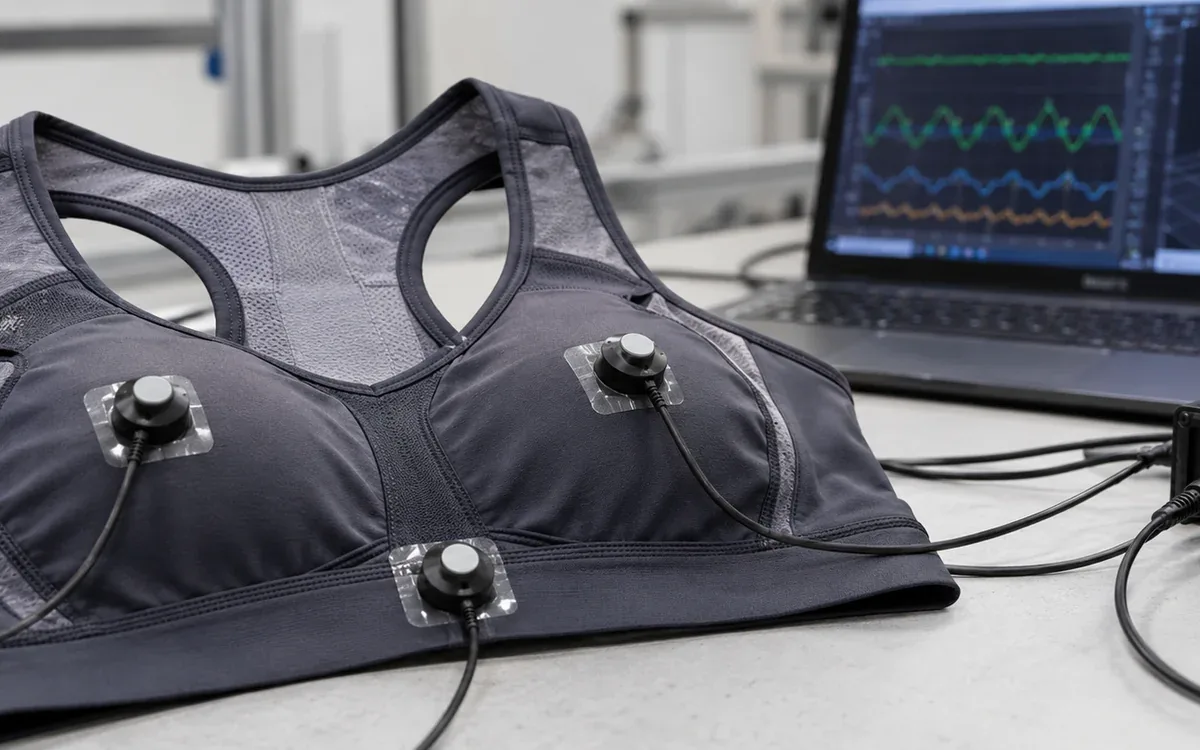
Record whether each marker sits on the skin or bra. State which region it tracks and how motion between those surfaces is handled. A marker on fabric may track the garment's motion. It may not track the tissue beneath it as closely.
Document the coordinate system, sampling rate, filtering and event selection. These form part of the method. They are not optional software details.
Ask the lab how it checks sensor attachment and spots unusable recordings. A clean graph is not proof that a marker stayed where intended.
Collect comfort information at the right time
Use clearly defined questions and scales. Distinguish breast movement discomfort from pressure at a strap, band, seam or closure.
Ask for ratings at consistent points, such as after fitting and after each task. Record the wording and the direction of the scale. “Higher is better” on one form and “higher is worse” on another can reverse a summary.
Do not convert an ordinal comfort response into a physical unit. A rating of 8 is not twice the measured comfort of a rating of 4.
The Coltman study combined strap discomfort, pressure, preference and displacement measures. Its design shows why a review needs several kinds of evidence. Each still measures a different outcome. Source: Coltman and colleagues.
Leave space for a brief location-specific comment. “Left strap edge rubbed during arm swing” is more useful to a pattern team than “uncomfortable.”
A comment records the wearer's experience. Inspect the sample next. The comment alone does not prove which part caused the problem.
Add a care and wear question when the claim requires it
A new-product test does not show how the bra will perform after repeated use. If retained support is part of the claim, define the conditioning and care history.
Keep the care plan tied to the product and agreed method. Record cycle count, load, detergent, drying route and rest before testing. Avoid inventing a universal wash count that certifies all sports bras.
Use matched samples and track damage, changes in size and fit settings. The question may concern the whole bra, not just stretch recovery in one fabric.
ApparelDiary's fabric shrinkage guide explains why measured dimensional change needs a defined procedure. For sports bra support, a fabric result is only one part of the garment evidence.
Care may change the fit so much that the old settings no longer work. Record both the change and any refitting. Quietly adjusting the straps can hide the effect the test was meant to assess.
Write a practical test brief
The following is an original planning template. Complete it with the lab. It is not a ready-made certified method.
Brief item | Decision to record |
Product question | New bra versus current model for a defined activity |
Claim scope | Tested sizes, wearers, garment state and conditions |
Participants | Recruitment plan, eligibility, consent and fitting |
Garments | Style, revision, sample count and care history |
Fit controls | Size selection, strap and band settings, pads |
Tasks | Activity, speed or cadence, duration and recovery |
Measurement | Sites, axes, sensors, units and processing |
Main outcome | Preselected motion measure and comparison |
Other outcomes | Comfort, pressure, stability and usability |
Data rules | Invalid trials, missing values and repeat criteria |
Analysis | Paired structure, summary method and uncertainty |
Decision | Required evidence and unresolved questions |
The brief should name who can approve a change in the method. If a sensor fails, the team needs a rule for repeats and excluded data. Set that rule before seeing which product appears to win.
Work through a development decision
Imagine a prototype with a better mean vertical reduction than the reference. Two wearers still report strap-edge rubbing. One further participant cannot adjust the band to the agreed fit. This invented result needs several decisions.
First, keep the fit failure in the report. If the preset method excludes that person's movement data, show the reason and the number left in that analysis. The sample count for a comfort question may differ from the count for valid motion trials. Label both.
Next, return to the two rubbing reports. Did the same edge rub during the same movement? Inspect the actual samples and strap settings. A wider strap might be a useful trial, but the reports do not yet prove that width caused the problem. A rough edge or a shifted attachment needs a different response.
The reviewer then writes a focused change request: address the observed rubbing while preserving the supported movement result. The revised sample keeps its own identity. It must not inherit the old prototype's results merely because most parts are unchanged.
For the repeat, the team checks skin contact and the related fit and movement outcomes. An edge change could solve the rubbing yet alter how the strap sits. The question is whether the revised garment retains the useful result.
Finally, write the decision in plain terms: which evidence supports release, which size or use remains unresolved, and what happens next. A single green cell marked “pass” would conceal the unfinished fit work. A longer list of numbers would not help unless someone connects each finding to an action.
Report support labels with care
A high, medium or low support label needs a stated basis. A threshold drawn from one research sample is not automatically an industry-wide rule.
Norris and colleagues sorted their study's movement-reduction values into thirds. They used these groups to compare support levels. Such groups depend on the tested sample and method. They should not be copied as universal certification limits. Source: Norris and colleagues.
A sound report names the products, people, tasks and reference. It explains the math as well. It also states what was not assessed.
For a consumer-facing claim, keep the wording tied to those conditions. “Lower measured vertical range than our previous model in this test” is narrower and more useful than “eliminates bounce.”
A link between a design feature and performance does not prove cause and effect. Adding that feature may not produce the same gain. Product features often change together.
Common questions
Is the lowest movement value always the best result?
It may be best for the selected movement outcome. The product still needs suitable fit, comfort and usability. Review those results separately before making a development decision.
Can a phone video prove a support percentage?
A video can help show garment movement or a fit issue. A numerical claim needs a validated method. Define the scale, reference, timing and data processing. Visual judgement alone does not supply those controls.
Should every participant run at the same speed?
That depends on the test question and the panel. The laboratory should choose a repeatable, suitable approach and explain it. Do not compare products tested under unexplained differences in task conditions.
Can I compare percentages from two laboratories?
Only after checking the full methods. Check the references, people, tasks, motion measures and averaging rules. Changes in any of these can make the percentages answer different questions.
Does testing one size cover the full range?
It provides evidence for that tested configuration. To extend the claim across a range, justify the plan. Account for changes in fit and construction.
Turn evidence into a useful product decision
Define the use and fit the bra the same way each time. Choose motion measures that match the question. Keep the reference condition visible in every percentage.
Then review motion, comfort and garment stability together. Keep their meanings clear. A strong report shows where the product improved and where it did not. It names what the next design step must resolve.
Support depends on stretch and fit, so see elastane fibre, narrow elastic testing and how to measure garments.
References
University of Portsmouth: Sports Bra Testing. Historical research-participation notice.
Norris and colleagues: How the Characteristics of Sports Bras Affect Their Performance. Accepted manuscript.
Discussion0
Loading the discussion…