
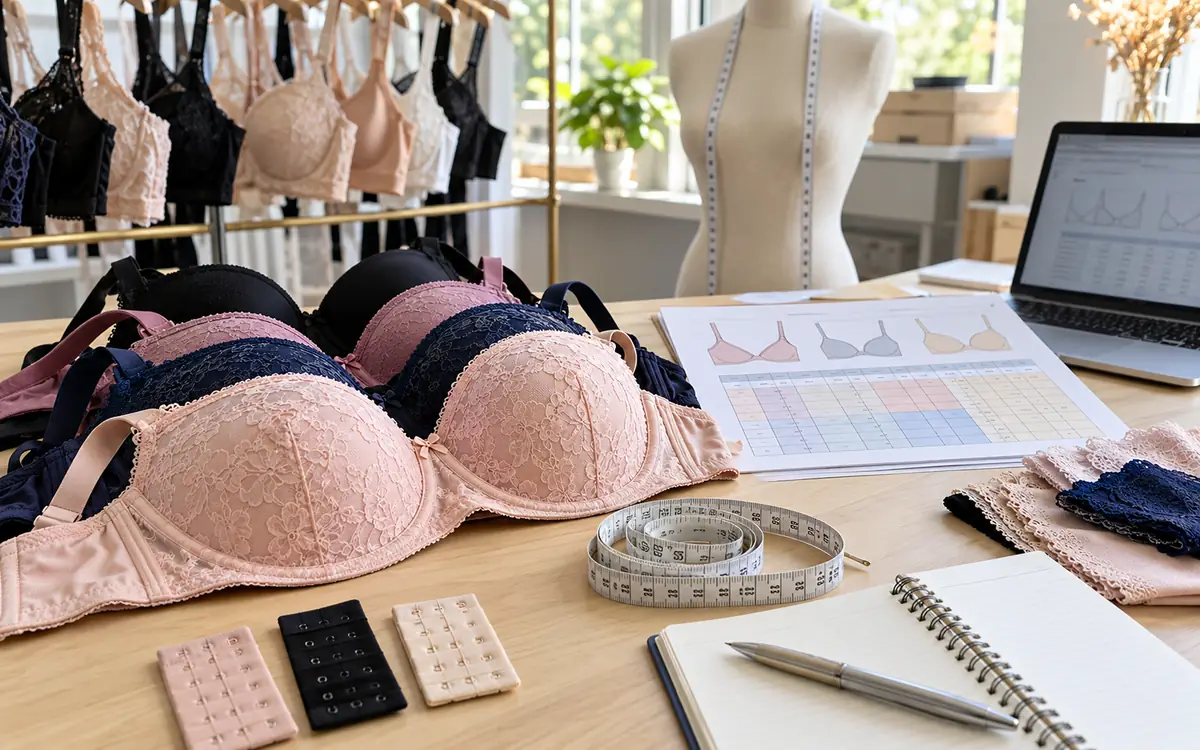
A bra marked 34F can mean different things on two websites. The letter alone does not explain the cup, and the number does not tell you the relaxed length of the garment. Before changing sizes, find out what the label means.
Bra size systems serve three linked tasks: naming a size, suggesting a starting point and helping a person choose a garment. A conversion chart mainly handles the first task, while measurement and fitting require further evidence.
This guide shows how to read UK, US and European labels with care. The examples use published brand charts checked in October 2026. Treat each chart as guidance for the named brand or range. When a product page gives more specific instructions, use those instructions.
Start with the complete size identity
Record four things before comparing bras: brand, style, size label and the system used by the seller. “34F” is incomplete because it omits the system; “Style A, 34F, UK labels” is a much better starting point.
A country setting can affect prices, delivery and size display without establishing which cup sequence the store uses. Freya's UK guide says that its lingerie and swimwear use UK bands and cups. Elomi's UK guide makes the same point for its own range. Read the guide attached to the listing instead of guessing from the website address. See Freya's size guide and Elomi's UK guide.
Also distinguish a sewn-in label from the size chosen in an online menu. A label may show several countries while the menu shows just one, and a marketplace may add its own conversion.
For a disputed order, keep the product code and the seller's size wording, then ask which label line matches that wording. This simple step can resolve a display problem before anyone concludes that the garment was made incorrectly.
What the band number tells you
The band is the part that runs around the torso beneath the cups. Its size number belongs to a naming system rather than providing a complete technical description of the band.
The following band pairs appear in Freya's international guide. They are useful for reading that chart, but should not be used as a ruler for an unknown garment.
UK or US label | European label | French label |
28 | 60 | 75 |
30 | 65 | 80 |
32 | 70 | 85 |
34 | 75 | 90 |
36 | 80 | 95 |
38 | 85 | 100 |
40 | 90 | 105 |
These are label pairs, not direct inch-to-centimetre conversions. For example, 34 inches equals 86.36 centimetres, which is a different quantity from 75 centimetres. The chart pairs the UK label 34 with the European label 75 for its sizing scheme. Source: Freya.
That distinction prevents a common shopping error. Multiplying a size label by 2.54 does not create its equivalent European label. Unit conversion changes the unit of a measured quantity, whereas a size chart maps one naming scheme to another.
Nor should you expect a laid-flat band to measure its label number. A garment measurement requires a defined path, fastening position and amount of stretch before the result can be compared with another garment. ApparelDiary's guide to repeatable garment measurements explains why those conditions matter.
Why cup letters stop matching
A cup letter needs both a band size and a stated sequence, so reading F as “the sixth cup” is unreliable when systems use double letters.
Wacoal America's chart for Elomi, Freya and Fantasie gives the following pairs. This extract shows where the label sequences diverge, a distinction that becomes more consequential as the cup designation increases.
UK cup label | US cup label in this chart |
D | D |
DD | DD |
E | DDD |
F | G |
FF | H |
G | I |
In this chart, UK F maps to US G, while UK E maps to US DDD. That does not authorize a universal rule for every product sold in the United States. Use the named brand's full chart before placing an order. Source: Wacoal size charts.
Think of a conversion as a lookup whose source matters as much as the answer it supplies. A useful note says “UK 34F to US 34G, according to this brand's chart.” An unsafe note says “F always means G.”
The second note loses the starting system along with the band, brand and date. A staff member could apply it in the wrong direction and create a new error.
European and French labels need their own check
European and French band numbers should not be treated as interchangeable. In the table above, European 75 and French 90 share a row, whereas French 75 appears on the row for a much smaller band.
Cup columns can also differ between published charts. Elomi's guide maps UK G to European I, while Curvy Kate's guide maps UK G to European J. Curvy Kate's displayed European sequence skips I at that point. Both pages were accessible when checked. See Elomi's guide and Curvy Kate's guide.
This is a good reason to question an anonymous “international standard” chart, because even a neatly printed table can hide a naming choice.
Do not solve the disagreement by averaging I and J or choosing whichever letter looks familiar. Return to the product you intend to buy and ask which chart applies to its size menu and physical label.
For a retailer, the correct action is to preserve the supplier's size identity. A general shop filter may help customers browse, but it should not silently overwrite the supplier's original label. Show both where needed and make the mapping explicit.
Measuring and converting are different jobs
Measuring asks, “What starting size does this brand suggest for these body readings?” Converting asks, “What other label does this chart assign to this size?”
Keep those jobs separate, since an online calculator can appear to disagree with a conversion chart when the tools are answering different questions.
For example, Wacoal asks users to measure over a non-padded bra. Its process uses a level underbust reading and a fullest-bust reading that does not flatten the bust, followed by optional questions about shape. That is a defined measurement method, not a claim that two numbers capture every aspect of fit. Source: Wacoal fit calculator.
Use the tape in the way the chosen guide requests. Avoid mixing one site's measurement position with another site's rounding rule. Preserve the raw measurements alongside the recommended size designation so that the original inputs remain available.
A useful personal note might read:
Field | Hypothetical record |
Measurement method | Brand guide, measured over a non-padded bra |
Underbust reading | 34 inches |
Fullest-bust reading | 39 inches |
Suggested starting size | Recorded from that guide |
Style tried | Product name and code |
Fit result | Band stayed level; upper cup edge cut in |
The last line often helps more than a second calculator result because it records what happened in the actual garment.
A worked starting-size example
Playtex publishes a simple inch-based method. It asks for the underbust measurement, rounded up to the next even band number, then a fullest-bust measurement. Its table maps a five-inch difference to DD. Follow that method only within its stated context. Source: Playtex Bra Fit Finder.
Consider a hypothetical person whose band reading is already 34 inches and whose bust reading is 39 inches. This example requires no odd-number rounding, which keeps the calculation separate from that particular decision.
Let B be the selected band number, T the bust reading and D the difference used by this table, all expressed in inches.
D = T - B = 39 in - 34 in = 5 in
The table suggests 34DD as a starting label, although the result remains a chart lookup rather than a measurement of breast volume.
The calculation contains no information about cup depth, neckline shape or the person's preferred feel. Those questions remain open until trying the garment supplies evidence that the arithmetic cannot provide.
Now imagine the raw band reading was not an even number. Record the raw value before applying the guide's rule so that you can explain how the selected band was obtained. It also makes it possible to revisit the choice without measuring from memory.
A second example using a centimetre chart
Chantelle's German guide links an underbust range of 73–77 centimetres to band 75. In that column, a bust range of 95–97 centimetres appears in row D. A hypothetical reading of 76 centimetres underbust and 96 centimetres bust therefore falls in the chart's 75D cell. Source: Chantelle's German size guide.
The reader finds the correct column and then the correct row, without forcing an inch-based formula onto a table built for centimetre measurements.
The two examples should not be used to prove that different charts measure the body in identical ways. They show how to follow the instructions attached to each chart.
If your reading lies near a boundary, record it as measured instead of turning 77.4 into 77 merely because one size is in stock. Equally, a decimal does not make a home tape measurement exact, because tape position, tension and posture can change the reading.
Repeat the measurement using the same method if the result seems doubtful. If readings continue to differ, a fitting appointment can help establish a useful starting point.
What sister sizes can and cannot do
Sister sizing changes the band and cup label together. It is used to explore a neighbouring band while retaining a similar nominal cup capacity.
Playtex gives 36C, 38B and 34D as sister-size examples. Going up one band step pairs with going down one cup step. Going down one band step pairs with going up one cup step. Source: Playtex.
A “step” means the next label in the applicable sequence, which may differ from the next letter of the alphabet.
A sister size is a candidate for comparison without a promise that its complete fit will match the original garment. Because the band changes, the complete garment needs another fitting assessment; use the adjustment when you have a clear reason to test a different band.
An adjacent size is especially useful for comparing whether a band change improves the original problem. If both bras create different problems, the right next move may be another style rather than another size shift.
Do not keep moving through sister sizes simply to reach available stock, since availability provides no evidence of a suitable fit.
Work through a sister-size choice
Assume a shopper is trying a UK 34F in one style. The cups seem suitable, but the band feels too loose after adjustment, so the next comparison uses a smaller band of 32. Moving one cup step up on the UK sequence gives FF.
The trial candidate is therefore UK 32FF. If the same 34F band felt too firm, the adjacent larger-band candidate would be UK 36E. These are worked label examples using the UK sequence.
Starting label | Reason for the trial | Adjacent candidate |
UK 34F | Try a smaller band | UK 32FF |
UK 34F | Try a larger band | UK 36E |
To compare the effect of the band change, keep the style and other fitting conditions as similar as possible. A 32FF in a new design changes more than the
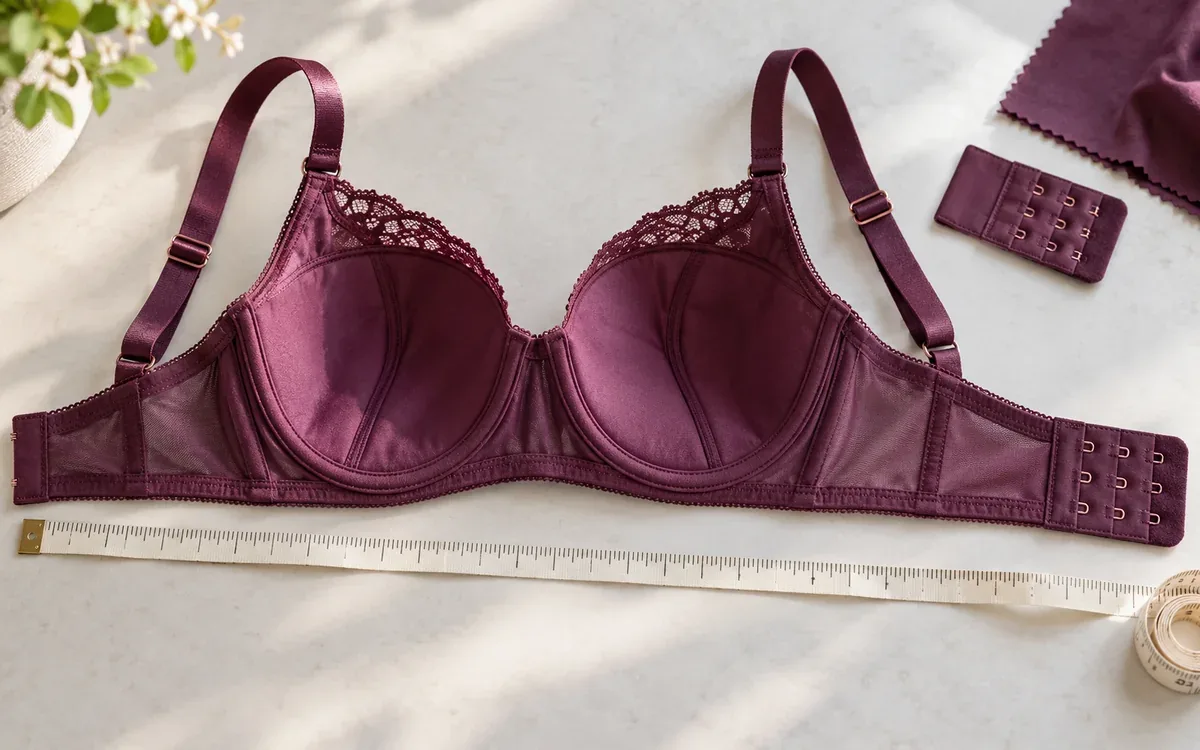
band.
After trying the candidate, record what improved and what became worse, using more specific observations than “tighter.” “Band stayed level, but the wire pressed at the side” gives the fitter a specific issue to investigate.
Never treat this table as permission to ignore pressure, pain or tissue being trapped by a wire. A size relationship does not make an uncomfortable garment suitable.
Turn the label into a practical fit check
Chantelle's fitting guide checks the band, cups, underwire, centre front and straps. It advises a level band, cups without bulging or gaps, and wire placement around rather than on breast tissue. These are useful observations for the kinds of bras shown in that guide. Source: Chantelle fit guide.
Use them as a structured trial after putting the bra on, settling the tissue into the cups and setting the straps. Then stand, sit and move your arms in ordinary ways while checking whether the garment stays in place.
The assessment must suit the design, since a wireless bralette does not have an underwire to assess. A low plunge has a different centre-front shape from a full-cup style. Do not reject a product for lacking a feature it was never designed to have.
Wacoal's separate fit guide also asks users to raise their arms and see whether the band stays in place. Its strap guidance focuses on staying on the shoulder without excessive pressure. That adds a movement check to a static mirror check. Source: Wacoal's five points of fit.
Read the problem before changing the size
Treat a symptom as a starting observation rather than a complete diagnosis, then use a trial plan in which each change answers a question.
Observation | First question to check | Useful next comparison |
Band moves upward | Were hooks and straps set as intended? | Adjacent band within the same style |
Upper cup edge cuts in | Is tissue settled fully inside the cup? | More cup capacity or a different neckline |
Cup has empty space | Is the gap local or spread across the cup? | Another size, then another cup shape if needed |
Wire presses at one point | Where is the wire relative to the tissue? | A different wire or cup shape through a fitter |
Strap slips | Is adjustment available and correctly set? | Strap placement or another style |
Bra feels fine standing but shifts sitting | Which part moves first? | Repeat the same movement in a comparison style |
This editorial troubleshooting sequence is intended to support a useful fitting conversation rather than provide a clinical test.
Avoid changing band, cup and style all at once if you want to understand the cause. Sometimes a new style solves the problem quickly, although that welcome outcome does not prove that the old label was wrong.
Why S, M and L need a separate chart
Letter sizes can cover several band-and-cup combinations whose meaning depends on the particular product.
Wacoal's size page separates general bralettes from named bralette ranges and from other garments. A medium in one table is not automatically a medium in every product on the page. Source: Wacoal size charts.
Before choosing a bralette, locate its exact range name and check both the band coverage and cup coverage. A single chest measurement may hide a difference that matters to the product.
If your band falls in one cell and your cup in another, consult the range's advice, a fuller-cup version or a different design instead of averaging the sizes. Record the mismatch when contacting customer service so the person helping you can see the issue.
The same discipline helps with a gift. Guessing a medium from a dress size may add uncertainty. A known product code and complete bra label give a far stronger reference.
Keep a size record that explains the next choice
A useful record should preserve what worked and why. Begin with the brand, style code, full label and the seller's size system. Add the date, hook position and a brief fit observation.
For example: “Cup edge smooth while standing. Right strap slipped when reaching. Band stayed level.” That note gives the next fitting a purpose. A score such as “fit 7/10” leaves the problem hidden.
Consider an invented repeat purchase. A customer has an older bra called “Everyday” in UK 34F. The shop now lists another “Everyday” bra, also in 34F. The style code differs. Even if the labels use the same system, the shared name does not establish that the two garments have the same construction or fit.
The customer's first question should identify the product change. Asking for a conversion would solve the wrong problem. If the shop confirms a new style, compare it as a new garment and retain the successful older code as a reference.
An exchange record needs the same discipline. Write “trying one smaller band in the same style” when that is the plan. If a different style is chosen, record that change too; otherwise, later notes may credit the band change for a result that involved several differences.
Retail teams can use these records to separate three return reasons: the wrong item arrived, the size display was unclear, or the correct item fitted poorly. Each calls for different action. A stock-picking error will not be solved by changing a fit chart.
Keep supplier mappings in the approved garment specification sheet. This record concerns retail labels. Developing the factory's graded size range is a separate task.
Check a store's conversion before trusting it
Here is a hypothetical customer-service case. A shopper knows that a UK 34E works in a familiar style. A retailer lists the same style in a menu marked “US,” with DDD available. The retailer's linked chart pairs UK E with US DDD, so the shopper selects 34DDD.
The parcel arrives with UK 34E on one label line, which alone is not evidence that the wrong item was supplied. Before arranging an exchange, check the style code and country lines to establish whether the order and label simply used different display systems.
If the menu never identifies its letters as UK or US, the same purchase becomes ambiguous before any garment is dispatched. The helpful question is, “Which system does this size menu use for this product?” Asking whether E is “bigger than DDD” misses the missing information.
A shop can test its pages with three examples: a size below D, a size just beyond DD and a larger cup where double letters occur. Follow each from the filter to the product page, cart and order confirmation. The size identity should remain clear at every step.
Use real supplier mappings for this check, because a tidy-looking conversion is still wrong if it changes the product being ordered.
Record any disagreement as a specific defect: missing system label, wrong mapping, or inconsistent display. Give each defect to the person who can fix that part of the page. A single complaint code called “sizing confusion” gives the team little to act on.
After a change, repeat the same three examples alongside a product that deliberately keeps its original labels. A site-wide rule should not erase a correct exception.
This small review concerns customer information. Its purpose is to establish that the shopper and warehouse refer to the same item, without requiring a change to the garment or size range.
Common questions
Is a D cup the same size on every band?
No. The letter is part of a band-and-cup label. It should not be treated as a fixed container with one universal volume. Compare complete labels and confirm the actual fit.
Is UK 34F always US 34G?
That pair appears in the Wacoal chart discussed above. Use it only when the seller follows that mapping. Verify the product's system before ordering, especially when the site uses F as an alternative US label.
Can I change to a sister size if my size is sold out?
You can consider an adjacent size as a fitting trial, but stock availability is not evidence that it fits. Keep the original fit needs in view. Do not accept a loose band or uncomfortable cup merely because the letters form a valid sister-size sequence.
Why does my label show both 75 and 90?
It may show European and French band labels. Read the country codes beside the numbers. Do not assume the larger number is the bust measurement or that one line is a manufacturing error.
Do I need to measure every time I buy?
A familiar, well-fitting style is a useful reference. If its fit has changed, or a new style feels wrong, fresh measurements and a fitting check can help. There is no need to discard direct garment evidence in favour of a calculator.
Can two bras with the same label fit differently?
Yes. A label does not describe every feature of a garment. Keep the style name with your size record so that a successful fit can be traced to the actual product.
Choose the next bra with a clear reason
Start with the exact label and the seller's size system, then use the relevant brand chart to translate it. Follow a defined method if you need a new starting size. Then let the actual garment supply the fit evidence.
Sister sizes are most useful when they answer a focused question about the band. They work poorly as a reason to keep an unsuitable bra.
A useful size record links the chart, the style and the result on the wearer instead of preserving only a number and a letter. That is what makes the next choice easier.
Size systems rely on consistent measurement and specifications, so see how to measure garments, the garment specification sheet and garment pattern types.
For how sizes turn into patterns, see reading a garment pattern and pattern making tools.

Discussion0
Loading the discussion…