
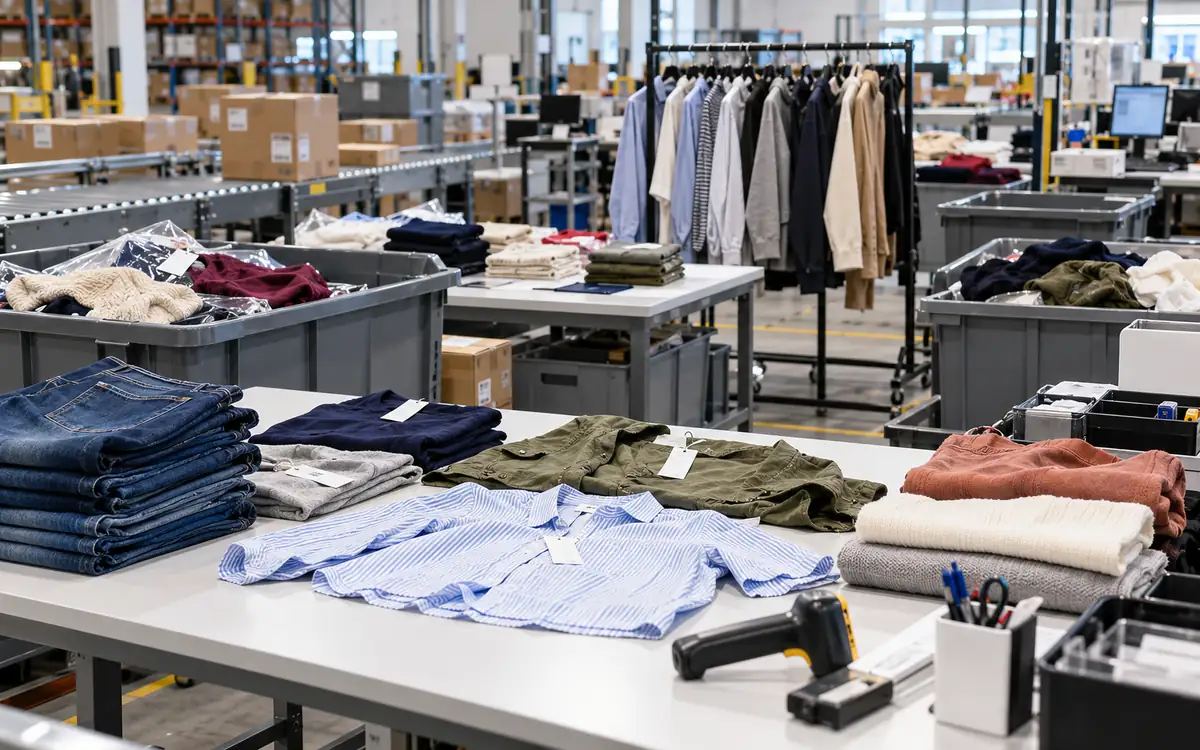
A returned shirt can be inside the warehouse and still be unavailable for sale. Its refund may be complete while its stock check remains open. A replacement may already be on its way to the customer. Those facts can all be true at once.
Apparel reverse logistics must connect those separate events. The team must identify the item and record custody. It must check the condition. It must then carry out the agreed remedy. It must also place the garment in the right stock state. Closing a shopper’s message does not finish that work.
This guide follows customer returns through an apparel ecommerce operation. One original example tracks garment counts. A second works through a refund and exchange. All figures are hypothetical. This process starts with the customer. Supplier returns and internal moves back to stores have different records.
Separate the return, refund and exchange
A return concerns goods moving back from the customer. A refund concerns money moving back. An exchange adds an outbound product. Shopify's returns overview distinguishes these actions. Build records that can show each one independently.
A refund may be authorized without a physical return. A garment may arrive before anyone decides the refund amount. An exchange can also require payment if the replacement costs more. Avoid one generic status that tries to represent all three flows.
Define the promises made to the customer. Set how each stage will be reported. Include the request, parcel movement, stock check and refund decision. Follow the applicable customer rights and the published policy. This guide does not set legal return windows or authorize fees.
Name an owner for cases outside the rules. Warehouse staff may confirm what arrived, while customer service resolves an eligibility question. Finance may handle a failed refund. Each team needs a clear handoff. Open tasks must stay visible as they move between systems.
Link authorization to the original sale
Use a stable return reference, often called an RMA. Link it to the original order and fulfilled line. Record the style, color and size. Add the exact unit count. Several variants may look alike. A broad product name is too weak to tell them apart.
Retain the customer's stated reason and requested remedy. Separate a request for a different size from a claim of a broken zip. Record whether the return is authorized, awaiting review or received without prior authorization. Record those states in the case file. Do not rely on memory of a phone call.
Keep the selling price and applied discount from the sale. The current web price may differ from the amount paid. Bundles and promotions may also require line-level treatment. Use the sale records to work out the agreed amount.
Microsoft's sales-return documentation links return lines to the original invoice. That link supports quantity and value checks. Its process also distinguishes physical returns from credit-only cases. The useful control is a clear connection between the remedy and the sale being corrected.
Check for past returns on the same line. Two requests may refer to the same garment. A replacement can create another order without erasing the original history. Keep the sequence clear. A repeat message must not create a second refund or receipt.
Plan the parcel route before it arrives
Give the customer the approved destination and packing instructions. The correct return address may differ from the dispatch location. Make the reference easy to include with the parcel. Provide a route for customers who cannot print a label.
One return can arrive in several parcels. One parcel may contain items from more than one order. Preserve those relationships. A tracking number identifies a shipment event. It does not prove the quantity or condition of every item inside.
Shopify's reverse-delivery documentation supports several reverse deliveries for one return. It separates shipping details from the carrier events. A label or tracking number may be on file. That alone does not prove the parcel reached the warehouse.
Keep carrier evidence separate from warehouse receipt. A delivered scan may refer to a shared receiving area. The warehouse still needs to find and open the parcel. Record the handoff time. Follow the site rules for recording visible package damage.
A customer may never send the goods. Keep that expected quantity open until staff complete the approved follow-up. Do not record receipt to clear an old task. Expiry or cancellation should have its own reason and evidence.
Receive into a controlled returns area
Keep unchecked returns in a separate receiving area. Keep them apart from outbound stock. Give each parcel a traceable location while it waits. The return record should help staff find the item. An unlabelled pile defeats that purpose.
Count the contents and compare them with the expected lines. Record missing units and extra items separately. Keep an unmatched item in a controlled hold area. Do not force it onto the nearest-looking SKU to make the receipt balance.
Confirm the actual variant from the garment and available identifiers. A bag label can belong to another item. A size tag can also be missing. Keep evidence where identity is unclear and seek a review. Do not create saleable stock from a guess.
Record when the item arrived, who checked it and the count. Take useful photos under the approved policy. Restrict customer details to those who need them. Keep the details needed for the decision. Avoid sharing other personal data around the warehouse.
Use ApparelDiary's cycle-counting guide for the separate investigation of stock differences. The reverse-logistics record explains how a returned item entered custody. A later stock adjustment should not replace that missing arrival history.
Preserve the customer's reason and the inspection finding
The customer's reason describes their experience. The check result describes what staff observed. They may differ without either being dishonest. A customer may report poor fit. Staff may also find a loose button that needs work.
Microsoft's reason-and-disposition guidance separates the return reason from the handling decision. Use that distinction in the local code list. A reason such as too small should not automatically release an item to stock.
Use clear, limited condition categories with written examples. Staff need to know which goods can be sold. Others may need repair or specialist review. Disputed items need a separate decision. Keep an option for unknown condition. A forced grade can hide a problem that needs a check.
Check the identity and condition. Check for missing parts and product restrictions too. Include detachable belts, matching parts and required labels. The exact checks should fit the garment and sales channel. Write what was found so another reviewer can understand it. A comment such as bad item gives little help.
Avoid making unsupported accusations when a return differs from the order. It may be a packing error, a customer mistake or an identity problem. Keep the facts and ask the approved team to resolve the case. The warehouse record should explain the discrepancy.
Make disposition a separate decision
Disposition means the approved next route for the item. The item may return to normal saleable stock. It may need repair or await another decision. An approved secondary sales channel is another possible route. Some items may require disposal. Record the route, approver and quantity.
Use a hold where the evidence is incomplete. A hold is a temporary state with an owner and next action. It should not become a bin for forgotten items. Review its age and the specific fact needed for release.
Units on one line may need different routes. Split the count to show each route. Microsoft's returned-item inspection procedure explicitly supports this distinction through split quarantine quantities. A returned batch need not receive one blanket decision.
Keep the payment decision separate from the item’s route. Refunding a customer does not prove the garment can be resold. An item may fail the resale check. That fact alone does not set the customer's financial remedy. Follow the agreed approval rules for both decisions.
Physical finding | Possible controlled route | Evidence needed before closure |
Correct, complete and acceptable | Normal saleable stock | Inspection and release confirmation |
Potentially recoverable fault | Approved repair or assessment | Work result and final release decision |
Suitable for a secondary sales channel | Separate stock by condition | Approved channel and clear description |
Unresolved identity or claim | Controlled hold | Investigation and authorized decision |
Unsuitable for reuse | Controlled disposal route | Approval and proof of movement |
The table shows workflow choices, not universal grading rules. Product safety, condition and applicable requirements limit the available routes. A lower selling price cannot make an unsafe or wrongly described item acceptable.
Work through a complete quantity example
Assume a closed group of approved returns expects 120 garment units. By the review time, 112 matching units have arrived. Eight expected units remain unreceived. Three additional items also arrived, but staff cannot yet link them to this group of return lines.
Keep the three unmatched items separate. Matched receipts are 112, while total physical intake is 115. The expected-return reconciliation remains 120 equals 112 matched receipts plus eight outstanding. Adding the unmatched items to that equation would conceal the missing units.
Inspect the 112 matched garments. Release sixty-eight to normal stock. Send eighteen for approved repair assessment. Ten need a secondary-channel review. Eight go to disposal. Keep eight on dispute hold. The five destinations total 112.
Initial route for matched returns | Units | Immediate normal-stock release |
Accepted for normal stock | 68 | 68 |
Repair assessment | 18 | 0 |
Secondary-channel review | 10 | 0 |
Disposal route | 8 | 0 |
Dispute hold | 8 | 0 |
Total | 112 | 68 |
This snapshot shows each route for the goods. It does not mean every refund is complete. Eight units have not arrived. They need an owner, as do the three unmatched arrivals. Neither group should vanish because the matched inspection table balances.
Reconcile later movement without counting a garment twice
The repair route later releases fourteen of its eighteen garments to normal stock. Three move to secondary-channel review. One joins the disposal route. The repair work is complete for this example. Those three outcomes now account for all eighteen garments.
Normal-stock releases therefore total eighty-two. Secondary-channel review holds thirteen. Disposal holds nine, and dispute hold still contains eight. These four current destinations total 112. Do not add the earlier eighteen repair units again. That was a previous state of the same items.
Suppose six disposal items leave through the approved route. Three await collection. There are now 106 matched units in custody. Of these, eighty-two are released. Thirteen await secondary-channel decisions. Three await disposal, and eight remain on dispute hold.
Matched goods still in custody = matched receipts − confirmed physical departures.
Substitute 112 receipts and six departures. The result is 106. Add the three unmatched items held separately. Total return-related custody is 109. This count covers more than saleable stock. Normal saleable stock increased by eighty-two.
This shows why deciding to dispose of goods differs from moving them. Control the goods until they actually leave. A write-off does not empty a cage. Nor does a change to the status field.
Control repair and secondary-channel release
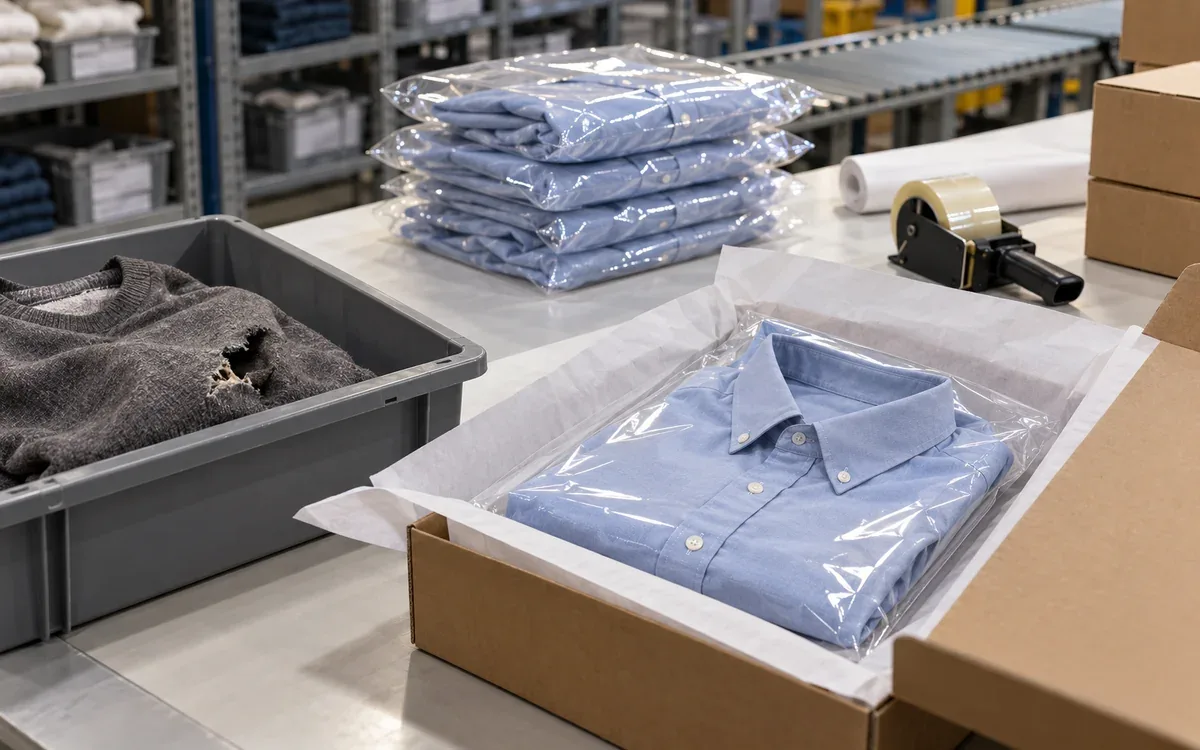
Set the permitted repair route and who can approve it. Keep the item’s identity through the work. Record what was done and inspect the final result. A work ticket may be marked complete. The garment still needs to meet its intended sales condition.
For stains or uncertain marks, use a qualified assessment. ApparelDiary's stain-diagnosis guide explains why looks alone cannot identify a suitable treatment. Use only the approved treatment route. A better-looking garment does not prove hygiene.
Secondary stock needs its own description and destination. A garment may suit an approved used-goods channel. It may still fail the normal sales requirements. Link its condition to the item. Include any required disclosures. Check the identifier and stock pool before release. The item must reach the correct pool.
Record what happens after dispatch. A garment sent for recycling has not necessarily been recycled at the moment of dispatch. Keep the proof of receipt and treatment required by the agreement. Report confirmed outcomes separately from planned routes.
Release stock only after the required checks
On-hand stock and stock available to sell are different measures. Shopify's inventory-state guide distinguishes available, committed and unavailable quantities within on-hand stock. Its unavailable examples include stock held for checks or damage.
Map each return state to the warehouse and sales systems. An inspected garment may still await relabelling or putaway. Complete the required release steps first. Then update the online available quantity. Name the system that owns that decision.
Check where the item is as well as its status. A released item in a returns cage may be impossible for the outbound picker to find. Confirm the putaway destination and completion. Available stock should be ready for staff to supply.
In the example, eighty-two units join normal stock. That does not mean eighty-two units remain available forever. Later orders may reserve or ship some. Reconcile later moves against the release event. Its count shows a past event. It is not a current stock balance.
Calculate a refund and exchange from the actual transaction
Consider a separate customer case. A customer returns a shirt originally paid at $27 and jeans paid at $48. The accepted return value is $75. Assume the agreed exchange is a different shirt priced at $32. The example also includes an authorized $3 return-shipping charge.
These are illustrative commercial amounts. Taxes and original shipping are excluded from this calculation. Their treatment depends on the actual order and applicable requirements. The example does not say that every business may charge a fee or withhold original shipping.
Refund balance = accepted return value − exchange value − authorized return charge.
Substitute $75 minus $32 minus $3. The customer receives a $40 refund, and the $32 exchange still needs fulfillment. The $3 charge remains a separately identified line. Do not describe the full $75 as cash already refunded.
Shopify's return-creation guide explains how the return, exchange and fees affect the balance. It also warns that partial processing can change the immediate result. Review the whole agreed remedy before issuing money. Avoid a refund that must later be collected again.
Use the original net selling value, not the garment's current web price. If the shirt now lists at $35, that price does not automatically replace the $27 transaction value. Keep any authorized exception explicit and approved.
Track payment completion and replacement fulfillment
A refund request can fail. It can also remain pending at the payment provider. Keep the payment reference and current state. Customer service needs to know what happened. Staff should not issue another refund just to get a new message.
An exchange needs its own outbound controls. Check the variant and address. Confirm stock and the agreed charge. A requested replacement is not the same as a reserved item. Shopify documents when exchange stock is reserved. This happens when the return is processed. Check the behavior of the system actually in use.
If the new item is out of stock, record the agreed next step. Do not quietly substitute a similar color or size. Link the customer's decision to the original return. Keep any change to the amount or delivery promise.
Where an upfront exchange is allowed, show the outstanding inbound return separately. The new item may leave before the old one arrives. Track that open return. It must not create a fictitious receipt of the old garment.
Shopify's processing guide supports partial processing and a separate refund step. It also provides actions for missing return items. Close each open task using the actual evidence. Use the permitted path to make any correction.
Reconcile systems after each important event
Check the order, warehouse and payment records together. Their identifiers and quantities should agree. Their states need not be the same. They should explain the same events. A warehouse receipt can be valid while the refund remains pending.
Give each system link a stable event reference. When a message is retried, the receiving system should identify the earlier event. It must not add stock or issue money twice. Test this behavior with a repeated receipt notification and a repeated refund confirmation.
Keep failed messages in a visible work list. Record the source, destination and reason for failure. After correction, reconcile the transaction result before resending blindly. A response may be late. That does not always mean the first request failed.
Compare each line and variant. A total of ten garments in both systems can still hide a size error. The same applies to a balanced refund total posted to the wrong order. A total match is a useful first check. It does not prove the detail is right.
Give stores and logistics partners the same handoff rules
Online orders may be returned to a store. Name who will check the original sale. State whether the store can release stock locally or must send it to a central facility. Keep the transfer separate from the customer's return decision.
A returns partner needs the same condition rules and identifiers. Agree which observations it records and which decisions it may make. Do not assume that a general receipt scan includes inspection or customer-refund authority.
Reconcile goods moving between the partner and the retailer. A partner may hold released goods, repair candidates and unmatched items at the same time. Ask for each group's state and location. A single total return count cannot show this.
Test a mixed parcel and a partial return before scaling the process. Include a wrong variant and an item without paperwork. The handoff should still preserve custody and ownership of the next task. Record what staff should do when the systems fail.
Measure work without confusing units and cases
Use the unit that answers the question. A return case can contain several parcels and several garments. A refund may cover only part of the case. Keep case, unit and parcel counts distinct. Track payment events separately.
For the quantity example, matched receipts are 112 units against 120 expected units. Receipt completion is 112 divided by 120. That equals 93.33%. The three unmatched arrivals do not increase that rate. They have not yet satisfied any expected line.
Normal-stock release is eighty-two divided by 112 matched units. That equals 73.21%. This share covers the stated group at the time of review. It is not a final resale rate. Some released garments may not sell. Some held units may later be released.
Track the time from receipt to disposition. Measure receipt to saleable release separately. Show the age of open work too. Three closed cases took twelve, eighteen and thirty hours. Their mean time is twenty hours. A fourth case is still open after ninety hours. It does not enter that completed-case average.
Show the open case alongside the average. Otherwise the report can look fast while the oldest returns remain unresolved. Use the same start and finish events at each site. A carrier scan and an opened parcel are different starting points.
Use cost and reason data to improve the process
Attach handling costs to a defined group of returns. For the 112 matched units, assume freight costs $240. Labor costs $168 and packaging costs $32. Approved repair adds $54, and disposal costs $18. The total is $512. This example leaves out the three unmatched items and wider overhead.
Divide $512 by 112 matched units. Direct processing cost is $4.57 per matched unit, rounded to cents. It does not measure total profit. Keep refunds and product cost separate. Future resale and overhead also need their own treatment.
Investigate patterns at the right level. Repeated fit complaints may point to one size or product description. Transit damage may point to packaging or handling. A reason code alone cannot prove the cause. Check the item evidence and original shipment facts before assigning corrective work.
Give confirmed findings to the team that can act on them. Preserve the original customer reason while adding the verified conclusion. Follow whether the change reduces the same issue in later comparable orders. Do not improve the report by simply renaming the return category.
Close a return with a complete record
Before closure, reconcile expected and received units, current locations and approved dispositions. Check the refund or additional-payment result and exchange fulfillment. Record any duty that remains open. One team may have finished its part. That does not make the whole case complete.
Allow controlled reopening when new evidence appears. Keep the first closure time and the reason it was reopened. A late parcel may arrive after an expected quantity was cancelled. Check its identity and condition first. Then decide any stock or money change.
Review a sample of closed cases at set times. Trace from original sale through parcel, inspection, stock and payment. This tests whether the process works as a connected chain. It also reveals where staff rely on undocumented workarounds.
Frequently asked questions
Can a returned garment go straight back to stock?
Only after the required identity, condition and release checks. A customer reason such as wrong size is not an inspection result. The garment must meet the rules for that sales channel.
Does a refund prove the item arrived?
No. Refund and receipt are separate events. Some approved remedies do not require a physical return. Use warehouse evidence for physical custody and payment evidence for the financial result.
What should happen to an unmatched item?
Keep it labelled and controlled while staff check the case. Do not add it to a guessed SKU or discard it merely to clear the queue. Assign an owner and record the decision.
Connect the customer's remedy to the physical result
A sound apparel returns process can explain each garment’s route. It also shows how each customer case ended. It preserves the difference between requested, received, inspected, released and refunded. This helps keep stock records correct. It also shows which work is still open.
Use stable identities and clear handoffs. Make the counts balance. Then check the actual payment and outbound exchange result. Finish the agreed work before closing the return. Keep records that support the result.
Returned stock needs the same control as other inventory, so see material issue and return controls, cycle counting, reorder points for trims and on-shelf availability.
References
Shopify Help — Returns, refunds and exchanges.
Microsoft Learn — Sales returns and original-sale links.
Shopify Developers — Reverse deliveries and disposition.
Microsoft Learn — Return reasons and disposition codes.
Microsoft Learn — Returned-item inspection and split quantities.
Shopify Help — Inventory states and availability.


Discussion0
Loading the discussion…