

A buyer receives two requests for antistatic clothing. One comes from an electronics assembly room; the other comes from a solvent area. A catalogue may put both garments under the same heading, yet their jobs differ. The first request concerns damage to sensitive parts. The second may concern a spark that could ignite a flammable atmosphere.
Before comparing prices, the buyer must identify the hazard. Where does the garment fit in the site's control system? That decision determines which evidence to request. This guide follows the choice through fabric, seams, cuffs, grounding, fit, and care. It also explains how to read a test report. A fabric result has limits that the buyer needs to understand.
Three questions that separate the needs
Ask what must be protected, what event must be controlled, and which standard applies. These questions prevent several common errors.
Question | Electronics work | Potentially explosive atmosphere | Electrical shock or arc hazard |
Main concern | ESD damage to sensitive parts | An incendiary static discharge | Current through the body or arc energy |
Clothing role | Part of an ESD control programme | Part of the assessed protection and earthing system | A different, task-specific protection role |
Useful starting document | IEC 61340-5-1 | EN 1149-5 and the site's hazard assessment | Applicable electrical safety and PPE requirements |
Dangerous assumption | Any antistatic fabric protects the parts | Any ESD lab coat is suitable | Antistatic means electrically insulating |
IEC 61340-5-1:2024 sets requirements for an ESD control programme for electronic items. Its scope excludes electrically initiated explosive devices and flammable liquids, gases, and powders. That exclusion makes the boundary clear. An electronics ESD claim does not establish suitability for an explosive atmosphere. That use needs its own assessment. IEC 61340-5-1:2024.
BSI describes EN 1149-5 as a material and design standard for static dissipative protective clothing. The clothing forms part of a total earthed system intended to avoid incendiary discharges. The scope has limits and does not cover protection against mains voltage. It also warns that the requirements may be insufficient in oxygen enriched flammable atmospheres. BSI public scope.
Do not reduce these distinctions to a colour code. A blue coat, white coverall, or grid pattern has no universal meaning. The evidence must identify the exact garment and its intended use.
Why ordinary clothing can matter to ESD control
Clothing can gain charge during contact and separation. A charged garment can discharge or create an electric field near sensitive items. Charge on clothing does not always drain through the wearer's skin. The fabric may be insulated from the body. EOS/ESD Association explains why clothing needs its own place in an ESD control plan. ESDA fundamentals.
A person can therefore pass one personnel check while a clothing problem remains. The question is not merely whether the wearer has touched a grounded object. The team must know which part of the clothing is controlled. How does it connect to the system? What happens during the task?
Think of the garment as a set of connected parts. Fabric panels join at seams. Cuffs meet skin or underlayers. A snap may connect to a cord. The cord connects to an approved point. A break or poor contact in one part can change the result for the whole route.
That model gives apparel teams a useful job. They must preserve the electrical function. The garment must also fit, move, close, and survive its care process. The pattern and sewing specification become part of functional performance.
Conductive, dissipative, and insulating are different ideas
Resistance describes how strongly a measured path opposes current. A conductive path has relatively low resistance. A dissipative path allows charge to move in a controlled way. An insulator does not provide the same route. The numerical categories depend on the property, method, and document used. Do not borrow a limit from a different test.
A surface test measures one path. A test between garment points measures another. Resistance through a worn system is a third measurement. These results are not interchangeable. They use different paths and may use different fixtures. Surface resistivity is another property, which accounts for a defined geometry. A report should say what was measured rather than using “resistance” as a catch-all word.
Low resistance alone is not a complete description of a good garment. The task may also call for control of charging and electric fields. Cleanliness, flame behaviour, and chemical protection may matter too. A property that is useful for one task can be irrelevant or unsuitable for another.
Avoid ranking fabrics simply by the lowest number on a supplier sheet. First check the units, electrode arrangement, conditioning, voltage, and specimen state. Then ask whether that property answers the actual product question. A precise number from the wrong test can be more misleading than an honest gap in the evidence.
What the garment test standard covers
IEC 61340-4-9:2024 provides methods for resistive tests of garments used in static control. Its scope includes conductive or dissipative outer garments. Garments with surface conductive elements are included too. It notes that the methods may not measure buried conductive layers. The 2024 edition changed several test details. These include cleaning and test voltage rules. IEC garment test standard.
This document defines test methods. Each work site still needs a purchasing specification. The product's role and control programme determine the required performance and use.
ESDA's description also covers garments that provide a ground path for a person. It includes a system resistance test for that role. This explains why a fabric swatch and a worn garment system answer different questions. ESDA garment standard description.
Ask the laboratory to state the method and edition in its report. A contract may still accept a report from an earlier edition. It should not be presented as a test to a later edition. Agree which evidence is needed before samples are prepared.
Understand the three ESD garment roles
ESDA describes three garment categories. A static control garment may affect the field from clothing underneath without a ground connection. A groundable garment can connect to ground. A groundable garment system also provides a defined ground path for the person. The distinction is about function, not style or price. ESDA garment categories.
Do not assume every ESD coat replaces a wrist strap. The site's ESD plan must define the approved personnel grounding method. Where a garment system supplies that role, the complete system must work as specified. Cuff contact, garment closure, cord, connection, and the wearer can all matter.
A coat hanging open over an ordinary shirt may not provide the intended coverage. Sleeves pushed above the cuff contact may change the system. A metal object may look conductive. Clipping a cord to it does not prove a valid ground route. The connection needs verification.
Write the wearing method in plain language and demonstrate it at issue. Ask the wearer to show the steps back. This can reveal a confusing snap position. A cord may catch during normal movement. Resolve the design or workstation problem so the wearing method is easy to follow.
A named product shows why details matter
Desco Europe's TB-9120 describes smocks with a hip-to-cuff feature. The product uses conductive cuffs and a defined connection path through the garment. The bulletin also gives use, test, and maintenance instructions. These details belong to the named Desco products. Do not copy them as instructions for every ESD coat. Desco technical bulletin.
The useful design question is where the required path goes. Follow it through the named product's cuff, panel joins, and connection point. Each part has an electrical role as well as a sewing or fastening role. A change that seems small to the sample room may therefore need a new technical review.
For an alternative product, have its supplier mark the required path on a garment drawing. Place the test points beside that drawing. The buyer can then check the report's scope. Does it cover sleeve-to-sleeve continuity? Does it cover the required route to ground? This comparison is more useful than matching the outer shape and cloth colour.
Keep this review at the finished garment level. A cloth supplier can provide useful evidence about its material. It cannot prove that later sewing preserved the route across every panel.
Static energy: a worked example with clear limits
A simple capacitor model helps explain why voltage matters. It is a teaching model, not a garment test or an ignition assessment. For an ideal capacitor, charge is Q = C × V and stored energy is E = ½ × C × V². OpenStax gives these relations and their units. Charge is in coulombs and capacitance in farads. Voltage is in volts and energy in joules. OpenStax capacitor energy.
Assume an invented system has capacitance C = 100 pF and voltage V = 2,000 V. Convert the capacitance first:
C = 100 × 10⁻¹² F = 1 × 10⁻¹⁰ F
Q = C × V = 1 × 10⁻¹⁰ × 2,000 = 2 × 10⁻⁷ C
The charge is 200 nC. Next calculate the stored energy:
E = 0.5 × 1 × 10⁻¹⁰ × 2,000² = 0.0002 J = 0.2 mJ
Now halve the assumed voltage to 1,000 V while keeping capacitance fixed:
E = 0.5 × 1 × 10⁻¹⁰ × 1,000² = 0.00005 J = 0.05 mJ
Energy falls to one quarter, because voltage is squared. It does not merely halve. The total charge may look small. The example shows why it can still deserve attention.
Do not use these values to declare a workplace safe or unsafe. Real discharge behaviour depends on geometry, materials, the environment, and the discharge path. The example supplies no ignition threshold and no electronic component damage limit. Those decisions need the relevant specialist assessment and test evidence.
Antistatic clothing in a flammable area
A potentially explosive atmosphere needs ignition controls. The garment choice forms part of that work. HSE identifies earth bonding as one way to reduce static discharge risk. Suitable antistatic work clothing and footwear can help too. It also requires the wider risk to be assessed and controlled. HSE guidance on explosive atmospheres.
The clothing specification should state the applicable protective standard and the intended use. BSI lists BS EN 1149-5:2018 as its current release. Check the adopted edition and any additional requirements for the market and site. BSI current standard record.
Review the entire outfit with a competent safety professional. Check the footwear, floors, and other equipment. Underlayers and the way the garment closes can also affect the system. A garment label does not prove that all those parts are suitable.
One “antistatic” result does not cover every flammable substance. Nor does it approve use in oxygen enriched conditions. Stay within the standard's scope and the maker's stated use. If the conditions fall outside them, stop the substitution and obtain the appropriate assessment.
This is also where language matters. “ESD safe” is often used loosely in sales copy. Replace it in the technical file with a precise claim, a named document, and the evidence for the task.
Turn the chosen role into a garment specification
Start the specification with the use, standard, and garment role. Then identify each part that supports the role. A practical file should connect the pattern, materials, construction, testing, and care instructions.
Specification item | What to define | Why the detail matters |
Base fabric | Exact construction and supplier code | Similar fibre content can hide a different electrical structure |
Panel joins | Approved seam and continuity details | Good cloth can become isolated panels after sewing |
Cuffs | Material, size, contact, and attachment 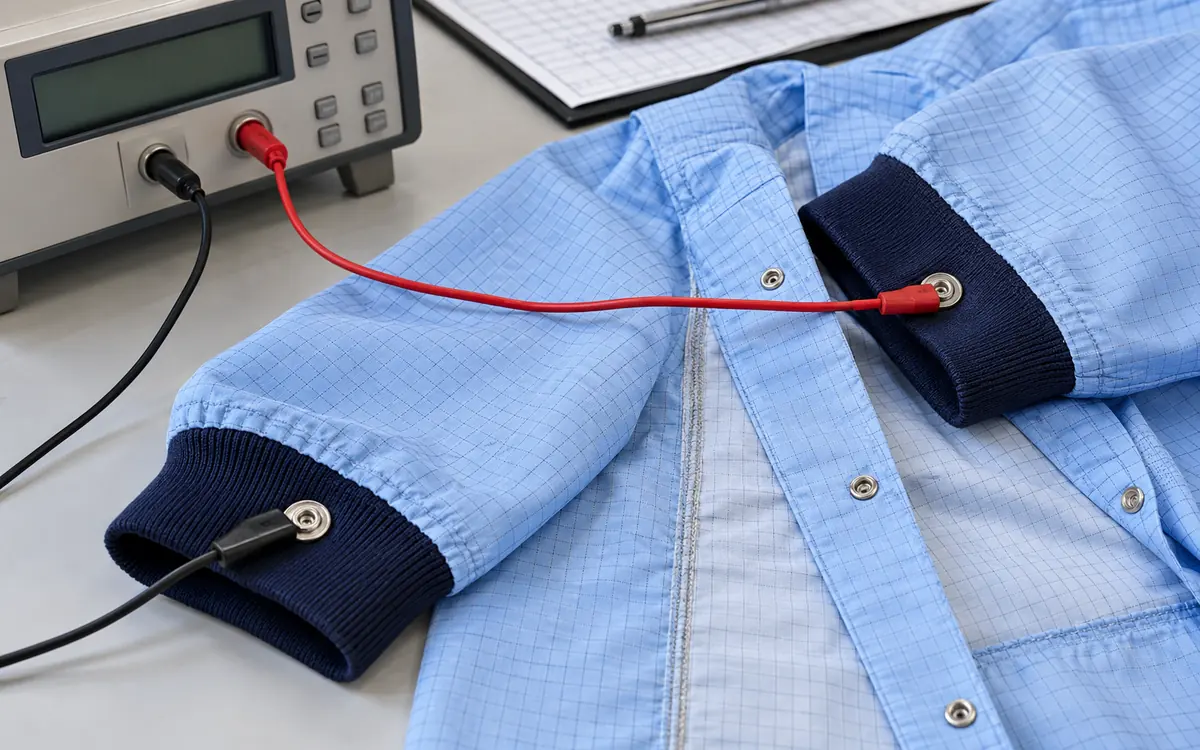 | A worn system may rely on skin contact |
Fasteners | Approved type and closed arrangement | Changes can affect coverage or the electrical route |
Ground point | Location and component identity, where used | A decorative snap is not a qualified connection |
Size range | Fit and functional checks across sizes | Reach and cuff contact can vary |
Care | Maker-approved process and limits | Residues or damage can change performance |
Test plan | Method, points, conditioning, and acceptance basis | A result must answer a defined question |
Keep optional features out of the electrical path unless they have a defined role. For example, a pocket, badge holder, or contrast panel should not interrupt a required route. Ask what happens when the wearer bends, reaches, or uses a tool. The approved garment must work through normal tasks, not only while standing still.
Fit trials should include the functional contacts
Check the garment on the people who will use it. Include the usual underlayers and approved equipment. Ask them to close it, reach forward, bend, and carry out representative work motions. Note any point where a cuff loses contact, a closure opens, or a cord pulls.
Do not prescribe one universal cuff tightness. The fit must support the specified function without creating an unacceptable wearing problem. The maker's design and the site's verification method should guide the trial. A wearer who rolls up a sleeve to relieve discomfort is useful evidence that the fit needs attention.
Review sleeve length in work posture. A sleeve that looks correct at rest may pull back during reach. A very loose sleeve can interfere with work. Size labels alone do not establish function, so record the actual sample and wearer feedback.
If a pattern change is needed, retain the approved electrical construction details. ApparelDiary explains working and production patterns. Its guide shows why each version needs control. Here, the change record must include any effect on contact, coverage, or continuity.
Separate qualification from routine verification
Qualification tests a product design against stated requirements. It uses prescribed conditions. Routine verification asks whether an item or system remains acceptable in use. They have different purposes and should not share a vague “tested” tick box.
For qualification, agree the samples and sizes with the laboratory. Define the conditioning, care preparation, and paths to test. Ask how results will be reported and which limits apply. Include the finished garment construction where the requirement depends on it.
The ESD or safety programme should define routine checks. State the method, interval, and person in charge. Set out what happens after a failure. Use appropriate equipment and trained staff. This article is not a procedure for applying test voltage to a person. It does not provide a method for tests in a hazardous atmosphere.
Keep results linked to item identity. A report for one garment cannot establish the condition of an untracked coat issued months later. Record repairs and care where the programme requires them. If an item fails, identify the affected work and follow the site's response process.
Keep enough detail to compare two reports
Put the object of measurement at the top of the comparison. Was the laboratory testing a fabric swatch, a finished coat, or a worn system? Beneath that, record the path, electrode method, test voltage, and conditioning. Add the garment's care history. This creates a short evidence map before anyone ranks the numbers.
Consider two hypothetical offers. Report A gives a result for new cloth between laboratory electrodes. Report B gives a finished garment result after the required cleaning process. A lower value in Report A does not establish better garment performance. Its scope leaves the seam, cuff, and care questions open.
Ask Supplier A for evidence that answers those open questions. Ask Supplier B whether its tested construction and care process match the proposed order. The next test should close a named gap. Ordering another generic fabric test may leave the purchasing decision in exactly the same place.
Keep a link to each original report beside the purchasing summary. Include its method and object of measurement in the visible record. A lone resistance value, even in a green cell, loses the conditions that make it useful. Preserve any qualification or limit printed by the laboratory.
Reading resistance results without losing the units
Electrical results often span many orders of magnitude. A missing prefix can change the meaning by a million. Keep units visible in forms, labels, and exports.
Consider an original arithmetic example. A laboratory reports 2.4 × 10⁷ Ω for a defined path. Convert it to megohms:
Resistance in MΩ = resistance in Ω ÷ 10⁶
2.4 × 10⁷ Ω ÷ 10⁶ = 24 MΩ
The same number is 24,000,000 Ω. It is not 24 Ω or 24 kΩ. Whether 24 MΩ is acceptable depends on the specified test and requirement. The conversion alone gives no pass result.
Suppose another report shows 2.4 × 10⁹ Ω for a different path. That is 2,400 MΩ, which is one hundred times the first value. Do not compare the numbers as if the garments were tested in the same way unless the paths and conditions match.
When a report says “greater than” the instrument range, keep that qualifier. It is not an exact reading at the range limit. Likewise, a result below a stated detection limit should not be entered as zero. Preserve what the laboratory actually measured.
Care and repair can change the result
Follow the instructions for the exact product. Do not copy a wash temperature or detergent recommendation from another brand. A named maker's bulletin can illustrate a care route. It does not set the route for every conductive fabric or finish.
Treat a change of laundry process as a technical change. Ask about detergent, softener, water, drying, contamination, and the required checks after care. Keep the process stable enough that a new failure can be investigated. ApparelDiary's care label validation guide provides the broader apparel control process.
Repairs need their own approval. Replacing a cuff with ordinary rib can remove a required contact. A seam repair can alter continuity. A new snap may fit the cord but have a different electrical or mechanical performance. Use the approved parts and process, then perform the required verification.
Retire an item when the applicable criteria require it. An intact appearance does not prove electrical function. A test number does not excuse torn or poorly fitting clothing. The garment must meet the whole use case.
A fault investigation that avoids replacing the wrong thing
In this hypothetical case, several garments fail a routine check after a laundry change. The style code has stayed the same. The ESD coordinator first identifies the failed test path. They also check the instrument and setup. They retain the affected garments under the site's response plan.
The failures cluster in one returned batch. That finding warrants a comparison, but does not yet prove a detergent problem. The team selects retained garments from before the change. They compare them with affected items from after it. Both groups are checked under the approved method. Care history and condition are recorded for each item. If the groups differ in other ways, those differences remain part of the investigation.
The team then follows the pattern of failures. One failed path directs attention to its cuffs, joins, and contacts. Changes across several paths may call for a wider material or residue review. This sequence narrows the next test. The date of a failure alone does not prove its cause.
Release depends on the site's acceptance criteria after a supported correction and verification. It does not depend on how urgently the coats are needed. Record the evidence for the cause, the approved change, and the items covered by the release. The next laundry batch can then be checked against the same clear record.
Questions buyers often ask
Is cotton automatically antistatic?
No fibre name proves a protective claim. The construction, finish, garment design, conditions, and test method matter. Ask for evidence for the exact item and use.
Does a conductive grid prove that the coat works?
No. The visible grid can help identify a construction. It does not prove continuity or whole-system function. Seams, cuffs, connections, and care still need the relevant checks.
Can an ESD coat protect against electric shock?
Do not make that assumption. Static control and electrical shock protection are different tasks. Use the equipment and clothing specified by the electrical risk assessment.
Can the same garment serve both electronics and a flammable area?
Only when the exact garment and complete use system have evidence for both needs. A claim for one application does not establish the other. Resolve both specifications before use.
Specify a function, then preserve it
A workable clothing specification connects the task to evidence for the garment in use. The hazard assessment sets the purpose. The relevant standard and control programme define the required role. Pattern, sewing, care, and repair decisions must preserve that role. Link each purchase claim to the garment drawing and test record. That link makes a later change easier to assess.
Protective clothing needs a clear specification and verified care, so see the garment specification sheet, care label validation and buyer audit preparation for how evidence is reviewed.
References
IEC 61340-5-1:2024: ESD control programme requirements and scope.
BSI: EN 1149-5:2018 material and design scope.
EOS/ESD Association: Basic ESD control procedures and materials.
IEC 61340-4-9:2024: Garment resistance test methods.
EOS/ESD Association: Garment standard description.
Desco Europe TB-9120: Smocks, grounding, testing, and maintenance.
OpenStax: Energy stored in capacitors.

Discussion0
Loading the discussion…