
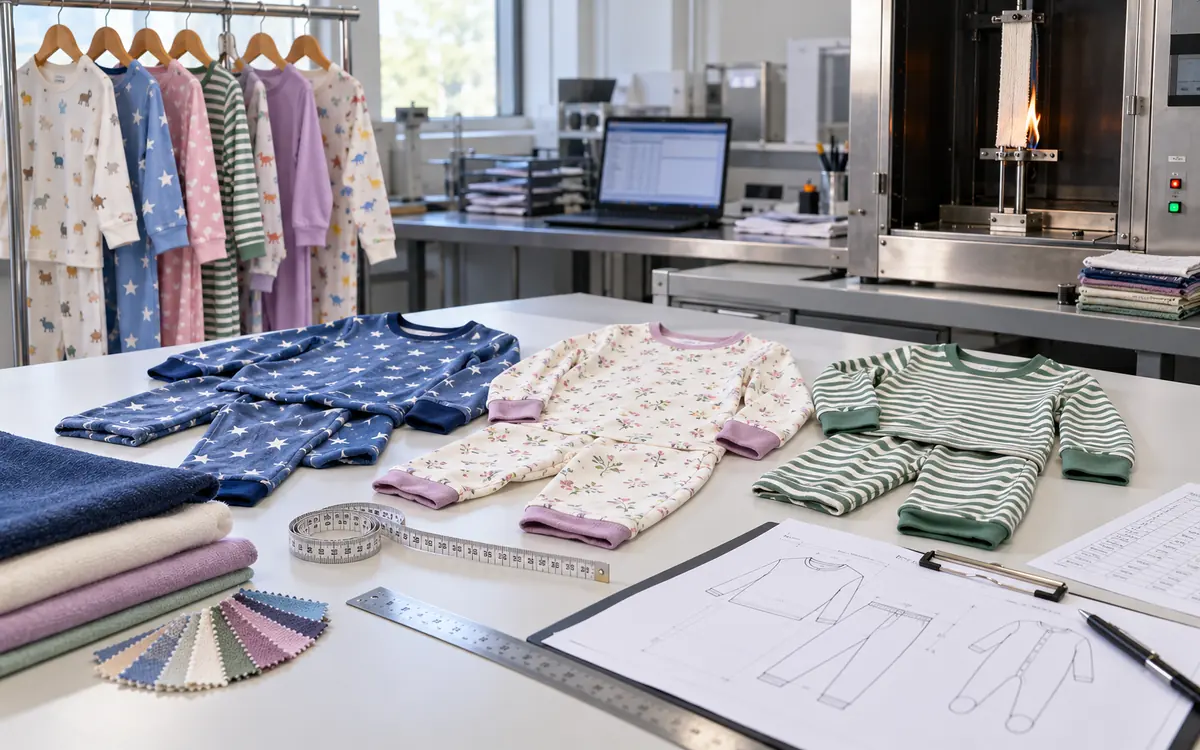
Choose a compliance route for children's sleepwear early. Settle it before placing the fabric order. A soft hand, a close fit or a supplier's test report does not settle that route. The garment, its size range, its use and its labels must be considered together.
U.S. children's sleepwear flammability rules shape product development. This guide explains how to work with them. It covers classification, measurement, lab instructions, production records and release decisions. The worked examples are hypothetical. They explain decisions without approving a particular product.
Sources were checked on 28 October 2026. The eCFR pages displayed Title 16 as current through 26 October 2026. Check the current rule before release. Have the responsible compliance specialist confirm the route. This guide does not give a complete lab method. It does not decide any garment's legal status.
Start with the product's intended use
A product name is weak evidence on its own. Calling a garment a lounge set does not settle whether it falls within the sleepwear rules.
The CPSC's March 2023 sleepwear fact sheet describes three broad factors. One is the garment itself and whether it suits sleep use. Another is how it is marketed and sold. The third is its likely use. Part 1615 covers sleepwear sizes through 6X. Part 1616 covers sizes 7 through 14. Both have defined exceptions.
Build a short route file at the concept stage. Include the sketch, size range, proposed fabric, product name and sales description. Add the intended photographs and sales category. Record the reasons for the proposed route and the person who reviewed them.
Consider an original development case. A team calls a matching knit set “weekend wear.” Its product page shows a child in bed, and the description mentions bedtime. The reviewer should see that material before deciding the route. Reviewing only the purchase order would miss relevant evidence.
Keep the route decision linked to its exact product revision. A later change in shape or sales claims should trigger a review. A decision made for a fitted top and leggings should not silently travel to a loose robe.
Separate the possible routes
Use the following table as a planning map. It does not replace the definitions or testing rules.
Proposed route | Evidence to establish first | Development consequence |
Sleepwear under Part 1615 or 1616. | Check use, sizes and the rule. | Plan fabric, prototype and production tests. |
Qualifying infant garment. | Check age size, length and labels. | Record the exception. Plan general flammability checks. |
Qualifying tight-fitting garment. | Check all dimensions, shape rules and labels. | Control the full definition in production. |
Product classed outside sleepwear. | Record its use and other rules that apply. | Set its own compliance plan. |
An infant exception has several conditions. The CPSC fact sheet sets out the infant route. It requires a size of nine months or smaller. It also requires set length limits and an age label in months. The one-piece limit is 25.75 inches; each piece of a two-piece garment must be no longer than 15.75 inches. Applicable general flammability rules still matter.
Do not treat “nine months” as the entire decision. Keep the measured length and label evidence beside the size claim. Use the exact measurement requirements and units in the governing text.
The CPSC's business guidance FAQ explains these exceptions. Qualifying infant and tight-fitting garments do not follow the sleepwear flammability test route. That route is in Parts 1615 and 1616. They remain subject to the general clothing textile rules. An exception from one test route does not mean that the product has no safety requirements.
Build a complete tight-fitting measurement file
“Tight-fitting” is a defined route, not a visual opinion. A garment can look close on one child while failing a specified dimension.
The current Part 1615 definition sets maximum dimensions at seven locations. They are the chest, waist, seat, upper arm, thigh, wrist and ankle. It also sets shape, taper, trim and labeling conditions. Use the correct size row and measurement diagrams. Check the corresponding Part 1616 definition for the larger sizes.
Create one worksheet per size and revision. Identify each point by name and drawing. Record the method and measured value. Add the rule maximum, result and reviewer. Keep a space for conditions that cannot be reduced to one number, such as the required taper.
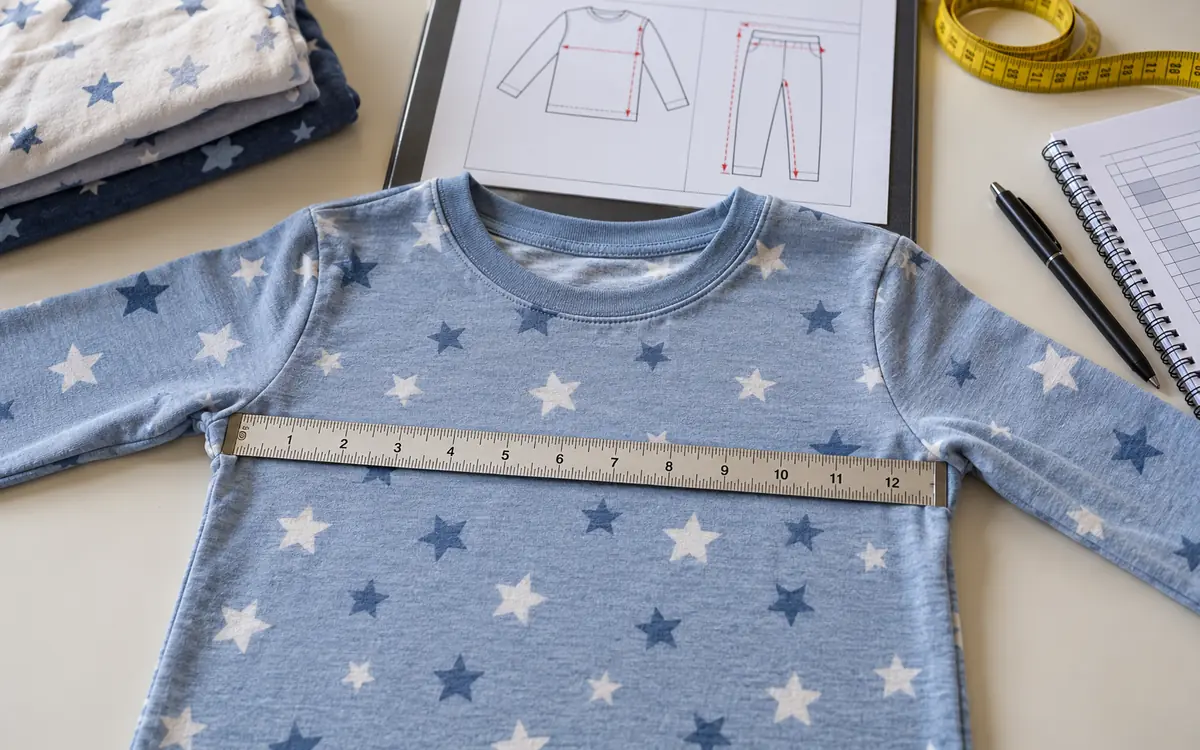
The regulation gives a measurement method. Lay the garment right side out on a flat surface. Smooth wrinkles. Measure and double the stated front distances. Its size 2 chest maximum is 20.5 inches. These details come from §1615.1(o).
Worked example: a flat chest measurement
Suppose the measured front width at the required chest points is 10.1 inches.
Doubled chest dimension = 2 × Flat chest width
Doubled chest dimension = 2 × 10.1 in = 20.2 in
Dimension margin = 20.5 in - 20.2 in = 0.3 in
That result is below the stated chest maximum by 0.3 inch. It says nothing about the wrist, thigh, taper, trim or labels. The worksheet should mark only the chest result at this stage.
Use the actual rule's points rather than a factory's usual fit chart. A familiar measurement name can conceal a different location. Attach the rule reference to the worksheet so that a second inspector can repeat the check.
Keep factory tolerances inside the legal maximum
A maximum in the rule is not a target with an extra factory allowance added afterward. A production tolerance must fit within the required limit.
Consider another hypothetical size 2 chest specification. The team proposes a flat width of 10.2 inches with an upper tolerance of 0.15 inch.
Upper flat width = 10.2 in + 0.15 in = 10.35 in
Upper doubled dimension = 2 × 10.35 in = 20.70 in
Amount above maximum = 20.70 in - 20.50 in = 0.20 in
The proposed spec permits a chest above the maximum. A sample at the nominal value would hide that problem.
This example illustrates tolerance budgeting. It does not recommend a particular target or tolerance. The team must choose a workable spec. Base it on process capability, fit and the rules that apply.
Check how the production team records dimensions. If one sheet uses flat widths and another uses doubled dimensions, name the basis in each column. Do not allow an unmarked value to move between them.
A useful review compares the nominal value, upper allowed value and rule maximum side by side. It should also identify the measurement method. Arithmetic cannot rescue a reading taken at the wrong point.
Repeat this review across the size range. Do not grade one approved size by habit and assume that every larger size remains within its own limits.
Select materials for the chosen route
Fibre content alone does not prove the finished product's performance.
The CPSC's sleepwear FAQ identifies some untreated fibres. Garments made from them typically fail the sleepwear tests. Its examples include 100% cotton, silk, rayon and modal. That statement does not establish that every alternative fabric passes. Nor does it remove the need to qualify a tight-fitting route in full.
Make the material brief specific. Record the fibre blend, construction, mass and finish. Add the colour or print, supplier and fabric identity. Keep those details with the sample sent to the lab.
Ask what the supplier's evidence actually covers. Is the report for finished fabric or an earlier unfinished state? Does its identity match the ordered lot? Is it a general apparel test or the relevant sleepwear test? Record a missing answer as an open issue.
Separate comfort choices from compliance evidence. A designer may prefer a soft finish or brushed surface. That choice still needs to enter the test and change review. A claim may cover only the base fabric. Do not extend it to an untested finish.
Use a material approval sheet that names the approved version. “Same quality as sample” is too vague when the sample's process history is unknown.
Give the lab a precise question
The CPSC lab manual dated July 2010 supports the standards. It says that it does not replace them. Its equipment descriptions are examples rather than required brands. Use it with the current regulation when preparing a test request.
A request reading only “test for flammability” leaves too much unresolved. State the product class and rule that applies. Add the test stage, sample identity and required care condition. Ask the lab to confirm the sampling and acceptance plan. Do this before specimens are prepared.
Some children's products require third-party testing. For those products, check the lab's CPSC acceptance. It must cover the right rule. A lab's general accreditation or name on a supplier report is not the full check. The CPSC certificate guidance identifies the role of a CPSC-accepted lab.
An original request packet can contain:
The signed route decision and size range.
The material spec and production identity.
The garment drawing, seam map and trim list.
The exact development or production stage.
The requested rule, care state and sampling plan.
The required report details and sample disposition.
A named contact for questions before testing begins.
Mark any unconfirmed item. Has a decorative detail changed? Tell the lab whether it belongs to the submitted version.
Do not conduct an informal flame demonstration as a release test. Holding a flame against an offcut proves little. It cannot establish the required sampling, conditioning or acceptance result.
Read the specimen results and the acceptance plan together
A report mean is useful. It is not the entire decision.
Part 1616 sets a five-specimen average char-length limit of 7.0 inches. It also addresses full-specimen burns. Read these criteria with its sampling and acceptance procedures. The number of specimens required for unit acceptance depends on those procedures.
Worked example: the same mean can hide different results
These invented readings illustrate report review. They are not an actual test record.
Set | Individual char lengths, inches | Total, inches | Mean, inches |
A | 4.8, 5.1, 5.4, 5.0, 5.2 | 25.5 | 5.1 |
B | 3.0, 3.0, 3.0, 6.5, 10.0 | 25.5 | 5.1 |
Mean char length = Sum of five char lengths / 5
Mean char length = 25.5 in / 5 = 5.1 in
The equal means conceal different outcomes for each specimen. Set B includes a 10-inch result. Do not accept the represented unit merely because the mean is below seven inches. Apply the plan for the correct stage. Check its full-specimen criteria and any required extra testing.
The opposite shortcut is also wrong. One such result does not always mean immediate unit rejection. The governing acceptance plan determines the next action.
The CPSC sleepwear lab bulletin discusses variation in prototype results. It links this issue to later production failures. It calls its added data analysis good lab practice. The analysis is not required by the rules.
Keep that distinction visible. A company's internal alert for variable results can prompt investigation. It must not be presented as a new federal pass rule or used to relax the required decision.
Resolve a report mismatch before judging a result
Read the report header before its pass or fail statement. Match the sample description to the submitted product. Check the report number, issue date, revision and stated test method. A revised report should have a clear reason for the change.
Suppose a report names a blue printed fabric, while the approved sample card names a red solid fabric. The reviewer should ask for the missing link. An email may say that the fabrics are “similar.” That does not identify the production unit tested.
Next, compare the requested and reported stages. A fabric result may relate to the same order. That does not make it a garment production result. Correct the
file structure or obtain the missing evidence.
Finally, retain the original readings with the decision. A summary spreadsheet may show only a green cell. It then hides each result and the relevant plan. Add a direct report reference and a brief statement of what was accepted. The purpose is a repeatable decision, not a larger pile of documents.
Preserve the link from fabric to production garments
The CPSC lab bulletin distinguishes three test stages. These cover fabric, seam and trim prototypes, and production garments. It also calls for records and physical samples. These connect manufacture with the finished product. A successful prototype does not by itself document the production stage.
Start the map with the fabric production unit. Link it to cutting records, sewing output and the garment production unit. Keep the actual identities in that map. A purchase-order number may cover several distinct materials or production conditions.
Imagine an order with two fabric deliveries. The cutting room uses both under one order number. The test report names only the first delivery. Before release, the reviewer must resolve which finished garments the report represents. The order number alone cannot answer that question.
Keep the general AQL inspection plan separate. It cannot replace the sleepwear rule's sampling plan. ApparelDiary's AQL sampling guide is useful for ordinary acceptance inspection. The regulatory flammability plan has its own purpose and conditions.
For each report, keep a short statement of coverage. Name the represented material or garment unit, relevant revision and test stage. Record any limits on that coverage.
When a result fails, hold the affected stock and preserve its identity. Use the applicable rule's disposition and rework provisions. Do not keep sending convenient replacement samples until one passes. That does not establish a sound release basis.
Plan care conditions before samples are sent
The current Part 1616 laundering provisions include two care states. Testing covers the stated initial condition and the state after 50 laundering cycles. They also contain defined provisions for certain guarantees and other conditions. Read the complete plan. It is wrong to assume that every finished garment always gets 50 washes.
Ask the lab to identify the rule provision. Record the care condition on the request. Retain the basis for any permitted treatment of the finished-garment stage. A preferred household cycle is not an automatic substitute. First check that the required method allows it.
A team can keep a simple care-state log. List each sample and its care preparation. Add the method used and the result. Keep initial results apart from results after laundering.
Also review the care artwork against the approved product and its test basis. ApparelDiary's care label validation guide provides a wider artwork review process. Sleepwear-specific requirements still need their own check.
The team may have ordered a generic care label early. That does not make its symbols correct for release. Complete the review while the artwork can still be corrected.
Treat labels and packaging as part of the product
The CPSC's e-commerce safety guidance explains the tight-fitting route. It needs both the set dimensions and labeling. The permanent statement is “Wear Snug-fitting, Not Flame Resistant.” It belongs on the front of the centre-back size label. Place it immediately below the size designation. A prescribed hangtag is also required, with further format rules in the regulation.
The hangtag wording, type, size and colour need an exact artwork check. Packaging has its own applicable presentation requirements. Use the official specifications; a paraphrased warning is not a substitute.
Approve three things: the words, the printed artwork and its placement. Check each on the finished product. Correct text can still be too small, covered by another label or missing from the packed item.
Review a finished packed sample. Check the size reference on the garment and package. Check the attached tag against the route file. Both must describe the same route. Photograph the approved arrangement for production control.
Do not transfer a label from another style solely because both are called pyjamas. The new style may follow a different route.
Include artwork revision numbers in the packing instruction. If a label changes, withdraw the superseded version from the line. A revised digital file does not prove that old printed stock has stopped being used.
Separate certificates from import filing
The CPSC's Children's Product Certificate guidance defines its scope. It covers products intended primarily for children aged 12 or younger. Those products must also be subject to relevant safety rules. The domestic manufacturer or importer issues the certificate. It needs the required evidence. The certificate and supporting test reports must be in English.
There are seven required elements. They identify the product, rules, certifier and records contact. They give the manufacturing date and place. They give the testing date and place, and identify the relevant lab. Testing exceptions do not automatically remove every certificate obligation.
Garment size and intended user age are different questions. The sleepwear rule extends to size 14. That does not settle the certificate class for every product. Check the intended age and correct certificate route.
Check the dates in CPSC's certificate update. It lists 8 July 2026 for general imports and domestic certificate changes. The date for entries from foreign trade zones is 8 January 2027. Importers must eFile data for products subject to certification. They must follow the stated timetable. Domestic production does not trigger that import filing step.
Give the importer the checked product details and evidence. Do this before preparing the shipment. Agree who supplies the certificate data and who checks that it matches the goods. A correct lab report cannot fix a product mismatch. The goods and their records must agree.
Make tracking information useful during a problem
CPSC tracking-label guidance sets rules for identifying marks. They must be permanent, visible and legible. They belong on children's products and packaging to the extent practicable. The marks must identify the responsible business. They must reveal the production location and date. They must also reveal batch or source details. Codes can be used with a way to obtain their meaning.
Tracking-label requirements are separate from the rules cited on a CPC. The guidance explains that the CPC need not cite tracking labels.
Test the traceability system with an actual finished sample. Give its code to someone who did not assemble the production file. Ask them to locate the fabric identity, sewing record, test evidence and shipment.
Record where the search fails. A code may point to a folder with conflicting versions. That is not a useful answer. Improve the records before a real incident makes time critical.
Use ApparelDiary's audit and traceability guidance for broader factory evidence management. Keep the sleepwear-specific records and decisions clearly identified within that system.
Use a change review that reaches the release decision
Consider an original factory scenario. A tested prototype uses one thread and seam setting. Bulk production changes the thread because the first choice is unavailable. The garment still looks similar.
The CPSC lab bulletin discusses production variation. Its examples include substances introduced during manufacture and differences in sewing inputs. That makes a change record useful even when the visible appearance is unchanged.
A practical change review should answer five questions:
What changed, and from which production point?
Which material or garment units used the change?
Which existing evidence still describes those units?
What further review or testing is required?
Who can authorize the resulting release decision?
Attach the answers to the affected stock record. A meeting note that says “quality informed” does not identify the decision.
If the earlier and changed goods have been mixed, treat the separation problem as part of the review. Do not assign an unverified identity just to close the report.
Complete the required evidence. Then store the accepted spec, labels, test coverage and decision together. Release should mean that the evidence describes the goods being shipped.
Frequently asked questions
Does a tight fit remove the need for every flammability check?
No. The defined tight-fitting exception has measurement, shape and label conditions. Applicable general clothing flammability requirements remain. Looking fitted on one wearer is not enough.
Can a supplier's fabric report approve the whole garment?
Only the report's stated coverage can be relied upon. Check the route, production identity and required garment stages. Seams, trim and production evidence may remain open.
Is a five-specimen mean below seven inches always a pass?
No. Individual results and the correct sampling and acceptance plan also matter. Review the full report, including the represented unit and test stage.
Can a larger factory tolerance be added to a tight-fitting maximum?
No. Set the production spec so its allowed values meet the rule that applies. A tolerance is a process control choice, not permission to exceed a rule.
Is the newest edition of a lab method always the required one?
Not automatically. A regulation may incorporate a named edition or procedure. Confirm the applicable reference and any permitted alternative with the lab.
Conclusion
A workable sleepwear programme starts with the product's intended use. Connect that use to its design, test route and production identity. Make that link before buying bulk material. Keep that link in labels and care review. Carry it through certificates and shipment records.
Use measurements and calculations to expose weak assumptions. Use the complete test plan to make acceptance decisions. When a product changes, review its evidence. It must describe the version being released.
Compliance plans depend on labels and evidence, so see care label validation, the garment specification sheet and buyer audit preparation.

Discussion0
Loading the discussion…